News Analysis: the American solution for emergency ‘boarding’

Milan Korcok examines wait times in the US hospital system, occupancy rates, and the current medical consensus
With the urgency of Covid-19 fading, America’s hospital emergency departments (EDs) are routinely being overwhelmed, forcing patients to tolerate sometimes days-long ‘boarding’ in bone-jarring gurneys jammed into hallways, auditoria, or makeshift shelters – anything with a roof overhead – for hours and even days. No private bathrooms, showers, or basic dignity. And meals, if they can be called that, are best brought from home by supportive families.
In city after city, ED choke points – which many medical professionals believe are self- inflicted – expand beyond patients’ endurance.
How did it come to this?
First, a little history. In 1986, the federal government enacted the Emergency Medical Treatment and Active Labor Act (EMTALA) requiring all hospitals with emergency departments to screen and stabilise patients regardless of their ability to pay. No other questions asked. That, by itself, marked the target for entry. But, according to Study Finds’ summary of a recent article published in JAMA Network Open, “America’s hospitals are facing an unprecedented space crunch that could reach dangerous levels
by the early 2030s”. And the problem isn’t just about physical beds, but represents “a complex crisis of staffing shortages, an aging population, and growing demands”.
Study Finds noted that a hospital might have 200 beds, but if it only has enough support staff to care for 150 patients, then effectively it has only 150 staffed beds. Researchers, led by Dr Richard Leuchter, Assistant Professor of Medicine at the University of California Los Angeles (UCLA), emphasised that hospitals are running nationally at 75% capacity, up from 64% before the pandemic. According to data from the US Centers for Disease Control and Prevention (CDC), when intensive care unit (ICU) occupancy reaches 75%, there are 12,000 excess deaths two weeks later.
In summary, Study Finds explained that an 85% occupancy rate signals a critical shortage, “leading to longer emergency room waits, increased medication errors, and other dangerous complications”.
In city after city, ED choke points, which many medical professionals believe are self- inflicted, expand beyond patients’ endurance
Medical consensus on eliminating boarding grows
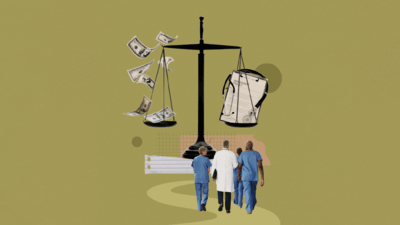
ED physicians, with the support of other specialties, have raised the boarding issue to critical status, not only on humanitarian grounds, but also given the fiscal reality that the daily cost of boarding patients in the ED (US$1,856) is double the $993 required for routine inpatient care in surroundings designed for that purpose.
Dr James Allen, a retired hospital Medical Director, blogger and Professor Emeritus of Internal Medicine at Ohio State University (who embraces the freedom of retirement, knowing he can’t get fired for expressing his views), stated quite explicitly that when it comes to boarding, “ER physicians hate it, the hospitalists hate it, the ER nurses hate it, and the patients hate it”. He added that, in the past, when hospitals tried to maintain occupancy norms of 80% capacity, there were always empty beds available for referral from emergency and “you could always postpone an elective admission for a day or two”.
That was fine, Dr Allen noted, as prior to 1990 elective admissions made up a large percentage of the total number of admitted patients. “But today’s financial pressure demands have pushed hospitals to up occupancy to 90–95% and all it takes is a minor surge in census to create the logjams that encumber the system.” He warned that when hospital CEOs or CFOs hear that the hospital is completely full, they praise the profitability. “But for the rest of humanity, having the hospital completely full is a terrible thing to hear.” He concluded that when the ED fills up with boarded patients, they need to be offered a trip to another hospital. “It’s that simple. When boarding happens, bad things happen.”
Changes over two decades
Throughout the US, the role of the hospital as being ‘all things to all people’ has changed dramatically. Standalone outpatient entities provide walk-in services, such as minor surgeries, chemotherapy and diagnostic technologies, and groupings of physician specialists with their own top-line equipment – all housed in new, comfortable surroundings – treat patients like customers, not supplicants.
Over the past two decades, hospital consolidations, divestitures, spin-offs of major services to outpatient status, have changed the American healthcare landscape dramatically: to be meaner, leaner, more profitable? Well, meaner and leaner maybe; more profitable is yet to be seen. But certainly, as access to more medical services moved to outpatient status, the number of beds in community hospitals has dropped from 1.2 million in 1990 to 913,136 in 2023. In comparison with European countries, that reflects a much thinner ratio of 2.7 beds per 1,000 population in the US, compared to 6 per 1,000 in France and 7.8 per 1,000 in Germany.
Hospital ‘boarding’ as seen in the US (and in Canada) is certainly not unknown in the UK, but it’s more gently characterised as ‘trolley waits’ and, throughout Europe and even Asia, is a growing phenomenon. But when it happens in the US, it becomes political, and with that come the headlines – like the one heralding Abby Bedard, a 13-year-old girl from Skowhegan, Maine (just a few miles from the Canadian border), seen joyfully waving at hospital staff and sidewalk crowds after leaving the Redington-Fairview General Hospital emergency room after 304 days in ED captivity, destined for a more normal life at a group home, close to her family home. It was a big day in Skowhegan – with waves from hospital staff, media lights, and a relieved father proclaiming he had had to “move heaven and earth” to get the transfer done.
Fighting back
In 2022, the American College of Emergency Physicians, along with a consortium of 34 other professional/medical groups that have energetically (and politically) been fighting to get national action against boarding, petitioned President Joe Biden for assistance, concluding that “boarding has become its own public health emergency”, causing preventable deaths and unnecessary deterioration in patients’ clinical status.
The petition emphasised that “many emergency physicians who submitted stories reported daily numbers of boarders close to or even exceeding 100% of the total number of beds in their EDs, while the number of patients in the waiting room comprised up to 20 times the number of free treatment beds in which they could even be seen. In the past, that often left only hallway stretchers within the ED to care for incoming patients. But now, those too are increasingly over capacity, and so the emergency department waiting room has become the latest ad-hoc location for receiving patient care.”
Any scanning of the medical literature relating to the spread of boarding floats a multitude of storylines that could fill a season of TV or podcast specials. Some are even funny, in a grisly sort
of way, like the article in the August 2023 issue of Annals of Emergency Medicine that related the tale of an elderly man approaching emergency room staff to ask if he might be permitted to go down to Target and purchase an inflatable bed for his wife to lie on: “She’s so tired. She just can’t sit here for another hour.”

For international travel insurers underwriting their clients’ adventures in the US, up until now the standard procedure for dealing with a medical ‘emergency’ away from home has been to call one’s insurer first to get guidance about where to go for assistance – if time permits; and if not, to get to the nearest hospital ED. But with multi-hour and even multi-day ED waits making headlines, a more measured response to travellers needing care might be the standalone urgent care centres opening their doors not only in America but in many countries around the globe.
An 85% occupancy rate signals a critical shortage, leading to longer emergency room waits, increased medication errors, and other dangerous complications
According to the Urgent Care Association (UCA), there are currently over 15,000 such facilities spread mostly throughout the US, but some also in Canada and abroad, many of them affiliated with community hospitals, and most of them offering qualified physicians, nursing services and technologies capable of handling most emergencies. Many have extended service hours, relatively short wait times, and the ability to refer to a hospital if necessary. Moreover, says the UCA: 89.4% of the US population is within a 20-minute drive of an urgent care centre (78.6% within 10 minutes). It is important to note that urgent care centres are not covered by the EMTALA protocol, so there are no freebies, but the costs are far less than would be required at any hospital-based service and may well be encompassed by most travel insurance plans, if not yet, soon enough.
Assuredly, national plans such as Canada’s provincial health insurance, the UK’s National Health Service, or Germany’s Krankenversicherung just won’t cut it at an American hospital pay window.
For higher-level care – equivalent to that available in hospital – emergency care centres are also now spreading out across America, although much more slowly than UCCs. These are mostly divestitures from community hospitals and are designed to handle the most critical life-threatening conditions. They also are covered by the EMTALA protocol for those who can’t afford to pay. All others, pony up.
But it may be consoling to know that, for any traveller with a smartphone, all it now takes is ‘Show me urgent care near me’ or, if ED is more appropriate, ‘Hospital wait time near me’, and it should provide the information needed.

July 2025
Issue
In this issue we look at health insurance for international students, and ask if the industry is adapting to offer inclusive, culturally sensitive policies. We also examine the potentially lucrative world of bancassurance, plus we investigate wait times in the American hospital system.
Milan Korcok
Milan Korcok is a national award-wining medical writer who has been covering international healthcare activities and trends in Canada, the US and abroad for many years. He has long served as contributing editor to the Canadian Medical Association Journal and the Journal of the American Medical Association. He is a founder of – and has served as editor of – the US Journal of Drug and Alcohol Dependence; a founder of the Travel Health Insurance Association of Canada, and currently serves as contributor to ITIJ.











February 2025
Issue
Offering readers a deep dive into the issues facing providers and payers of healthcare services around the world. Cost containment, international patient department development, the role of AI in healthcare delivery and more.