Attracting international patients

Danny Quaeyhaegens, Head of the International Insurance Department at Bangkok Hospital Pattaya, Thailand, spoke to the International Hospitals & Healthcare Review about what hospitals can do to attract more international patients – and their insurers

First, we must define who or what ‘international patients’ are. By social status, one can distinguish four major categories: regular tourists, working expats, long-staying (or permanent) retirees and medical tourists. However, there’s a lot of grey areas and overlap between these groups, and hospitals need to identify which category they wish to attract before they implement a marketing process.
Different needs, different approaches
Tourists mostly need acute medical care due to injury or illness, and so will be choosing where to receive medical care in a different way than other groups. Without wanting to be prejudicial, we often see that the above is affected by nationality. For example, the Chinese tourist who travels in a group will ask his tour guide, the Russian tourist who has to follow insurance policy conditions will call his alarm centre, and the American who travels alone will check Google.
To attract the gambler, it’s mostly about physical appearance and first impression. The building and staff must be visible and look reliable – a high building with the name in large letters on top, street signs, some ads in the tourist guides, marble, uniforms. To attract the Google searcher, it’s about social media, ad words and Google rankings (the percentage of patients that go to a provider on the 2nd page of the search results must be extremely low).

For those advised by the hotel staff, tour guide, taxi driver, or waitress, while ideally it would be because they are locals and they know that provider X offers the best quality for a reasonable price, some medical providers may also accomplish this by financial kick-backs or commissions.
To be advised by the respective insurance/assistance alarm centres, I hope (and believe in most cases) it’s all about price-quality equation and not so much about discounts or commissions. To be top of an assistance company’s list, a hospital has to look for that price-quality equation, but also make direct billing agreements, update them when new services are launched, accept and accommodate ‘Guarantee of Payment’ letters, etc.
Long-staying or permanent retirees know the local situation better so there’s the potential to offer satisfaction with the service provided (adjusted to the needs of the foreigner) to turn customers into returning customers. Word of mouth in local expat clubs and local internet forums, combined with ads in local foreign media, might be ways to attract them too.
If they don’t know, they might ask the opinion of their neighbour, landlord or of another waitress; in these situations, public opinion (objective price-quality, PR, CSR, advertisements, promotions, loyalty programmes) will have some effect.
Price (affordability) and quality will often be the deciding factors in elective cases or cases such as cancer, regarding whether they will stay and have the treatment in your facility or they return to their home country.
Working expats are in some ways similar to the above retirees, but in this case, a hospital should also consider that the HR department of the company (and possible corporate agreements
To attract the Google searcher, it's about social media, ad words and Google rankings

between company and medical provider) kicks in. Here, health promotion programmes (about hygiene and safety in the workplace, CPR and first aid, yearly check-ups etc.) will be helpful to have them get to know and trust you as medical provider.
We often see that this group is better insured and often relatively well paid. Thus, with money being a less important decision-making factor, service level becomes an even more important issue.
Due to few financial worries and sufficient time available, we also often see them undergoing elective treatments as well; those that are higher quality and/or lower price and/or faster than in their country of origin. Typically, we see them having a ‘let’s do this before we have to go back’ attitude in the period towards the end of their expatriate assignment.
For medical travellers, having the right products with high quality and at the right price is crucial. A smooth process pre-, per- and post-treatment and availability when the patient wants it (not when it’s convenient for you) are also crucial. Here, a hospital’s competition is not just the clinic across the road and the other hospital three blocks away. Instead, you’re competing with the whole world. Even when you have all the above, you need to find ways to relay that info to potential customers all over the world.
Agents and third-party administrators have a role here. Insurance companies could have a larger role than they currently do, but even after all these years, we still in reality see very little ‘global steering’ of insured customers for elective care due to the well-known challenges as distance, air travel, liability, follow-up care etc.
Thus, a significant proportion of medical tourists are individuals looking for a solution that has a perfect price-quality level for them. To lead them to your hospital, to get them to know your hospital, worldwide advertising via the classic channels as magazines, newspapers, television … is extremely expensive and probably not too effective. This must be solved by having a digital presence with the following:
- A good website, (multi-lingual if possible)
- Easy, fast, clear answering and of course free contact channels for questions and enquiries, again where possible in the patients’ language, not necessarily in the hospital’s language
- Social media accounts
- Positive reviews, feedback and ratings on consumer websites
- High Google search engine rankings External accreditations such as JCI (Joint Commission International), Temos, EURAMI, CAMTS, ISO, etc. can be helpful here as they will affect the trust from the patient.
Challenge extended
The International Hospitals & Healthcare Review asked what the main challenges are when hospitals provide care to international patients. Quaeyhaegens selected his top five, which are:
- Obtaining accurate medical history
- Being clear on what a procedure costs
- A lack of trust in the healthcare being given
- Stress around repatriation
- Insurance company ignorance of what a local healthcare system can offer.

Medical history (MH)
MH is often incomplete and checking this with a patient may or may not result in accurate information. Only last week, I was doing a pre-operative assessment with a French patient and upon asking ‘Do you have or did you ever have a heart condition or do you take any medication for blood thinning’?, the patient’s answer was ‘No’. Upon asking what medication he was taking daily, he answered: ‘Aspirin, Plavix®, beta-blocker and diuretics’. So, we must be very careful, and if needed, contact overseas physicians.
To assess coverage, also alarm centres / assistance companies often have to pass some processes to, for example, check for pre-existing conditions. Apart from the new and stricter rules of GDPR this brings with it, time is often an issue here as sometimes it takes them many days (sometimes even weeks) to contact the medical providers or GPs in the patient’s home country.
Finance
Some patients come from healthcare systems where they hardly ever see / realise the real cost of treatment or medications, as there is a free at the point of care national system, their insurance picks up the bill directly, and/or pharmacies sell the medications by only charging the patient’s excess. When they then come into a hospital and are quoted the full price for a procedure, they get to see the full price for medications or they need to wait one or two days (or longer in some cases) to obtain some authorisation and coverage assessment from their insurer, they might be surprised and not understanding. Again here, native co-ordinators can give further explanation about this process and the reasons hereto.
Emotions
Often, patients are confident in their own country’s healthcare system and wary about an overseas healthcare system, especially if ‘overseas’ is a developing country such as Thailand. Then, when they get ill or injured, especially for tourists who don’t know the country very well, emotions of fear, (lack of) trust, panic, may be much stronger for the patient and their relatives or friends.
Once more, this is a task for

our native co-ordinators to speak with the patients / relatives, explain our standards of care and build their trust. Staff from alarm centres / assistance companies also have an important role in this situation.
Bangkok Hospital Pattaya also tries to ameliorate this situation by improving the information given. For this, we translated all the important documents, information leaflets, brochures, screening documents, patient information, consent forms, into the 12 most frequently used languages for the patient to be able to read and better understand the information in his/her own language.
(note: signature for consent etc. still needs to be done on the original Thai and/or English forms for reasons of legality but at least the patient will know exactly what they are signing for).
Repatriation
This is not only an expensive issue (for the insurance company), but also usually a stressful event for a patient (who has probably never experienced anything similar in their life before). It’s very important to give the patient good and clear information. The better the patient is informed, the less likely they will worry, panic or feel uncomfortable so the more likely the repatriation process will be successful.
Insurance companies
Some insurance companies don’t always know the local situation in a particular area or country well enough and want to apply ‘home conditions’ in countries where this is not possible.
They may ask to send the patient to a rehab centre, or home with a home healthcare service, but not every country has such services. They may suggest OPD treatments in places where transport / accessibility of medical provider is not suitable for such a case.
Some will only cover treatment in a government

facility but in some countries, government facilities are not appropriate to treat a foreigner, whether because of language barriers, lack of resources, lack of international standards, or no direct billing facility.
It’s important, therefore, that insurance companies make themselves familiar with the local conditions or if lacking that, to use a local intermediary such as an assistance company.
International accreditation – is it worth it?
For some third parties (insurers / assistance companies / TPAs), the accreditation in itself is important as they may only send customers to accredited facilities, as it will give these clients the indication that a minimum of quality standards will be in place.
It may be the same for some patients, but many (non-US) probably have no idea what JCI, for example, means. Showing them a seal may be helpful, but the main thing for any hospital will be to show quality and safety standards in daily practice, with each patient contact.
I believe that, especially in underdeveloped or developing countries, accreditation is more necessary. If I were a tourist myself in Germany, France, Switzerland … and I needed to be admitted, I would (I may be wrong, I don’t know) not worry for a single second about the quality of the nearest hospital. However, if I needed to be admitted to a Thai hospital (or in a hospital in any other developing country) I’d possibly be more worried about the care I’m about to receive. In such a case, seeing some indications of international quality would probably increase my trust and peace of mind.
It's important, therefore, that insurance companies make themselves familiar with the local conditions
Making a difference
There are some key changes that a hospital can make that would make it more attractive to an international patient or insurance company.
Transparent pricing structures, and demonstrations of quality (accreditation etc.) are without doubt vital components, but there are also language and cultural hurdles that must be overcome if a hospital is to truly cater to an international patient base.
There should be an acceptable level of English
for all staff depending on position, tasks and responsibilities. If possible, do not employ ‘English translators’ as they will take away the need for all staff to improve their own level of English; they become dependent on these English translators.
From language groups with sufficient patient volumes, native staff is preferable, so that they don’t just have language skills ‘as native’ but are in fact real natives. Alternatively, a hospital could employ those who have lived for a substantial period of time in the concerned country so that they aren’t limited to ‘language translation’, but are also experienced with ‘culture translation’ as well.
Cultural training programmes for nurses and doctors are also very useful in this matter. Every culture has its own peculiarities. Below are just some of the incidences and differences we have noted when treating international patients.
Why does an Arabic translator use 10 sentences to translate one simple question? Why is this Dutch patient so loud and why does the Italian look so angry with all his arm gestures?
Europeans can leave a doctor’s office happily also if they don’t get three different medications in four different colours.
Why do we need to explain each step carefully to the European patient (where to some of the local patients the doctor is ‘the one who knows all’ and is blindly trusted)?
How to deal with Islamic patients? Can we give them porcine valve implants? Should we give blood to this traffic accident victim who’s a Jehovah’s Witness? Should we use male / female staff?
What about palliative and end-of life care? DNR, living will and euthanasia?
Co-operation with third parties
To make a patient’s journey through a hospital a smooth process, a facility should accept GOPs, and have an open and accepting attitude toward third party (credit) payers. To facilitate this, the provider must enable good co-operation with the insurance companies. A direct billing agreement is important, but perhaps more so is the daily communication that takes place. Mutual trust

is the first requisite, with providers trusting Guarantee of Payment letters from / giving credit to insurance / assistance companies, and the insurance / assistance companies trusting the provider that good and appropriate treatment is provided.
Insurance companies also need to have fast and complete information on every case so that they can assess the coverage. Clear and detailed cost estimates must be provided prior to the treatment, clear and detailed invoices are needed to conclude the process.
Medical information must be clear, detailed and in English; treatments must be administered according to international standards, with no under- or over-treatment, and should be of the highest quality. Updating each other regularly about the activities is important.
Communication with customer pre- and post-treatment
We are living in a digital era, with many and more and more online and offline communication tools, so patients will be able to shop around and make inquiries about treatments and costs. Patients then also expect fast, clear and complete answers, if the answer doesn’t satisfy them they may move on to the next potential provider in whom they have, based on the reply to their inquiry, more trust due to a ‘more professional style of communication’.
And, as in any business, whether one sells cars or delivers any kind of service, the after-sale-service is very important to ensure you have satisfied customers. Hospitals should also be prepared to learn from previous customer experience in order to be able to continuously improve the product which is delivered, so it is worth following-up with contacts to check-up on the patient’s condition, the patient’s satisfaction and to pro-actively manage any complaints or dissatisfactions the patient may have is more and more important. ■
Lynne Fung, Executive Director, Business Development, Matilda International Hospital, shares her insights on the international patient market with the International Hospitals & Healthcare Review
The key challenges in serving an international community of patients are mainly rooted in their cultural differences in care expectations and communication, as well as the healthcare system, doctors’ practice and the charging methods.
In terms of communication, challenges include language and terminology, classification of insurance coverage in different countries, the popularity of using e-communication channels and even the expected response time. The time difference in different countries may also pose a challenge for having direct communications sometimes. When it comes to communication with patients or insurers, it is always important to manage their expectations by learning more from them, being patient with them and clarifying with them where necessary. Before the patients are admitted for treatment, education (of patients, insurers and other third-party payers) via different channels is crucial.
It’s essential to understand patients’ needs. International patients who travel and seek treatments outside their own countries may want more assistance separate from their medical needs while they are accompanied by their family members or friends; for example, hotel accommodation, local transport or visa extension. We have a dedicated patient service team with frontline experience, as well as knowledge in healthcare and handling health insurance matters. The Patient Service Centre personnel assist patients in admission, insurance matters, doctor referral, appointment booking as well as providing advice on the availability of nearby accommodation and booking of limousines.
It takes effort to help staff to understand cultural differences, create an innovative approach to developing a strategy or improving the system to streamline processes. Collaboration among staff, doctors, and insurers are equally important for catering to cultural differences.
Continuous improvement on IT systems and websites also enable patients to obtain hospital information faster, contact us more easily, and streamline enquiry handling for a faster response.
Human resources planning can contribute to serving our client mix. Many of our staff come from overseas, studied abroad or have experience serving expat clients and are well aware of being sensitive to the service details and cultural differences.
Key changes that could attract patients:
Sub-specialise
We set up an Orthopaedic and Spine Centre in 2017 and a Referral Centre in 2018 to provide a single enquiry point. We have regular reviews and update the logistics and the services offered to patients. The Orthopaedic and Spine Centre focuses on handling enquiries and bookings in these specialities since treatment has become highly sub-specialised into hands and wrists, shoulders, hips knees, ankles, paediatric orthopaedic, and so on. Designated personnel at the Referral Centre can give patients faster responses regarding referral to appropriate specialists for further treatment or follow-up, including an ear, nose and throat specialist, general surgeon and plastic surgeon. The staff from these centres also help set up appointments, provide quotations, assist in insurance and logistical matters.
Accreditation
There are always some patients who arrive in Hong Kong and are not familiar with the local healthcare system and hospital choices. International accreditation enables us to align and benchmark our standards with international practices, so as to enable patients to get to know our standards better. Certain insurers also work with us for independent audits or questionnaires or visits so they get to know more about our services and care practice and give recommendation to their insured clients.
- We believe the introduction of more useful IT systems and channels can enhance, streamline and facilitate internal and external communications. The use of data exchange systems between hospitals and insurers will also help improve efficiency and accuracy in billing and claims.
- We have been adopting price transparency policies and best clinical practice, eg. shortening length of stay and minimising the chance of return to theatre, which are welcomed by both individual patients and insurers who pay the bills. In many cases, lower initial quotations (that prove attractive to many people) do not necessarily mean that their final bills are as low. Looking into the future, we will continue to increase price transparency of our services and educate patients for clinical service standards, reviewing hospital quotations and pricing, so as to enhance our mutual understanding in these areas.
- Continuously expanding direct billing and cashless agreements enable easier access to our services.
- Last but not least, patient care involves human interaction. We always identify any gaps in human skills and attract more talent to join our hospital.

February 2019
Issue
With this issue, we bring you the International Hospitals & Healthcare Review, in which Danny Quaeyhaegens of Bangkok Hospital Pattaya lends his expert opinion on attracting international patients; Dr Sapan Desai of QuartzClinica, a cloud-based healthcare data analytics platform that helps hospitals rethink how they operate, discusses how big data and machine learning are improving quality of care; and Dr Peter Lachman, CEO of the International Society for Quality in Health Care, talks about the Society’s work to inspire and drive improvement in the quality and safety of healthcare worldwide.
Danny Quaeyhaegens
Danny Quaeyhaegens is Head of the International Insurance Department at Bangkok Hospital Pattaya, Thailand.











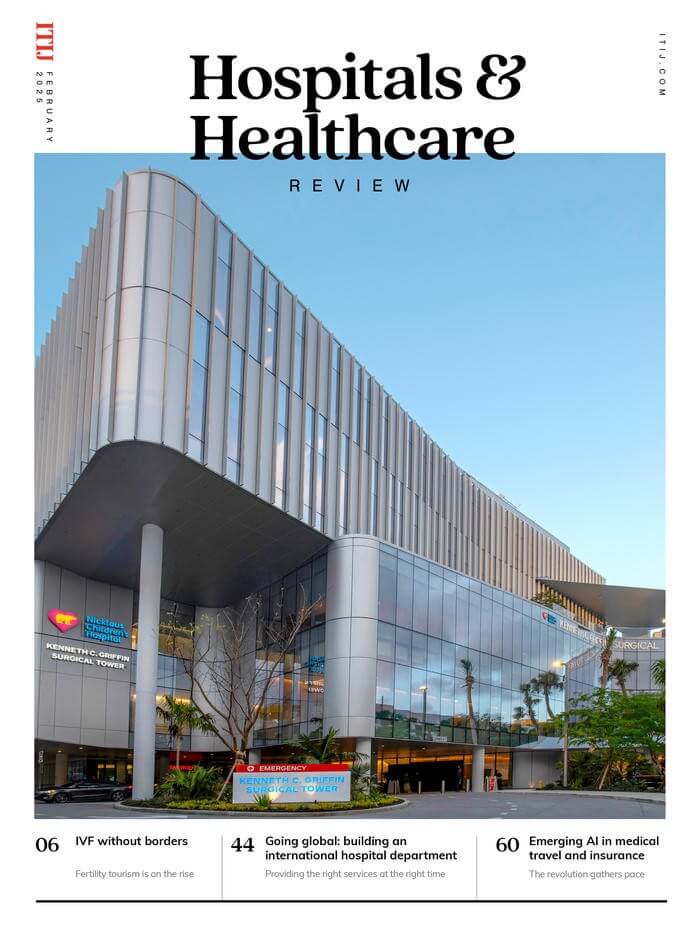
February 2025
Issue
Offering readers a deep dive into the issues facing providers and payers of healthcare services around the world. Cost containment, international patient department development, the role of AI in healthcare delivery and more.