Assessing the provision of healthcare for international patients in Greece

Robyn Bainbridge reports on the access to, and issues associated with, healthcare in Greece
Long considered to be the ‘Cradle of Western Civilisation’, Greece is an idyllic tourist destination, with more than 200 inhabited islands. But when it comes to needing medical assistance, how does the healthcare system deal with the increasing influx of annual visitors and expatriates?
Tourists flock to the sun-soaked region each year, mainly coming from Europe, and a large number also come from the US, according to data from the World Tourism Organization. Simon Worrell, Global Medical Director of international private medical insurance provider Collinson, pointed out that ‘a colossal 32 million tourists visit Greece each year’ – up by two million each year since 2014 – and as a result, the Greek health system can be subject to considerable strain.
As a result of this economic crisis, there is a certain variability between healthcare provided and facilities available within the public and private sectors. There are public hospitals all over the country; particularly concentrated in the mainland of Greece. Inez Tissink, Co-ordinator of International Activities at InterAmerican, a local assistance company based in Athens, noted that the best public hospitals are the ones connected to a university, and Dr Koliniatis detailed that most geographical departments are covered by a university hospital. “There are university hospitals in Alexandroupoli, Heraklion Crete, Ioannina, Thessaloniki, Rhodes, Athens and Larisa,” Tissink said.
Private hospitals
In terms of private hospitals, Tissink said that most are of an international standard – especially those in Athens and Thessaloniki. “They have the appropriate accreditations and some are specialised,” she said. “Euroclinic Athens has a paediatric hospital, the ‘Onassio’ in Athens is specialised in cardiology, and ‘Iaso’ in Athens is specialised in gynaecology, obstetrics and maternity.”
Greece has been profoundly affected by the global financial crisis, with wide-ranging economic, social and political consequence
Healthcare Executive and General Manager of Onassis Cardiac Surgery Center Dr Panos Minogiannis said that private facilities in Greece ‘possess ultra-modern units equipped with state-of-the-art technology, acclaimed and experienced medical staff and scientific consulting groups’. “They focus on specialised medical services, adapted to the personal needs of each patient, aiming at maintaining the high level of providing medical services,” he extrapolated. He added that the Athens Medical Centre (Iatriko Kentro Athinon) and non-profit hospitals like the Onassis Cardiac Surgery Center offer reliable and effective clinical options for patients. Clara Giannakopoulou of Thessalonica-headquartered assistance company Healthwatch SA also pointed out that the Iatriko Group, which has seven clinics within Greece, has accreditation from international authorities.
In addition, there are still more private clinics scattered across the rest of the country, although Tissink said that these are ‘of less quality’, with the exception of Euromedica Rhodes, Iasis General Clinic in Chania, Crete and the InterClinic in Heraklion Crete.

Public vs private
So, what are the reasons for the variability between standards of healthcare in the public and private sectors? And how does this affect patients’ access to medical care?
On the one hand, European patients with a valid European Health Insurance Card (EHIC) need pay nothing in public hospitals. However, Tissink explained that, due to crisis and austerity measures, public healthcare has suffered a lot, and largely because there has been a ‘huge exodus’ of skilled professionals. Dr Koliniatis also referenced this problem, explaining that ‘diminished funds’ and a ‘shortage of resources’ that arose as a result of the ‘global financial crisis’ resulted in a decrease in the number of doctors available: “More than 15,000 physicians left the country to work abroad.”
Overall, there is little argument to suggest that doctors and physicians in Greece are not highly skilled in both the public and private sectors. Indeed, Dr Minogiannis said that the Greek healthcare workforce is ‘one of the best educated workforces in the EU and recent investments have introduced state-of-the-art equipment in all service lines. “One could argue that a patient in Greece receives European standards of care for significantly lower prices,” he added. Tissink further emphasised that medical staff are very well trained and highly capable, thanks in part to the fact that, when a Greek person is training as a doctor, they are required to do part of their internship at one of the many tiny and ill-equipped ‘health centres’, where they learn, very quickly, to do all manner of tasks in a high-pressure environment. “It is a huge loss for Greek medicine that so many of these excellent doctors have left the country,” she mused.
A word from HYGEIA Hospital's Group Commercial Director Stella Gioni
HYGEIA Hospital is an Athens-based hospital that treats international patients throughout the year.
HYGEIA Group offers a variety of medical services for people of all ages in one location in Athens, which facilitates easy relocation of the patient and their travel companions. HYGEIA Hospital offers medical services to adults while MITERA Hospital offers paediatric, gynaecological, and maternity services to adults and children.
Private hospital groups like HYGEIA Group offer their own certified car ambulance fleet and are able to transfer patients from Athens International Airport or Piraeus port, which are the biggest tourist hubs in Greece. HYGEIA and MITERA are located within 25 km from both of these locations, allowing fast and reliable pick-up and patient transportation to the hospital, within a matter of minutes. HYGEIA ambulance cars can even travel throughout mainland Greece and organise the safe transportation of patients, with an escort doctor, if needed.
ADVERTORIAL
Tissink also explained that, because many of the medical professionals leave the country, bedside manners in the public sector are non-existent, and relatives are called upon to take care of hospitalised family members with regards to food and personal hygiene. Giannakopoulou noted that even newer public hospitals, such as GH Rhodes, which employs skilled doctors and has a good level of medical care, is subject to an ‘overload of work and lack of equipment’, meaning that the staff there cannot perform as well as they are capable of doing.
A 40-per-cent reduction in healthcare spending has been attributed to the economic hardships experienced in Greece over the last decade
In addition, public hospital waiting times, especially for less serious or outpatient cases, are a huge problem. Giannakopoulou highlighted that, due to the economic crisis, the population that attends public hospitals is now much bigger, as they cannot afford private facilities. Due to this, there are often bed shortages in public hospitals – with beds spilling into corridors. “If, for example, the ICU in one hospital is full, the patient will be taken to the next hospital with ICU capacity,” commented Tissink.
Giannakopoulou also highlighted that, for public healthcare, there is no discrimination between local and international patients; everyone must wait their turn, and often, where it is not deemed ‘urgent’, surgery can be postponed to ensure emergency cases have access to the facilities.
Due to what Tissink describes as a ‘dire situation’ in public hospitals, most people who can afford to have taken out private insurance. This covers them for admission to any private facility and transport from any remote area of Greece to an appropriate hospital in Athens, either over land by one of the provider’s ambulances, or by air ambulance or helicopter, all organised by the provider, said Tissink.

Dr Minogiannis drew upon the problem with funding, organisation and delivery of healthcare services in Greece and how this causes an imbalance between the public and private sectors. He noted that the system is financed by the state budget, social insurance contributions, private insurance contributions and private payments. “It suffers from the absence of cost-containment measures and defined criteria for funding, resulting in sickness funds experiencing economic constraints and budget deficits,” claimed Panos. “Private payments, therefore, are almost 45 per cent of total healthcare expenditures.”
Savvas Karagiannis, Communications Manager, Business Development Division of Athens Medical Group – a private medical group that provides quality primary and secondary care at its centres throughout the country – noted that Greece has been lagging behind nearly all EU countries in terms of health insurance coverage – ranking 27 out of 28, according to OECD data. Karagiannis explained: “About 60 per cent of health spending in Greece is publicly funded, compared with about 80 per cent in the EU,” and the debt crisis that began in 2009 means that the situation for public hospitals has worsened. In fact, noted Karagiannis, in 2015, the government spent only four per cent of the GDP on the healthcare system, compared to 10 per cent in 2009.
Geography and healthcare
The geographical spread of Greece means that, unsurprisingly, there are some smaller islands that don’t have access to the same technologies and capabilities that some of the larger mainland clinics and hospitals have. And this geographical layout further impacts patients’ access to healthcare.
Dr Minogiannis explained that primary care in remote areas is provided by public health centres. Further to these, hospital emergency rooms and clinics are available, as well as ODCs, diagnostic centres, multispeciality surgeries and private ambulatory offices. “All private insureds and cross-country EU patients are also covered, albeit with certain geographic variability,” he said. The main two metropolitan centres of Athens and Saloniki, as well as other major areas like Thessaly and the Peloponnese, along with the islands of Crete, Corfu, Rhodes and Khos provide greater access to high level services. He noted that smaller islands are connected through air and/or boat transport to the mainland.
About 60 per cent of health spending in Greece is publicly funded, compared with about 80 per cent in the EU
Worrell detailed: “[Although] hospitals that are located in more remote regions of Greece have the capacity to stabilise an acutely unwell patient, for conditions that require specialist facilities, such as cardiac interventions following a heart attack, patients usually need to be transferred to centres of excellence in Athens.” He stated that originally, these medical flights used to be organised by the Greek National Health System (the ESY), but that in more recent years, these flights are few and far between, ‘necessitating insurance companies to step in with private air ambulances’. That being said, Worrell added, once patients have been transferred to Athens, they rarely need to be evacuated further afield.
Dr Koliniatis noted that, in touristit areas and resorts, primary care depends on private facilities, of which there are many, and all are equipped to accommodate patient needs. He explains that these facilities are closely linked with hotels, guides, taxis, port agents, and so on, and all of these play a ‘fundamental role in patient direction’.

Tissink explained that InterAmerican is easily able to manage issues around patient steering: “We have agreements in place with most private hospitals in Greece.” Dr Koliniatis added: “Further direction depends on assistance company procedures, network and knowledge of the local healthcare map. This is the only way to overcome issues of quality, time and costs, as it is in every highly touristic country.” Tissink also emphasised that private facilities on some of the most touristic islands, including Corfu, Zakynthos, Crete and Rhodes are ‘very expensive for the local population, and even more expensive for the tourists’.
Meeting in the middle
The Greek healthcare system throws up further issues for both assistance providers and hospitals. Dr Koliniatis explained that, due to problems with supplies, access and infrastructure, problems that arise are often solved by inter-hospital co-operation and referrals. He noted that public hospitals charge by diagnosis related group, and some accept direct billing by foreign insurance companies, though not all. The bills, he says, are non-negotiable and not audited, but charges are regulated by the Ministry of Health and are kept relatively low. Tissink said that public hospitals will not often accept Guarantees of Payment from foreign companies. But InterAmerican, he noted, can arrange for direct payment through one of its local co-operators in the event that such issues arise.
However, there are positives to arranging treatment through public hospitals for assistance providers. “There are standard fees, there is never a question of overtreatment or overcharging, and the patient is discharged as soon as his/her treatment can be continued at home,” Tissink noted. On the other hand, Giannakopoulou warned that the private sector tends to overcharge and overtreat, although she noted that this can be controlled through agreements on course and discounts, and that clinics do generally accept deductions that are fully justified.
Dr Minogiannis said that co-ordination with foreign insurers, especially for emergency care, poses a certain challenge at times. “Payment issues have occurred on occasion,” he said. “But in general, all major private institutions have set up international departments to smooth out such issues.” Dr Koliniatis further highlighted that pricelist agreements and audits are able to ensure cost containment in private facilities, and are sometimes even essential in some destinations where the charges can be unjustified and not customary.
InterAmerican clients also have access to a 24/7 four-digit telephone number (1010), with the possibility to speak to a physician, who will then advise them on further steps to be taken and which hospital would be most appropriate for the specific problem. There is also an extensive network of InterAmerican doctors across Greece, who will make suitable recommendations for each case.

Communication challenges
Another issue worthy of note is that communication with public facilities sometimes leaves a lot to be desired: it is quite difficult to contact doctors and obtain medical information or medical reports, and Tissink ascribes this to the medical staff being overworked. Worrell said: “As ever, communication is easier with private medical facilities, which are often more attentive to the requirements of assistance companies.” And Tissink proposed a solution: “In the rare case that the in-house doctor is unable to communicate with the treating doctors, one of our own doctors is sent to the hospital to get the information we need.”
Communication is easier with private medical facilities, which are often more attentive to the requirements of assistance companies
Dr Minogiannis noted that, despite private hospitals exhibiting remarkable success in attracting international patients, the main challenges they face have to do with language barriers, even though almost 90 per cent of hospital staff are fluent in English. Dr Koliniatis noted that some private hospitals that have dedicated international patient departents ‘offer excellent communication and co-operation with assistance companies’.
Worrell expounded: “Taking all this into account, at Collinson, the approach that we take with managing cases in Greece is to firstly ensure that the patient’s condition can be treated at the facility to which the patient is admitted. Once in hospital, our experienced multi-lingual team of doctors, nurses, and assistance specialists will contact the admitting facility directly to obtain regular medical reports. When necessary, the patient will be transferred to a superior facility – as the healthcare facilities are variable in Greece, this is often required.” He also said that, thereafter, keeping a close eye on patients will ensure that the most appropriate treatment is received. And once the patient has sufficiently recovered, it is then possible to arrange for the safe repatriation of the patient to their home country. “In this way, although the local healthcare may be patchy, patients are protected, and receive the best available attention,” he reasoned.
A flourishing sector
Despite the issues that the recent economic crisis has brought about, Greece remains a popular tourist destination and has much to offer international patients, with low-cost medical fees in the public sector and highly skilled medical professionals that populate the mainland and smaller islands of Greece. The vast disparity between services offered within the private and public sector presents both issues and opportunities to assistance companies, whether local or international. The main issues for both assistance providers and local hospitals continue to revolve around communication and cost inconsistencies between the public and private sector. Assistance providers are bridging these gaps by setting up cost containment methods, including cost audits and direct billing with many of the medical facilities, as well as deploying local co-ordinators throughout Greece to counter issues with communication. Furthermore, hospitals that have set up international patient departments experience fewer setbacks when dealing with international assistance companies. Long-term, it seems likely that the private healthcare sector will continue to flourish in Greece, and assistance companies that continue to work closely with healthcare facilities will benefit accordingly. ■

May 2019
Issue
Greece’s healthcare marketplace is our special focus in this edition of the International Hospitals & Healthcare Review. We also speak to industry specialists about growing medical networks in remote regions, explore healthcare personalisation with Dr Mitesh Patel of Aetna International, and interview Dr Peter Mills of Cigna Europe about his role and tackling global healthcare challenges.
Robyn Bainbridge
Robyn Bainbridge edits the International Hospitals & Healthcare Review and is a writer and copy-editor for both ITIJ and AirMed&Rescue. Six years a freelance writer, she enjoys injecting a fresh take on a tired topic and is a keen advocate of sustainable tourism. She also has over 15 species of plants in her living room.










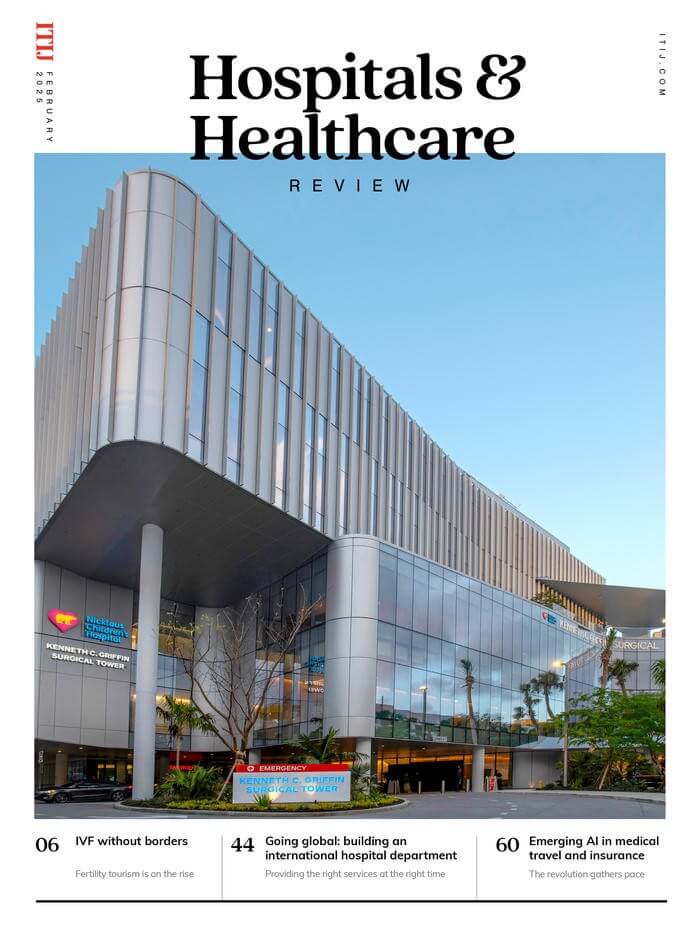
February 2025
Issue
Offering readers a deep dive into the issues facing providers and payers of healthcare services around the world. Cost containment, international patient department development, the role of AI in healthcare delivery and more.