Navigating Europe’s ground ambulance divide and cross-border challenges

Chloe Fox speaks to experts about how rising demand and fragmented systems are reshaping how ground ambulance services deliver safe and timely patient transfers in Europe
Ground ambulance provision across Europe is far from uniform. National health systems, regional funding realities, and a growing private sector presence all shape services, creating both opportunities and operational challenges, especially for organisations arranging cross-border transport.
Armando Cipparano, President of Assistiamo Te, described Europe’s ambulance landscape as highly varied. “In many Western and Northern European countries, services are still predominantly publicly or semi-publicly provided and closely integrated into national healthcare systems,” whereas in other regions, particularly Southern and Eastern Europe, “there is a stronger presence of private operators, especially in scheduled medical transport, hospital discharges, and interregional or international transfers”.
Cipparano highlighted the ways in which these structural differences affect daily operations, explaining that “significant regional differences also exist in operational standards, response times, technological equipment, and reimbursement models”. He sees fragmentation as a challenge for consistent cross-border services, but also an opportunity for collaboration between public and private providers.
Dr Antonio Magliocca, Medical Director and Strategic Leader at BMC Travel Assistance h24, pointed out that the sector was moving beyond a simple public–private divide. “Across Europe, ground ambulance services are increasingly delivered through hybrid public–private models rather than purely state-run systems. While emergency coordination and dispatch typically remain under public control, operational delivery often combines public providers, nonprofit organisations, and certified private companies.”
Significant regional differences also exist in operational standards, response times, technological equipment, and reimbursement models
He emphasised that public–private partnerships had become the norm. “They allow systems to expand capacity and improve flexibility without overburdening public resources. Northern and Central Europe tend to have highly structured, well-funded networks with strong clinical staffing, while Southern regions often rely more heavily on private contractors and volunteer organisations to fill coverage gaps.”
Dr Magliocca outlined the resulting disparities: “Urban centres generally benefit from advanced fleets, digital dispatch, and faster hospital handovers, whereas rural or financially constrained areas face slower response times and fewer medicalised vehicles.” At the same time, he observed that private providers were consolidating and professionalising, taking on more strategic roles, including high-acuity and cross-border transfers, especially for insurers and assistance companies managing international patients.
For Dr Lee Collier, Chief Medical Officer at SkyCare, these differences are very tangible. He explained that public system access could be extremely limited in some countries: “We’ve generally not been able to access public ground ambulance services. For the UK NHS, these services are under extreme pressure, and even where we could get agreement for help, the waits would likely run to many hours.”
Elsewhere, local models can be of value. Dr Collier noted that in countries where ambulances are integrated into hospitals, crews often have deep knowledge of the facility. “The latter model can be very helpful if we are able to find the right person to talk to, as we benefit from the local knowledge of an ambulance crew that knows the hospital setup.” Yet even single-provider systems carry risks: in parts of Germany, where the Red Cross is often the primary provider, having a single point of contact can also create a bottleneck for capacity.
Maximilian Jankowski, Paramedic and CEO of maxis.group, explained: “In Germany, most emergency and rescue services are provided by traditional aid organisations, although private providers are becoming increasingly important, particularly in patient transport. Their appeal lies in flexible response times and flatter hierarchies, which enable faster decision-making.” However, he noted that “regional laws create variations in vehicle types, equipment, and staff training, resulting in inconsistent service quality. While specialisation in patient transport has proven to be an effective market strategy, standardised certifications could help reduce disparities for insurers and service requesters.”
When rising demand meets limited capacity
Increasing demand is exposing pressures that have long been simmering: workforce shortages, ageing fleets, and regional imbalances.
Dr Magliocca framed the issue broadly: “At BMC Travel Assistance h24, rising demand has amplified three main capacity pressures: workforce shortages, ageing fleets among local providers, and strong regional disparities.” Recruiting qualified medical staff is particularly challenging for long-distance or specialised transfers. Hospital overcrowding can delay patient handovers, limiting overall system responsiveness.
Cipparano echoed the concern, noting that personnel and vehicles are central to operational strain. “As for many organisations in the sector, the primary challenges relate to the availability of qualified personnel, in a context of increasing workload pressure and competition for specialised healthcare professionals. This is compounded by the need to continuously maintain and renew vehicle fleets, ensuring reliability, regulatory compliance, and suitability for different levels of medical care.”
Jankowski emphasised: “If employees have a good working environment with good conditions and colleagues, then satisfaction is high, which ensures that there is an increase in the number of employees. When it comes to vehicles, it must be made clear that they should be replaced after 300,000km or five years. With equipment, you must keep up with the times to maintain standards. Unfortunately, there are regional inequalities, but if you have a good team and good equipment, characteristics such as punctuality, quality, and customer satisfaction come naturally.”
Across Europe, ground ambulance services are increasingly delivered through hybrid public–private models rather than purely state-run systems
Geography adds to these challenges, especially for long-distance and complex cases. Cipparano highlighted the consequent importance of careful planning: “Demand is growing, particularly for long-distance transfers and complex cases, which require more detailed planning and coordination. These challenges make strong operational management essential to ensure continuity, punctuality, and service safety.”

For Dr Collier, the international element adds another layer of complexity: “We have a large and growing network of direct relationships with ambulance providers that we have vetted, but this is not yet global, so when we access a region or country that’s less familiar, we’re forced to look for a new partner or use a broker.”
Seasonal variations can push costs and demand even higher. Dr Collier explained that in ski regions, for example, “the costs of a ground ambulance can be two to five times the cost at peak season compared to low season. A further cost pressure is access to oxygen supplies, particularly for the Balearic Islands, where this is often added as an additional charge after the fact.”
Dr Magliocca described BMC h24’s approach to tackling these local bottlenecks: “Rather than owning large fleets, we mitigate these risks through a curated national network of vetted partners. We work exclusively with providers that meet strict clinical and operational standards, ensuring modern vehicles, certified crews, and rapid deployment capability.” This network-based model gives them flexibility: resources can be activated dynamically across regions, avoiding local bottlenecks while maintaining consistent service levels, even during peak periods.
Navigating unpredictable costs in cross-border care
Financial pressures influence decision-making just as strongly as operational considerations, particularly in complex cross-border transfers where insurers and assistance companies must balance cost control, clinical safety, timely patient movement, and coordination across multiple jurisdictions.
Jesse Delien, International Services and ICM Expert at Ambuce Rescue Team (ART), highlighted the key challenges involved in cross-border medical transport: “Language barriers, availability of medical specialities, response times, quality standards, transport logistics, and regulatory differences all influence the outcome of a case. A lower price does not automatically translate into better or even equivalent care.”
Echoing this concern, Dr Magliocca also warned against focusing solely on price. “Cost pressure is a constant factor in cross-border medical transport, driven by fuel prices, staffing costs and regional tariff differences. However, in our experience, core ambulance costs across qualified providers are relatively stable and predictable.”
For him, the greater risk lies in false economies: choosing the lowest-cost option often leads to delays, lower standards, or complications that ultimately increase overall costs. He added that BMC h24 prioritises transparency, pre-agreed pricing, and clinical pathway advice to avoid last-minute changes.
Dr Collier said that cost pressures made it difficult to give a definitive quote to customers at the point of enquiry. “The simple approach is to add a significant cost to every quote to cover the most expensive ground ambulance costs, but this does not offer good value for our clients.” Instead, he emphasised the importance of strong partner relationships to provide accurate, comprehensive bed-to-bed quotes quickly, turning to global broker services only as a fallback.
Jankowski added: “Cross-border requests often differ in quality and cost because standards for personnel, vehicles, and equipment vary across Europe. This affects both service consistency and pricing.
Rising demand has amplified three main capacity pressures: workforce shortages, ageing fleets among local providers, and strong regional disparities
“A solid, trustworthy package can convince insurers and clients that certain standards must be met. Certifications under Deutsches Institut für Normung (DIN) and International Organization for Standardization (SIO) and from third-party providers are key, and specialisation with high-quality execution is essential to stay competitive.”
Delien concluded: “Early identification of medical, logistical, and financial parameters helps reduce last-minute cancellations, unexpected surcharges, medical and operational risks.”

Keeping care personal in a complex system
Even under operational and financial strain, providers emphasise that patient care must remain central. Cipparano outlined several key priorities for delivering high-quality care, including selecting the right staff, providing ongoing training, implementing clear clinical protocols, and maintaining a constant focus on patient safety and comfort, especially during long-distance transports. “Empathetic communication and the management of sensitive situations also shape the patient experience, alongside digital tools and real-time monitoring to improve transparency and efficiency,” he said.
Looking beyond day-to-day operations, Delien pointed to structural challenges within the wider system. He told ITIJ: “The biggest area for improvement lies in regulatory harmonisation. While national regulations are becoming increasingly strict, there is no consistent umbrella framework governing cross-border repatriations. This creates grey zones when crossing jurisdictions, particularly in operational standards and clinical responsibility.”
For Dr Magliocca, maintaining high standards in such an environment requires more than simply scaling capacity. Consistency, he argued, is critical. “Our focus is on clinical governance, careful partner selection, and patient-centred processes,” he explained.
Empathetic communication and the management of sensitive situations also shape the patient experience, alongside digital tools and real-time monitoring to improve transparency and efficiency
Reinforcing this emphasis on quality and oversight, he added that BMC h24 works exclusively with accredited providers that meet defined medical, technical, and training criteria. “From the patient’s perspective, the overall experience is just as important. We prioritise clear information, multilingual support, and continuity of care throughout the journey, particularly for vulnerable travellers far from home. Dedicated case managers coordinate every step, helping to reduce stress for both patients and their families.”
Delien agreed that stronger alignment across the sector was essential. “Establishing and maintaining quality benchmarks across providers and countries should be a priority for the industry and insurers, even within borders. Further integration between operational services could significantly improve response times and continuity of care.”
A more connected future for ground medical transport
Looking ahead, longer-distance road transfers, an expanding private sector, and cross-border cooperation supported by technology are shaping the sector. Delien acknowledged that the availability of qualified personnel remains a key structural challenge: “Labour market shifts in Western Europe are directly affecting response times and operational planning. The emergence of differentiated medical roles such as Advanced Nurse Practitioners and specialised bachelor-level medical professionals is reshaping team composition in ground ambulance and medical escort services.”
Building on this, Dr Magliocca identified the key trends driving change: “First, private providers are taking on a larger operational role, offering flexibility and specialised capabilities that complement public systems. Second, technology is transforming ambulances into mobile care units through telemedicine, real-time monitoring, and digital dispatch. Third, cross-border collaboration is becoming essential as patient mobility increases across Europe.”
Cipparano reinforced these points, highlighting the growing role of specialised private providers and digital tools, alongside cross-border collaboration driven by patient mobility and an ageing population. He said that Assistiamo Te was addressing this trend through international partnerships, streamlined operational processes, and a flexible service model that keeps quality and reliability at the forefront.
Considering practical application, Jankowski told ITIJ: “It is
crucial to establish clear standards. Our fleet is equipped with a
GPS Fleetboard system, and our multilingual crew and control centre ensure smooth coordination. To address the shortage of doctors, we use both onboard and portable systems that provide a live connection to a physician. Live images, electrocardiogram readings, and other vital data are transmitted in real time, allowing the doctor to guide the ambulance crew directly. All documentation is fully digital, legally compliant, and continuously updated via Bluetooth from connected devices.”
Financial realities also shape operational decisions. For Dr Collier, the increasing use of long-distance road transfers reflects both cost pressures and practical limitations. “Although we would love there
to be budget for air ambulance transfer for every patient, cost pressures on insurance and private payers makes long-distance road transfer an attractive option.”
Maintaining high standards under operational pressure requires consistency, not just capacity
These financial and operational pressures make it essential to ensure continuity and minimise risk across providers. Delien added that optimising trust and coordination was key: “The well-known ‘wing-to-wing’ air ambulance model demonstrates how seamless transfers can reduce risk and delay. Building trusted networks with aligned quality standards is essential, not only to accelerate response, but to ensure that quality does not fluctuate depending on which provider is involved in a specific segment of the transport.”
Europe’s ground ambulance sector now combines public, private, and hybrid models, all shaped by rising demand and operational pressures. While public systems often face strain, private providers can support state services, offering additional capacity, but access and affordability remain critical considerations. At the same time, challenges such as workforce shortages and ageing fleets require flexible, network-based approaches. By coordinating resources effectively and planning carefully, providers can maintain safety, continuity, and efficiency.
In conclusion, patient experience remains central. Structured protocols, skilled staff, and empathetic communication, supported by digital tools, help make transfers safe and reliable. As technology and cross-border cooperation continue to advance, the sector’s future will depend on providers’ ability to harmonise care and logistics into a cohesive, patient-centred system.
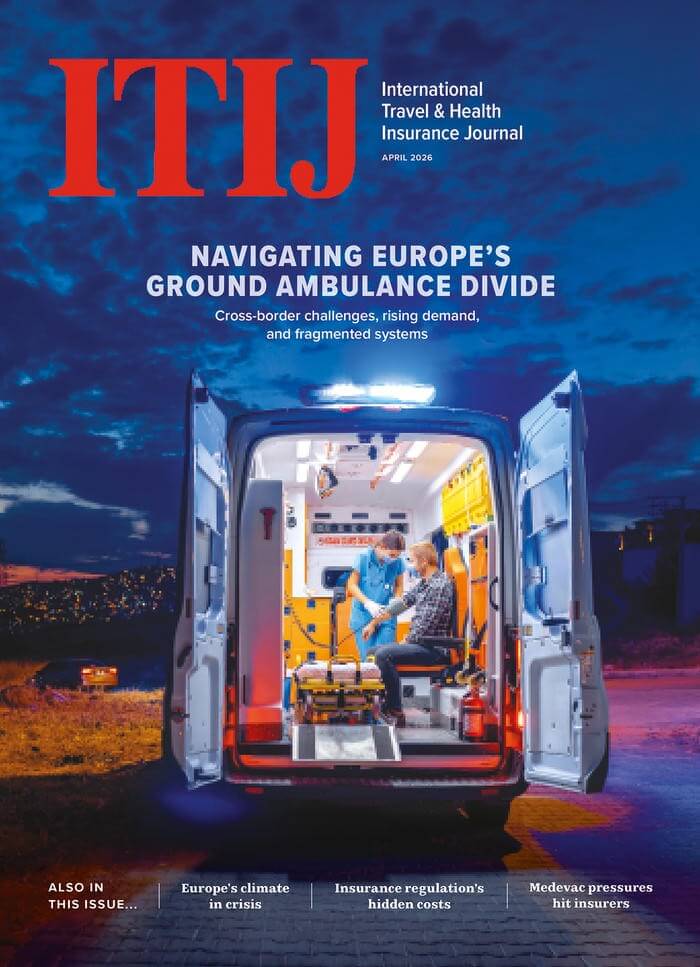
April 2026
Issue
Across Europe, demand for ground ambulance services is rising, while capacity, workforce availability, regulatory limits and inflationary cost pressures intensify. We look at the evolving landscape, highlight major market stress points, and assess how stakeholders are responding. We also have anassessment of the latest regulations in different jurisdictions that are hindering insurance development and growth. We cover the most important regulatory frictions across major and emerging jurisdictions, explain how they impede growth, and propose actionable mitigations for industry stakeholders.
Chloe Fox
Chloe Fox is a Junior Editor at Voyageur Group, having joined in 2024. She writes for ITIJ and AirMed&Rescue, covering a range of topics including international travel and health insurance, medical assistance provision, and air medical transportation. Chloe holds a BA (Hons) in English and an MA in English Literature from the University of Bristol.












February 2025
Issue
Offering readers a deep dive into the issues facing providers and payers of healthcare services around the world. Cost containment, international patient department development, the role of AI in healthcare delivery and more.