Interview: Richard Heinzl, MD, Global Medical Director of WorldCare International, Inc

Dr Richard Heinzl discusses the company’s continued evolution and how it is positively impacting on healthcare outcomes worldwide

How and why was WorldCare established?
Founded in 1992, WorldCare was originally focused on technology and telemedicine operations emanating from Massachusetts General Hospital (MGH). As the pioneer in the field, MGH was the first hospital to test teleradiology in 1968. As an off-shoot of MGH, WorldCare was the first company to obtain Food and Drug Administration (FDA) clearance for wavelet compression, which allowed diagnostic quality images to be compressed and sent digitally. Thus, we were able to send medical records quickly and securely, providing medical second opinions within days of receipt of complete medical records and even within hours if necessary. As we evolved, we continued to adhere to the highest-quality standards, initially working with only Harvard Medical School affiliated physicians to provide critical illness medical second opinions.
WorldCare is recognised as the world’s leader in providing the highest quality, virtual medical opinions for serious illness. Our mission was, and continues to be, to improve healthcare outcomes of our members worldwide by connecting our clients to the foremost medical experts at the top-ranked US academic and research hospitals of The WorldCare Consortium.
While other providers seem to be losing sight of the human-element, our members are our number one priority. Our company was founded on the belief that everyone deserves access to the best healthcare and we continue to remain steadfast in our commitment to making this happen. We are proud of our member satisfaction rating, which is above 98 per cent and we will continue to work hard every day to keep it at this level and even try to make it 100 per cent.
Why are there such a large proportion of misdiagnosed patients?
Medicine is highly complex. Differences in diagnosis and treatment decisions are part of the fabric of medicine. Therefore, there are many reasons why one in 12 adult patients is misdiagnosed. With over 10,000 diseases and only 200 to 300 symptoms, primary care physicians are simply not able to diagnose their patients with the accuracy and precision that the medical specialists and sub-specialists of the world’s leading research and academic hospitals have, as these generalists do not have access to the most recent clinical research and most cutting-edge medical information.
On the other hand, the physicians in The WorldCare Consortium have particular expertise with rare and complex conditions as well as access to clinical trials and experimental treatments, which helps reduce the chances of misdiagnosis. Other contributing factors to misdiagnoses include incorrect radiology and/or pathology readings and reviews related to the limited availability and access of sub-specialists in these two fields and inaccurate, lost or unreported test results. In addition, overconfidence in the abilities of one’s own doctor is also a contributing factor, with a recent Gallup poll indicating that 70 per cent of Americans do not feel the need to check for a medical second opinion.

What more can be done to improve the situation?
The correct diagnosis of a serious illness can be a complex process, due to the fact that the diagnosis might need a multidisciplinary team approach, similar to the tumour board process in the case of a cancer diagnosis. Treatments for serious illnesses are constantly being refined and updated based on new medical research and innovation. Obtaining a medical second opinion from a team of specialists at a world-class research and academic hospital will ensure that the diagnosis and recommended treatment plans are based on the latest information and research available, along with the expertise of specialists and sub-specialists whose knowledge is focused and precise. To improve the situation, medical second opinions from top-ranked hospitals, such as those of the WorldCare Consortium, can be obtained and delivered, along with a wealth of relevant information, to patients and their treating physicians, in order to confirm or modify a diagnosis and implement the most effective treatment plan going forward.
How does WorldCare ensure it remains at the cutting edge of medical technology, research and information, and why is this important?
The WorldCare Consortium hospitals are at the forefront of medical research, with access to over 20,000 medical specialists and sub-specialists with more than US$4 billion dollars in annual biomedical research funding. These hospitals conduct advanced clinical trials, have access to state-of-the-art technology and are spearheading the collection and publication of the most up-to-date research and information. The hospitals of The WorldCare Consortium lead the world in identifying and treating rare, serious and complex medical conditions, and have access to the most current and advanced disease treatments.
Our unique relationship with these hospitals dictates that our team maintain a high level of knowledge of the most-advanced medical remedies, which enables us to provide our clients and their members and treating physician with direct access to this information so they can make informed decisions about how best to proceed with their care. And, with the rapidly advancing science of medicine, having access to this calibre of research, technology and expertise cannot be replicated and helps to improve medical outcomes.

What are some of the key issues facing diagnosis and treatment?
Due to the very nature of critical illnesses, one physician cannot possibly have all the answers or access to the research and technology available to effectively diagnosis these ever-evolving diseases. Plus, the rapidly changing treatments available make it nearly impossible for physicians to stay abreast of the latest protocols. That is why good medicine today is a collaborative effort between teams of physicians working together in the best interest of their patients.
How is WorldCare working to help tackle these? What progress has been made?
We break-down these boundaries for treating physicians by providing access to teams of specialists and sub-specialists at The WorldCare Consortium hospitals, which have access to the latest research and protocols. Thereby empowering treating physicians with the information and resources needed to make optimal treatment choices for their patients. As a result, in 26 per cent of the cases we have reviewed we have changed the diagnosis and in 75 percent of the cases we reviewed we have recommended a change in treatment plan, ultimately improving outcomes while reducing costs.
Our company was founded on the belief that everyone deserves access to the best healthcare and we continue to remain steadfast in our commitment to making this happen
Can you tell us about WorldCare’s unique disease management approach?
Tertiary care medicine, which deals with complex medical illnesses is always managed by a highly-skilled group of medical specialists and sub-specialists (tumour board process for a cancer diagnosis) operating under one roof of an advanced medical institution. We are the only provider who replicates this process by using a unique disease management approach that digitally recreate the experience of a patient walking into one of these advanced medical institutions in the US to provide the highest-touch coaching, virtual medical second opinions available worldwide.
This is done by first collecting, reviewing and consolidating each member’s medical records into a concise history and ensuring they meet our strict quality standards before selecting the most appropriate hospital to review each case based on the diagnosis. Then, once the hospital is selected, a team of specialists and sub-specialists within the selected hospital is established to provide a clinically-deep review of the case. Including, if necessary re-reading radiology and re-doing pathology in order to ensure the diagnosis is accurate and to provide optimal treatment plan recommendations.
Then, if needed we go a step further and have yet another team of specialists at another leading hospital review the case if the diagnosis varies from the original diagnosis or treatment recommended. It is this collaborative, team approach to medicine that is unique to WorldCare; other providers simply have only one physician review the case. We will always go as far as needed to ensure our members and their treating physicians receive complete and exceptional guidance. All of which is completed within days of receipt of complete medical records and even within hours if necessary.
What is the WorldCare Consortium and what makes it unique?
The WorldCare Consortium is a network comprised of the top-ranked academic and research hospitals in North America, including Harvard-affiliated Brigham and Women’s Hospital, Massachusetts General Hospital, Dana Farber Cancer Institute and others including: Mayo Clinic; Northwestern Memorial Hospital and UCLA Health. WorldCare’s unique, contractual, strategic, technological and operational relationship with the hospitals of The WorldCare Consortium enables us to have multi-disciplinary teams of the top-specialists and sub-specialists review each and every case.
The physicians in The WorldCare Consortium have particular expertise with rare and complex conditions, as well as access to clinical trials and experimental treatments, which helps reduce the chances of misdiagnosis
We average around four specialists reviewing each case. This depth of clinical rigor is unmatched in the industry. And, because of our direct link into the Consortium hospitals, we are able to submit our cases past the hospitals’ firewalls directly into their daily workflow resulting in consistent turnaround times of within days of receipt of complete medical records and if necessary within hours. And, in cases where the diagnosis varies from the original diagnosis or treatment, we have yet another team of specialists from another hospital within The WorldCare Consortium provide an additional review of the case for an added level of clinical-rigor. If requested, we also facilitate a conversation between the treating physician and the specialist within 30 days of completion of the medical second opinion.
What will WorldCare’s focus be in the coming five to 10 years?
We are working with our clients to develop laser-focused medical second opinions that address the key issues their covered members/employees are facing. This includes adding new levels of reviews to our existing medical second opinion service that specifically address mental health issues, pain management, speciality drugs and disability. These will improve patient care needs while also introducing ways of containing healthcare costs, which are increasing dramatically. We will also continue to expand The WorldCare Consortium to meet the increasing demand for our services and expand our investment in the infrastructure; technology and staffing needed to support this demand. All while never losing sight of our priority; improving healthcare outcomes for our members while reducing costs.
Can you discuss your hopes and expectations for the future of patient care and diagnosis?
Medical science is advancing rapidly, some would say exponentially, and this is bringing tremendous potential for improving human health. The institutions we work so closely with are at the forefront of these changes. WorldCare takes these profound capabilities and knowledge and puts it in the hands of the referring physician and our members. As medicine continues to evolve, WorldCare will be uniquely positioned to lead in this regard worldwide.

November 2017
Issue
In this issue:
Destination spotlight: Thailand
Tech corner: Prime Medical’s surgical scrubs
3D printing – how it has and is progressing?
How virtual reality is revolutionising medicine and healthcare
Superbug: Drug-resistant bacteria are here – the issue, cases, health challenges, how hospitals and health authorities are tackling this problem.
Canadian healthcare system changes
The value of hospital accreditation
Editorial Team
The Editorial Team updates the ITIJ website daily, and works on features for the print edition. With expert industry knowledge and years of experience in writing about complex travel insurance issues, the Editorial Team is ready to investigate and report on the topics that matter most to ITIJ's readers.









February 2025
Issue
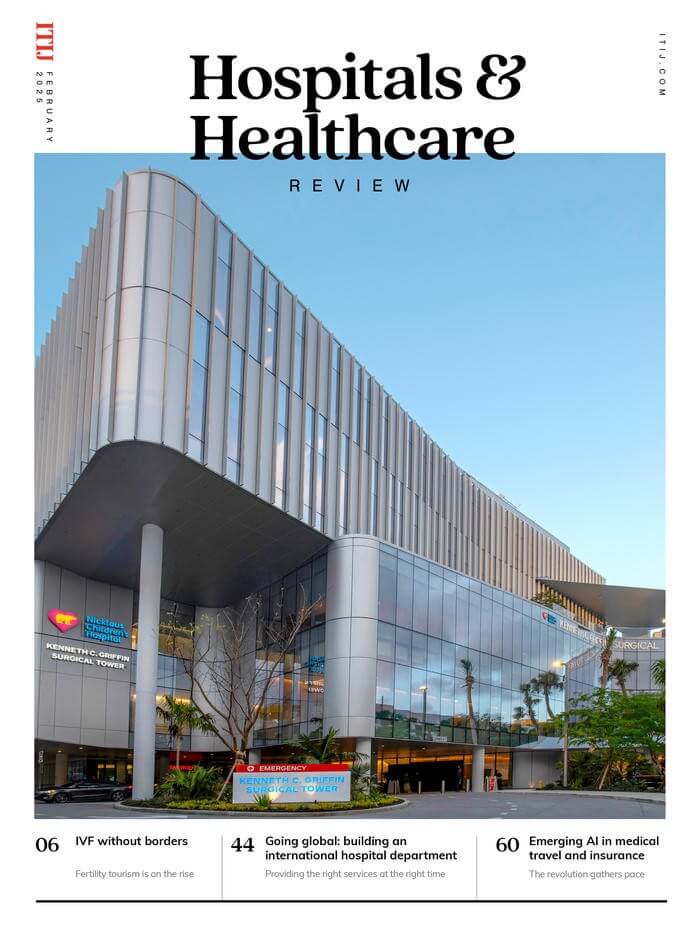
Offering readers a deep dive into the issues facing providers and payers of healthcare services around the world. Cost containment, international patient department development, the role of AI in healthcare delivery and more.