Health insurance for international students

Chloe Fox speaks to experts about how the industry is adapting to offer inclusive, culturally sensitive services that address the unique needs of a diverse student population
As universities grow globally, so too does the challenge of supporting a broader international student population. This feature examines how the industry is evolving to better support international students, from enhancing mental health resources to providing clear pre-departure guidance. Insights from experts including Justin Poehler at International Medical Group (IMG) and Leslie Reynolds of International Student Insurance highlight how insurance providers are adapting their strategies, offering culturally sensitive services, tailored coverage, and multilingual support to help students succeed abroad.
Adapting to a growing customer base
With an increasingly diverse student population, insurers are rethinking their strategies to provide services that are inclusive, respectful of different cultures, and responsive to the unique needs of international customers.
Poehler, Chief Commercial Officer at IMG, highlighted that although the international student insurance market has “traditionally been dominated by students from China”, India recently surpassed it and is now the country with the largest number of international students seeking insurance.
Reflecting on how the industry is adapting to the changing landscape, Reynolds, University Relations Manager at International Student Insurance, commented: “We see more of our carriers offering multilingual customer service support, as well as connecting with students in an increasingly broad number of spaces such as WhatsApp, WeChat, and social media.”
Reynolds went on to add that schools are increasingly requesting immunisation coverage, as certain vaccinations required by the school or host country may not be available in the student’s home country. As a result, she observed, providing benefits that help students access these necessary vaccinations has become more common.
Giving clear guidance on how to access care – including virtual visits, routine medical services, and mental health support – is essential
Considering the complexity of the US healthcare system, Megan Prescott, Head of Marketing at AXA Partners US, said that giving clear guidance on how to access care – including virtual visits, routine medical services, and mental health support – was essential.
However, Poehler pointed out: “Insurers must focus not only on the ‘hard skills’ and services they bring to the table, such as multilingual capabilities, but also the ‘soft skills’ of their employees to empathise with these students from a range of cultural backgrounds.”
He suggested that offering resources and proactive engagement on key healthcare topics, such as mental health, throughout the academic year, would help international students feel supported in a way that is relevant to their cultural and personal experience.

Supporting students through change
Culture shock is increasingly recognised as one of the leading mental health challenges faced by international students as they adjust to a new country, language, and social norms. By understanding the unique mental health needs of international students, insurers can play a crucial role in providing services and resources to help students manage their emotional wellbeing and adapt to their new environment.
Poehler explained that one of the biggest culture shocks international students face in the US is the difference in social interactions and communication styles. “In many cultures, relationships are built gradually, and long-term friendships are the norm,” he said. “However, in the US, social interactions tend to be more casual and fast-paced, making it difficult for international students to form deeper connections.
“Language and accent barriers further complicate social interactions,” he added. “Even students who are fluent in English may struggle with understanding fast speech, slang, idioms, or regional accents. This can lead to self-consciousness, reluctance to participate in conversations, and, ultimately, social isolation. Over time, these challenges can contribute to feelings of loneliness, anxiety, and a sense of not belonging.”
Claudia Reichstein, Head of International Programmes at Dr-Walter, said that providing access to mental health professionals who specialise in cross-cultural issues could help individuals manage feelings of anxiety and isolation. She suggested that offering telehealth services would make this support more accessible, recommending that it be included as part of the assistance services alongside an insurance plan.
Culture shock is increasingly recognised as one of the leading mental health challenges faced by international students
Prescott emphasised the importance of a well-organised library of resources, including pre-travel information on cultural norms, language barriers, and local support options, all of which can significantly help students adapt to their new surroundings and reduce stress, both academically and socially.
She said that by combining education, early intervention, and continuous support, insurers can significantly improve international students’ wellbeing and adjustment.
Pre-departure planning and guidance
Dean Hoski, Vice President, Special Risk Underwriting, Crum & Forster (C&F), believes that coordinated support between insurers, universities, and assistance providers is essential in ensuring students receive proper guidance before and during their studies abroad.
Isabelle Moins, Head of International Private Medical Insurance (IPMI) at APRIL International Europe, agreed: “By working together, universities, insurers, and specialised partners can offer comprehensive guidance on health risks, cultural adaptation, and available resources.”
Hoski noted that one of the challenges in coordinating support is ensuring student awareness and engagement. “Some [students] may not fully understand the extent of their coverage or the range of services available,” he said.
Moreover, according to Poehler, insurance companies don’t always know how engaged a university is or plans to be regarding providing pre-departure student support. He suggested that, from an insurer’s standpoint, “it is most important to assume responsibility in raising awareness amongst student customers about the mental health resources available to them, both pre- and post-departure, after they have purchased a plan”.
Beyond this, he said that “insurance providers can offer guidance on those resources, helping students better understand their coverage and how to access therapy, telehealth services, or emergency care before they need it”.
Reynolds emphasised the importance of educating international students in the US about the crucial link between medical care and insurance. She suggested that “teaching students about the different types of healthcare providers in the US and when to use each one could significantly reduce healthcare costs, easing one aspect of their adjustment process”.
Reynolds noted that, in many cultures, individuals are discouraged from acknowledging or seeking help for mental health challenges. She stressed the importance of organisations, schools, and insurance companies understanding these cultural differences and offering a variety of avenues for students to access support.
Another easily overlooked challenge, particularly for students with pre-existing mental health issues, is maintaining continuity of care. Reynolds shared: “We’ve heard from many international student advisers who’ve seen students stop taking their medications when they begin a programme abroad, thinking it’s the easier option – but this often turns out to be a debilitating choice.”
It is essential that universities and their partners educate students before they leave their home country about the importance of sticking to their medication regimen, as well as offering resources – through both the university and insurance – that enable students to continue their mental health care while studying abroad.
Prescott said that alerts and recommendations issued by insurers could encourage individuals coping with anxiety, depression, or mood disorders to consult their mental health provider before travelling. However, effectively supporting each student with the appropriate tools to meet their needs relies heavily on the willingness of the student to be open about their condition, noted Reichstein.
Alerts and recommendations issued by insurers could encourage individuals coping with anxiety, depression, or mood disorders to consult their mental health provider before travelling
Finally, Reichstein pointed out that the lack of universal guidelines for managing pre-existing mental health conditions in students abroad makes it challenging to provide consistent support to universities and organisations before and during a student’s travels.

Offering adequate and flexible coverage
Many universities and visa requirements mandate a minimum level of insurance coverage for students studying abroad. However, this baseline coverage may not always be enough to fully protect individuals from unexpected events. Without additional coverage, students could find themselves underinsured, with gaps in protection that leave them vulnerable. So, is the insurance industry doing enough to offer flexible products that go beyond the basics?
Reynolds said that students often look only at the premium cost and fail to recognise the out-of-pocket potential if they were to encounter a serious illness or injury. Hoski pointed out that “many standard health insurance plans for domestic students do not account for the unique needs of international students, such as medical evacuation, trip interruption, or baggage loss”.
Reynolds said that an area the industry could do better in is educating both students and institutions about insurance options and how the out-of-pocket costs work. “There are still many schools in the US that don’t require insurance or don’t monitor the continued compliance of insurance coverage,” she noted, “so there are likely hundreds, if not thousands, of international students underinsured or not insured at all.”
Reichstein believes there is scope for more tailored, accessible, and comprehensive coverage. She highlighted the growing need to be agile and responsive to local changes in order to effectively meet the diverse needs of students.
Underwriting mental health conditions
As mental health conditions such as anxiety, stress, and depression become increasingly prevalent, insurers are faced with the challenge of incorporating these factors into their underwriting processes. While understanding the nuances of mental health is crucial for providing comprehensive coverage, determining how to accurately assess and manage these conditions presents a range of obstacles.
Hoski said that one of the biggest challenges in underwriting mental health conditions is the increasing frequency of cases, particularly post-pandemic, when depression and anxiety levels have surged. “Insurers must find a balance between providing adequate coverage and managing risk effectively,” he commented.
“Another challenge is the variation in mental health coverage standards across different markets,” said Hoski. “Some countries have stricter regulations on mental health benefits, while others may not prioritise them.”
Moins suggested that “comprehensive assessments and the inclusion of mental health support services, like telehealth consultations, are strategies employed to manage these challenges effectively”.
Students often look only at the premium cost and fail to recognise the out-of-pocket potential if they were to encounter a serious illness or injury
Poehler added that because many countries have different perspectives on mental health conditions, there can be significant variations in record-keeping. As a result, it can be challenging to obtain adequate medical records from an insured individual after they’ve filed a claim, depending on their country of origin.
Prescott raised the issue that many mental health emergencies arise unexpectedly during travel because universities cannot pre-screen for medical conditions due to non-discrimination policies. “Voluntary self-assessments and pre-travel access to support services can help mitigate risks and provide early intervention,” she said.
In conclusion, as the international student demographic grows, insurers are challenged to offer more inclusive, culturally sensitive coverage. By enhancing mental health support, multilingual services, and pre-departure guidance, the industry will be better equipped to meet the diverse needs of students studying abroad.
A proactive approach will help ensure students receive the support they need for a successful academic and personal experience.
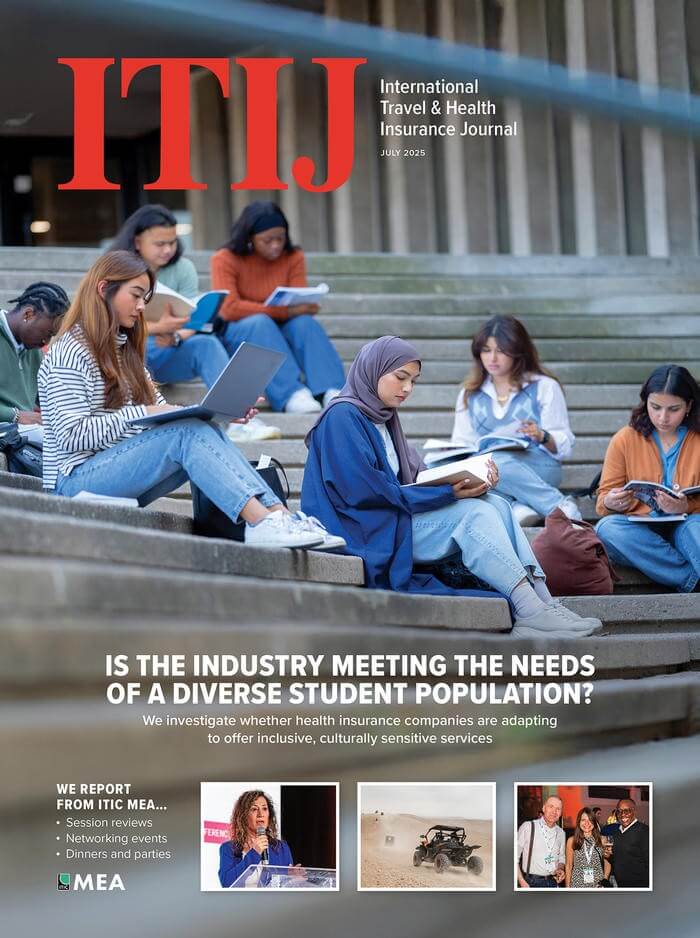
July 2025
Issue
In this issue we look at health insurance for international students, and ask if the industry is adapting to offer inclusive, culturally sensitive policies. We also examine the potentially lucrative world of bancassurance, plus we investigate wait times in the American hospital system.
Chloe Fox
Chloe Fox is an Editorial Assistant for Voyageur Group, joining in 2024. She writes for ITIJ and AirMed&Rescue, covering a range of topics including international travel and health insurance, medical assistance provision, and air medical transportation. Chloe holds a BA (Hons) in English and an MA in English Literature from the University of Bristol.













February 2025
Issue
Offering readers a deep dive into the issues facing providers and payers of healthcare services around the world. Cost containment, international patient department development, the role of AI in healthcare delivery and more.