
Is studying abroad still a viable choice?

As international student enrolments soar, Milan Korcok examines the current changes in students studying overseas
For almost two decades, colleges and universities in the US, the UK, Canada and Australia (the ‘big four’) have dominated the international market for higher education, in 2021 enrolling 44% of the estimated 6.5 million students taking classes in countries other than their own. That’s an increase of two million international students since the year 2000, the US absorbing 17% of all international applicants, the UK 11%, Canada 10%, and Australia 6% – tied with France and Germany, according to International Consultants for Education and Fairs (ICEF).
After a brief slowdown during the Covid-19 years, the recovery of student migrations was quick and strong, motivated by an insatiable demand for high-quality education and prestigious degrees from evolving middle-class families in China and India (which account for 24% of the total number of expatriate students worldwide), as well as Sub-Saharan Africa, Bangladesh, Iran, Pakistan, Ghana, and nations throughout Oceania, the rest of Asia, and Europe, according to UNESCO.
To most of the big four, there initially appeared no downside to these migrations, with tuitions for expatriate students grandly subsidising those of their domestic counterparts, and student spending on housing, daily goods and services, food and fuel, all providing an economic windfall for host countries. In Australia, for example, international higher education became its fourth-biggest export after iron ore, gas and coal – worth A$36 billion in 2023.
However, in Canada, the UK and Australia, all now straining under immigration overloads, governments forced major reductions in student visas, barring applicants from bringing dependants with them through a back door into housing markets already bursting at the seams, and imposing tougher guidelines about how much and what kind of work students, or their dependants, could be allowed.
In Canada, faced with a population surge of 1.16% in the 12 months ending June 2023 (the highest since 1957), most of which was attributed to immigration, the government cut back student visa slots by 35% over the years 2023 to 2025, which is estimated to take them from 510,000 at the end of 2023 to just 250,000 in 2025.
In Australia, the federal government capped international student arrivals at 270,000 for 2025, with individual limits per institution. Education Minister Jason Clare said the cap would mean a limit of about 145,000 new starters for publicly funded universities and 95,000 for vocational institutions. That is about 7,000 below pre-pandemic levels, and about 53,000 lower than 2023–24.
In the UK, as of January 2024, international students (except those on postgraduate research courses or courses with government-funded scholarships) were no longer able to bring in family members, and their student visas no longer allowed a ‘backdoor’ opening to work. The crackdown was expected to pare 140,000 student-related arrivals. Government figures show that in the previous year, ending September 2023, 152,980 visas were issued to dependants of students. This was more than a 930% rise from the 14,839 in the year ending September 2019.
Demand continues, but there’s a different game plan
With demand for higher education growing exponentially in all time zones, it was inevitable the big fours’ monopoly would give way. And according to Dr Fanta Aw, Executive Director and CEO of NAFSA: Association of International Educators, “the idea that the US and the [established] foreign market can continue to dominate is a very old framework. There are many emerging countries, and students, policymakers, and others looking at those countries.” But she warns legacy educational institutions that such rapid growth inherits responsibility: “We have been very clear with our institutions: do not bring international students if you do not have the structures in place to do right by those students and their families. That is dishonest and it’s going to backfire in ways that will be unprecedented.”
After a brief slowdown during the Covid-19 years, the recovery of student migrations was quick and strong
Degrees remain priceless – some more than others
In contrast to its three big four cohorts, America’s universities continue to attract and accept record numbers of international students: over one million during the 2022–23 academic year – almost 12% more than the previous year and the fastest growth rate in more than 40 years, according to US NEWS & World Report, a widely acknowledged authority on school ratings. Chinese and Indian students accounted for more than half the total (54%) of offshore enrolments in 2023/24, with expanding numbers of arrivals from Ghana, Nepal, Nigeria, Bangladesh and more.
But unlike its big four partners, the US is well endowed with on-campus dormitories and other residential facilities that keep students from upsetting local home prices and rentals. And under F1 and F2 visa rules, students’ and dependants’ job aspirations are controlled. F1 students may not work off-campus during the first academic year but may accept on-campus employment subject to certain conditions and restrictions. F2 visa holders (dependants) are not allowed to engage in employment while in the US.
For millions of aspiring students in cities and villages around the world, there will always be the lure (for most, unattainable) of prestigious degrees from the world’s highest-rated temples of higher learning. And for the foreseeable future, American universities top the list with 36 out the top 100 in The Times Higher Education 2024 world rankings. The UK’s Oxford University was number one, and Cambridge number five, in those rankings.
Learning medicine, law or journalism in English?
But as the remaining big four partners work to retain their attraction, they find a new phenomenon challenging them throughout Europe and the rest of the world: the spreading use of the English language, which many academics say is becoming the lingua franca of higher education, and which through English Taught Programmes (ETPs) is cascading through universities worldwide.
In the UK, as of January 2024, international students were no longer able to bring in family members
Let’s make it clear: ETPs are not courses in the English language. They are full courses in as many disciplines as can be imagined being taught in English on university campuses (and some online) worldwide, often in non-anglophone countries: e.g., engineering, medicine, business management, law, architecture, all the science, technology, engineering and mathematics (STEM) courses, and more. According to the British Council (an organisation specialising in international cultural and educational opportunities) and Studyportals (an Eindhoven-based online education choice platform), “the surge in ETPs beyond the traditional anglophone destinations marks a significant shift in global education… and has profound implications for global student mobility”.
The British Council/Studyportals survey found that in 2024 there were 40,786 ETPs offered by more than 1,700 universities outside the big four. Among the 15 countries with the most ETPs, the top three were Ireland (2,662), Germany (2,392), and the Netherlands (2,167) followed by Turkey, France, Italy, Spain, Sweden, Switzerland, Poland, Portugal, Finland, Czechia, Belgium and Hungary in the top 15. Going beyond Europe, ETPs are rising in East Asia, Chinese regions, Sub-Saharan Africa, South Asia, the Middle East and North Africa, and the Americas (outside the US).
We have been very clear with our institutions: do not bring international students if you do not have the structures in place to do right by those students and their families
A note of caution for the big four markets: the market share of ETPs previously claimed by them has dropped from 82% in 2021 to 78% in 2024. And though they still remain the biggest players in the provision of English language education in all disciplines, prospective students can now choose from 72,500 full-degree study options taught in English at the top 1,000 universities in over 700 cities, and in many cases do it far less expensively than they would at home. As Studyportal emphasised: “Attending school abroad can actually be more cost-effective than staying in your home country as universities increasingly woo international students. In Europe for example, several countries are offering free-tuition master’s and PhDs, making overseas schools attractive for US and Asian students, who often have to pay high fees to study.”



Travel the world and study for less
That’s a tantalising prospect for aspiring international students, and particularly for their parents who pay the tab. It’s also an issue that should catch the attention of travel insurers worldwide, for whom the student market has untold potential for expansion and refinement – in developing varying forms of coverage for countries with different rules, needs, healthcare facilities and risk requirements. Also note the growing need for proof of travel insurance benefits.
For millions of aspiring students in cities and villages around the world, there will always be the lure (for most, unattainable) of prestigious degrees from the world’s highest-rated temples of higher learning
According to an Allied Market Research (AMR) report, the value of this market in 2023 was US$2.8 billion, and it was estimated to reach $15.5 billion by 2032 (growing at a CAGR of 21.1% from 2024 to 2032). As AMR summarised: “The student travel insurance market is driven by rising awareness among students and educational institutions about the importance of having comprehensive insurance coverage while studying abroad. Furthermore, the mandatory requirement of student travel insurance by many countries and universities further propels the market growth. In addition, the rise in the trend of students participating in various educational programmes, internships, and volunteer opportunities overseas creates a higher demand for tailored insurance solutions that cater to the specific needs of student travellers.”
January 2025
Issue
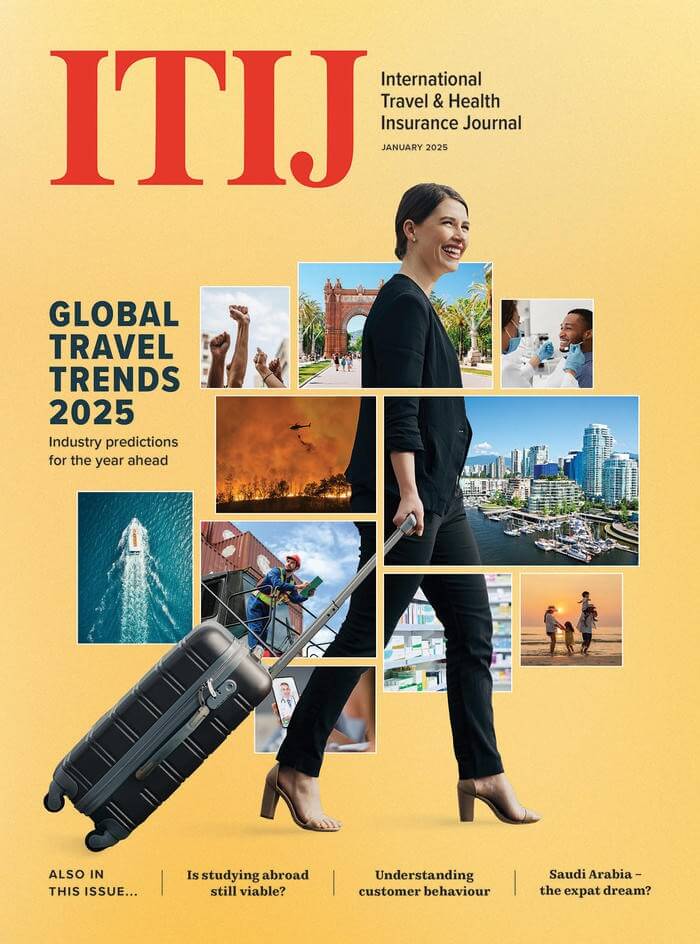
In this issue we look at worldwide travel trends for the year ahead; speak to insurance experts about how they go about understanding their customers; examine the pros and cons of living and working in Saudi Arabia; and look at the shift in the international student community.
Milan Korcok
Milan Korcok is a national award-wining medical writer who has been covering international healthcare activities and trends in Canada, the US and abroad for many years. He has long served as contributing editor to the Canadian Medical Association Journal and the Journal of the American Medical Association. He is a founder of – and has served as editor of – the US Journal of Drug and Alcohol Dependence; a founder of the Travel Health Insurance Association of Canada, and currently serves as contributor to ITIJ.