Virtual reality in healthcare delivery

Virtual reality might be the latest Hollywood plaything, or the stuff of gamers’ dreams, but the ability to look at a make-believe world, and operate inside it, is actually helping hospitals from Australia to the US to treat patients. Tatum Anderson enters this exciting domain
Consultancy PwC’s Health Research Institute (HRI) predicted that virtual reality (VR) will be one of the disruptive technologies of 2017 and that the healthcare industry will need to prepare for its expected impact on business models, operations and workforce needs at the very least.
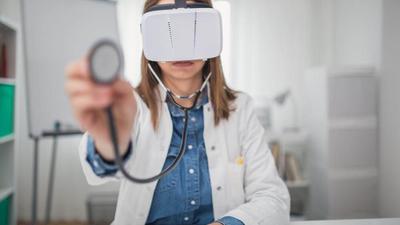
VR has, for many years, found a natural home in training students, from architects to paramedics. Doctors with VR headsets can obtain a 3D view of anatomical structures, organs can be modelled in motion, and functions and actions simulated – arteries can pulsate and cut blood vessels can bleed. As one VR expert put it: “We have created virtual patients for clinicians. So clinicians can screw up a bunch before they are get their hands on a real one.”
even qualified surgeons will benefit from VR
By its nature, VR doesn’t just use visual images. It makes use of touch, smell and even feedback to enhance the feeling of reality. Trainee dentists, for example, use a system called HapTEL (haptics in technology-enhanced learning) to perform fillings on a set of 3D teeth using a virtual drill which replicates the movement and pressure of a real drill. Subtle changes of pressure help students to adjust their techniques.
The thinking now is that even qualified surgeons will benefit from VR.
Existing procedures can be practised so that they are quicker and less risky. Hospitals are enabling surgeons to use VR to practise, plan or rehearse a range of complex surgical procedures; paediatric cardiac surgeons at Lucile Packard Children's Hospital Stanford – who carry out thousands of operations every year – use virtual imaging technology to digitally convert CT (computed tomography) and MRI (magnetic resonance imaging) scans into 3D images that can be viewed prior to surgery, as well as in the operating room using a VR display.
But, importantly, patients and their families can put on a VR headset and use handheld controllers to look inside a virtual heart to better understand heart defects, and how their doctor will be closing up a hole in a septum, for example. This beats trying to understand their doctor’s incomprehensible diagrams, plastic models and hand-drawn sketches before a procedure, said the hospital.
Although it is in its early stages, the logical next step might be remote surgery. Surgeons have already tried to operate on a patient located 400 km away using VR and remote surgical equipment.
VR Mind games
Telesurgery may be futuristic, but actually VR is not a new technology. It has been used clinically since the 80s, when it was first used to combat phobias, including fears of flying, lifts and heights. Clinical VR scientists have constructed virtual airplanes, skyscrapers, spiders, battlefields, social settings, beaches, fantasy worlds, and the very ordinary, such as schools, offices, the underground train, the cabin of the plane or the supermarket. These environments are helping patients deal with all sorts of mental health problems, from depression to paranoid delusions and eating disorders.
Patients can be helped to face uncomfortable situations – those that trigger stress and anxiety – through the controlled environment of a VR headset; those afraid of heights are taken at their own pace to the top of a high building, for example.
Some patients are completely immersed in the environment, and even subjected to smells, using a VR helmet and body-tracking technology that helps doctors understand where their patient is looking. Others stand inside a room-sized 3D cube, surrounded by up to six screens on which images are projected around them while they wear 3D glasses. Some applications are not immersive – so-called augmented reality – so that they can still see the real world, but with realistic images superimposed on it; in application, developed in New Zealand, arachnophobic patients see massive red-and-white hairy striped spiders crawl all over their hands. Every action of the spiders can be controlled, for example aggression, as well as the number of spiders.
Things to touch (such as a pole of a tube train, when treating people with a fear of travelling on the underground train), rumble pads and other stimuli heighten the sense of presence in the virtual world far more than watching television or movies, or playing a 2D handheld videogame or game console, say VR experts.

Navigating the real world in VR
VR to treat post-traumatic stress disorder (PTSD) is on the rise and has been used to treat Vietnam veterans and World Trade Centre survivors. Dr Skip Rizzo, director, medical VR at the Institute for Creative Technologies within the University of Southern California, US, and colleagues, have developed Bravemind, which repeatedly exposes traumatised soldiers to different scenarios, with a qualified psychologist. “We have a controlled environment that we can put people through and help them to confront their emotional memories and things that they fear,” said Dr Rizzo. “We have an evidence-based trauma-focused exposure therapy and leveraged the principles of what works in the real world to deliver the treatment effectively in VR.” The treatment is available at more than 100 sites in the US including Veteran Health Administration hospitals, clinics and private facilities.
Now, Bravemind is being extended to the treatment of military sexual trauma. But Dr Rizzo sees it as a viable treatment for all kinds of sexual and non-military trauma – from urban violence and kidnapping to earthquakes. “We can make a case for treating civilian trauma, from first responders and police to victims of terrorist attacks, sexual trauma, motor-vehicle trauma, bad weather or hurricanes. There’s a hell of a lot of trauma in the world,” he said.
While getting people to face their fears may be one application of VR, others aim to distract them. That’s because distraction is now known to attenuate pain perception, anxiety and general distress during painful medical procedures, such as wound care, chemotherapy, dental procedures and routine medical procedures.
Some burns specialists are even starting to view VR as a form of anaesthetic. Using Snowworld, a game designed to help burn patients, and developed at the University of Washington HITLab in collaboration with Harborview Burn Center, burns victims can adventure in a cold world, and hide in huts made of snow. This helps to calm and distract the patient and block pain signals when bandages are changed, wounds are cleaned or staples removed. The creators believe VR dramatically reduces excruciating pain, more intensively than mere gaming – such as giving a child a Nintendo play with while their dressings are changed.

Pain control applications are expanding quickly and are interesting hospitals around the world. From Cedars-Sinai Medical Center, which is looking at patients with a range of conditions – from abdominal pain from pancreatitis to chest pain from pneumonia – to Stanford, which plans to trial VR in labour and delivery.
Several hospitals are trying VR by rolling out patient and calming orientation and distraction applications within children’s hospital units. My MRI at King's College London in the UK guides children through the events on the day of a forthcoming MRI scan, from arriving at the hospital to entering the scanner. The technology helps them understand how it feels inside the MRI scanner and helps them to learn to keep still for the duration of the scan.
Distraction technique
Toronto’s Hospital for Sick Children has even created a space dedicated to virtual and augmented reality to help children with the boredom of being in hospital by sending them on virtual trips to outer space and providing augmented reality mobile games. Its Childlife VR allows children to visit operating rooms, recovery rooms and X-Ray suites, allowing them to get used to the unfamiliar sights and sounds of these strange environments.
At Stanford Lucille Packard Children’s Hospital, children may choose a VR helmet with a game especially designed so that they will move just their heads, and not their arms – which need to be still – during an IV insertion. There is no death or dying in these games, and the level of distraction can be increased by the doctor just at the point when they insert the needle. So, as well as destroying aliens in space, children will start to see hamburgers and fries flying at them at the very point when the needle is inserted.
One reason many of these technologies are finding themselves more widely used, is that the cost of technologies has plummeted says Dr Tom Caruso, co-founder of this distraction VR programme, called CHARIOT. “As the cost of these technologies such as VR headsets have come down they become more available to innovators and there are many uses for these within the hospital,” he commented.
For example, headsets from Samsung, Oculus Rift, and HTC cost hundreds rather than thousands of dollars now. And, the US$15 VR headsets coming onto the market from companies like Google are even cheaper. Creators and doctors are using off-the-shelf VR developer software, to help build applications too.
The VR headsets are affordable. For example, children with a scheduled cardiac catheterisation procedure are sent home with a VR headset so they can learn about the procedure and practice relaxation techniques.
The technology may be becoming cheaper, but there are limitations says Caruso. For example, some are covered in cloth, which cannot be disinfected, or the area that touches the eyes cannot be replaced – which may be necessary in patients that have particular infections. Developers say they can’t see what the patients are seeing and would like to be able to manage what patients are seeing remotely. Similarly, the straps aren’t designed for children, let alone different children with different head sizes. The Stanford Lucille Packard Children’s Hospital has, therefore, recruited student engineers and other designers from Stanford University to customise commercial handsets. This means VR is out of reach for many smaller hospitals, who cannot customise this kit, they say.

Augmented reality finds a place
Augmented reality technology is further behind VR, although Apple, Google and Microsoft have all jumped into this space recently and experts say the technologies are improving fast. With new cheaper headsets and smartphone applications, it will be far more accessible, however. “Now the system is becoming smaller and more affordable, people are starting to explore other applications,” said Albert Kwon, the paediatrician who together with co-founders, has created a company trialling augmented reality applications for rehabilitation from stroke to amputation patients. “I think the future is augmented reality.”
Kwon’s company, Augmentx is exploring a variety of therapeutic applications including mirror therapy using a VR headset. Here a patient can watch a mirror image of one working limb in order to help them recover movement in the other, paralysed limb. Importantly, augmented reality, rather than complete immersion, may work better for people who may be unstable on their feet, so need to see the world around them in order to prevent falls.
Augmentx is one of several organisations, including USC, that are attempting to incorporate rehabilitation exercise and teaching exercises for people who need to get moving again. With movement tracking, they can also measure how well patients adhere to rehabilitation programmes.
Many forms of rehabilitation are being attempted; from navigation and spatial training in children and adults with motor impairments to functional skill training and motor rehabilitation in patients with central nervous system dysfunction after traumatic brain injury (TBI), spinal cord injury (SCI), cerebral palsy and multiple sclerosis.
Kwon envisages a world where hospitals give patients augmented reality headsets while they are still in hospital, and they are then able to them home where they can continue to recover and do their exercises at home. It may be useful Knee replacement, as hip replacement and postsurgical recovery, for example, or after concussion. As USC’s Rizzo says: “Rehab is very boring, repetitive and frustrating. We make it more game-like and capture those changes over time.”
It appears VR will become a standard part of patient life in the not-too-distant future, assisting with boosting the morale of paediatric patients, making surgery safer and less risky, as a useful tool in therapy, and enabling patients to recover from the comfort of their own home. What once seemed like a wild fantasy is now becoming, virtually, reality.

November 2017
Issue
In this issue:
Destination spotlight: Thailand
Tech corner: Prime Medical’s surgical scrubs
3D printing – how it has and is progressing?
How virtual reality is revolutionising medicine and healthcare
Superbug: Drug-resistant bacteria are here – the issue, cases, health challenges, how hospitals and health authorities are tackling this problem.
Canadian healthcare system changes
The value of hospital accreditation
Tatum Anderson
Tatum Anderson is a journalist and has written in-depth features for ITIJ and its supplements for over 12 years. An experienced tech, business and global health specialist, she specialises in writing about all manner of medical travel and technology, from AI and telemedicine to crew health and cost containment. She routinely interviews high-level executives from international hospitals and insurers to assistance companies and air ambulance firms worldwide. Tatum has also written for a range of high-profile publications including The Bulletin of the World Health Organization, BBC News Online and The Guardian. She was a stringer for The Economist and has contributed to The Lancet, BMJ and Nature.









February 2025
Issue
Offering readers a deep dive into the issues facing providers and payers of healthcare services around the world. Cost containment, international patient department development, the role of AI in healthcare delivery and more.