From tariffs to telehealth

Gitte Bach, CEO at New Frontier Group (NFG), talks to ITIJ about challenges and innovation in the industry
How have recent shifts in US tariff policy impacted the industry, and what ripple effects are you seeing in your business?
When hospitals have to pay more for equipment, those costs get passed right down the line. And for international insurers, that can mean bigger bills for everyday services. What we’ve had to do is get very proactive and dig into charges that are outside of usual and customary. Even with a network discount, it is important to audit carefully and make sure international payers are not absorbing increases that aren’t justified. Being independent, we have built direct relationships with many providers across the US which really helps us push back.
It is also important to be sure that services are not being unnecessarily inflated with tariffs being used as the rationale for increases when they are not having a specific impact on certain services.
Beyond the usual suspects like administrative overheads and pharmaceutical pricing, what lesserknown factors are quietly inflating US healthcare costs?
A big one is consolidation across the industry with private equity buying and rolling up specialty practices and large US insurers buying into the delivery side of healthcare. We often talk about private equity rolling up specialty practices like anaesthesia or orthopaedics, and when that happens, prices almost always climb because there’s less competition. But we’re also seeing large US insurers buying physician groups, urgent care centres, and even home health companies.
That vertical integration means they control more of the ecosystem, and while you’d think it might lower costs, in reality it often creates pricing power that drives them higher.
Another factor that doesn’t cause inflation but makes it difficult to track is the lack of transparency. So, an MRI might be $300 at one facility and $3,000 at another, and you wouldn’t know until after the bill arrives. Even though hospitals are legally required to publish their negotiated rates and cash prices, compliance has been spotty. At one point, fewer than a quarter of hospitals were fully compliant. That’s starting to shift now because CMS has introduced steeper fines. We are seeing some improvement, but it’s still inconsistent. For an international payer, that inconsistency can be a real problem.
In your view, is the lingering fear of travel post-pandemic more psychological or systemic, and how can the industry rebuild trust and confidence?
I believe it is a mix of both. People still remember what it felt like to be stuck abroad or not sure if they’d get access to care. Systemically, we also saw real cracks like overwhelmed hospitals, border closures, and supply shortages.
To rebuild trust, I believe we need an industry that is really transparent and proactive. We have focused on things like telehealth, a trusted provider network, and experts to guide patients through complex cases.
What role do geopolitical tensions, health risks, and digital misinformation play in shaping modern travel anxieties?
Geopolitical tension makes people worry about safety and access to care even more so than the past trauma of a pandemic. Health risks add another layer of stress. And misinformation – that’s the wild card. A rumour on social media can spread faster than a fact sheet from the World Health Organization, and suddenly people are scared to travel. What we can do as an industry is provide clarity and consistency.
What innovations do you see as essential for the industry to remain competitive and resilient in the face of global health and travel volatility?
I’d say three things – telehealth, tech, and continued independence. Firstly, we see telehealth as not just an add-on but as an integrated part of cost management. It’s such a powerful tool for avoiding unnecessary ER visits, getting second medical opinions, managing chronic care or post hospitalisation follow ups, and mental health support. Secondly, on artificial intelligence (AI) and data analytics the trends in helping spot billing anomalies and predicting trends will continue to allow cost management vendors like us to act faster and be able to really focus in on the anomalies. Thirdly, we believe independence in partnerships is important to be flexible and remove inherent conflicts within an organisation. Because we’re not owned by an insurer, we can pivot quickly, tailor solutions, partner with other independent and larger organisations as needed, and really focus solely on the best cost management and optimal care outcomes.
Innovation is fantastic, but it only matters if it helps real people.
Gitte Bach
CEO, New Frontier Group
With over 20 years in the industry, Gitte is recognised for pioneering solutions that blend clinical expertise, financial savings, and compassionate care to support international insurers, assistance companies, and globally mobile patients.
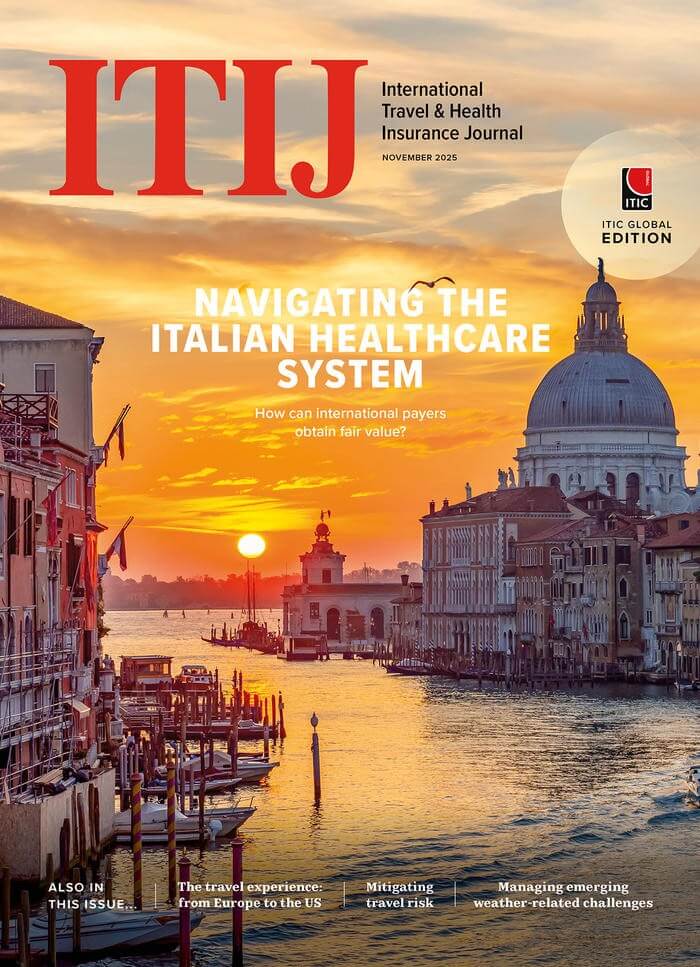
November 2025
Issue
In this issue of ITIJ we look at current travel patterns to and from the US and Europe, take a close look at the Italian healthcare system, and examine how insurers are adapting policies and coverage to manage weather-related challenges.
Editorial Team
The Editorial Team updates the ITIJ website daily, and works on features for the print edition. With expert industry knowledge and years of experience in writing about complex travel insurance issues, the Editorial Team is ready to investigate and report on the topics that matter most to ITIJ's readers.













February 2025
Issue
Offering readers a deep dive into the issues facing providers and payers of healthcare services around the world. Cost containment, international patient department development, the role of AI in healthcare delivery and more.