Redefining trust

María Cecilia Aponte Caicedo, Head of International Care and Wellness Program at Hospiten, speaks to ITIJ about having confidence in healthcare systems and how new tech is helping the industry
What does ‘trust’ mean in the context of international healthcare, and how has its definition shifted since Covid-19?
Trust in international healthcare means that patients, insurers, and governments feel confident they will receive the same quality, safety, and transparency across borders. Since Covid-19, the definition of trust has expanded. It is no longer only about medical outcomes, but also about resilience, rapid communication, digital access to care, and coordinated responses in times of crisis. At Hospiten, we learned that building trust also requires empathy and agility, which is why we’ve invested in standardised protocols and international care pathways that ensure consistency across all our hospitals.
At Hospiten, we learned that building trust also requires empathy and agility
How can healthcare institutions and governments build crossborder trust when facing disparities in resources, transparency, and regulatory standards?
The key is collaboration and standardisation. Even in the face of disparities, institutions and governments can align around shared protocols, accreditation frameworks, and transparent reporting. Building trust means reducing uncertainty: patients and insurers must know what to expect regardless of where care is delivered. At Hospiten, operating in five countries, we face these realities every day. Our solution has been to implement international quality standards across hospitals, reducing uncertainty for patients and insurers and creating confidence in the care they will receive, no matter the destination.
What role does data sharing – particularly sensitive patient data – play in fostering or undermining trust internationally?
Data sharing is both foundation and a risk. When done responsibly, with strong safeguards, it fosters trust by ensuring continuity of care, faster decision-making, and better outcomes across borders. But when data privacy is compromised or unclear, it can undermine trust completely. The challenge is to stablish secure, interoperable systems where patients know their information is protected and only used for their benefit. Transparency in how data is managed is essential for maintaining international trust. At Hospiten we prioritise secure, interoperable systems and train teams to handle international patient data with the highest ethical and legal safeguards.
Data sharing is both foundation and a risk
In your view, how can technology such as artificial intelligence (AI), telemedicine, blockchain etc, be harnessed to strengthen rather than erode patient and public trust across different healthcare systems?
Technology must be used as an enabler for human connection, not a replacement for it. At Hospiten, we use telemedicine to maintain continuity of care for international patients, and we see AI as a tool to support, not to replace clinical judgement. By combining innovation with clear communication and patientcentered design, technology becomes a driver of trust. Our goal is always to ensure that patients and partners feel both supported and protected, not managed by machines.
How do cultural perspectives on healthcare ethics and communication impact the global effort to create trust between providers, patients, and policymakers?
Healthcare is always delivered in a cultural context. At Hospiten, working in Europe, Latin America, and the Caribbean has shown us that adapting communication and respecting cultural expectations are essential to earning trust. What unites all contexts is the commitment to dignity, clarity and respect. By training our international teams to deliver care with cultural sensitivity and transparency, we help bridge differences and strengthen trust with patients, insurers, and policymakers worldwide.
María Cecilia Aponte Caicedo
Head of International Care & Wellness Program, Hospiten
María Cecilia is a global healthcare strategist who has built six successful international patient departments across four countries. Her success lies in humanising the patient journey, focusing on details that make a difference for those travelling abroad for care, and optimising cross-border healthcare experiences.
November 2025
Issue
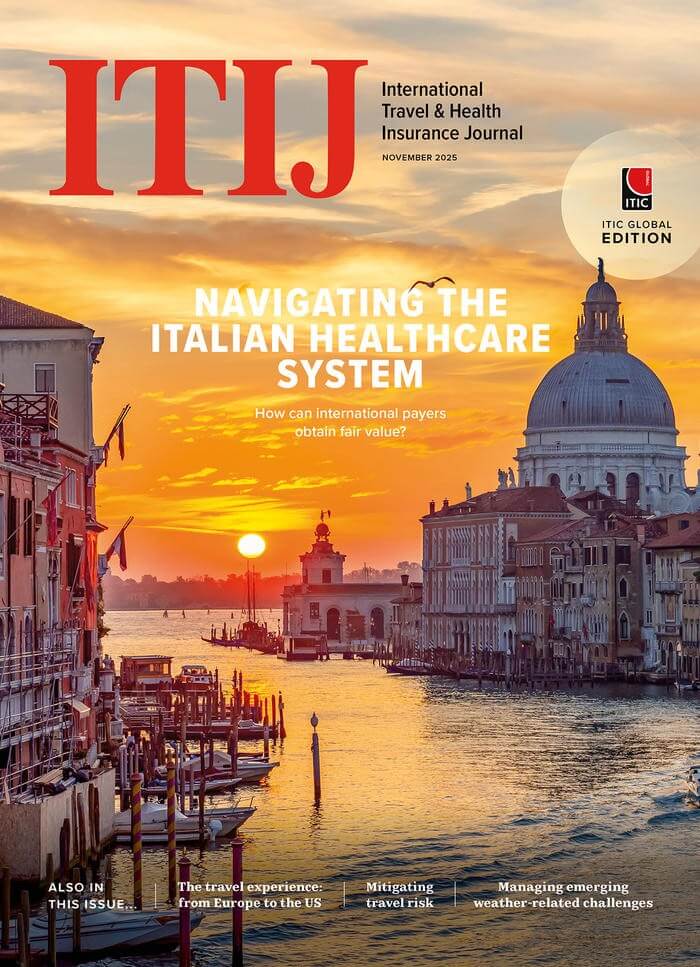
In this issue of ITIJ we look at current travel patterns to and from the US and Europe, take a close look at the Italian healthcare system, and examine how insurers are adapting policies and coverage to manage weather-related challenges.
Editorial Team
The Editorial Team updates the ITIJ website daily, and works on features for the print edition. With expert industry knowledge and years of experience in writing about complex travel insurance issues, the Editorial Team is ready to investigate and report on the topics that matter most to ITIJ's readers.













February 2025
Issue
Offering readers a deep dive into the issues facing providers and payers of healthcare services around the world. Cost containment, international patient department development, the role of AI in healthcare delivery and more.