Excellent trauma care in Thailand

Ekkit Surakarn, Deputy Hospital Director at Bangkok Hospital, talks to ITIJ about trauma care, the importance of technology, and how they measure success
Can you tell us about your extensive BDMS trauma care network and how the BDMS Medevac Center plays a part in this?
The BDMS Trauma Network includes all 59 hospitals (57 in Thailand and two in Cambodia). The network shares the standard of trauma care with agreements for patient transfer and consultations. This collaboration ensures the appropriate level of care for injured patients in all regions of Thailand and our catchment area.
The BDMS Medevac Center coordinates with all hospitals in the BDMS Trauma Network to activate prehospital care, the initial trauma care at a local facility, and the arrangement of patient transfers for definitive care in proper facilities. It also supervises and supports the mission to maintain the level of care at all times.
The BDMS Trauma Network includes all 59 hospitals (57 in Thailand and two in Cambodia)
Embracing new technologies and providing advanced facilities are a big part of the BDMS ethos. Can you explain more about what technology the business is embracing?
We are using Extracorporeal Membrane Oxygenation (ECMO) and Hybrid Operating Room (OR).
ECMO provides vital support in circulatory failure and respiratory failure. Severe trauma patients complicated by multiorgan failure are not uncommon, and these patients benefit from ECMO as a bridge to recovery.
Currently, we are the only ECMO team in APAC that is certified by Extracorporeal Life Support Organization (ELSO).
Hybrid OR with advanced medical imaging enables modern trauma. BDMS has an established transport ECMO programme to safely transfer critically injured patients from local hospitals to higher levels of care in one step. The intervention radiology for bleeding control and complex surgery such as endovascular aortic repair, angiographic embolisation, pelvic fracture fixation, and visceral organ repair, can be done in the same session.
BDMS has an established transport ECMO programme to safely transfer critically injured patients from local hospitals to higher levels of care
BDMS had more than 34,528 trauma admissions in one year (2024). How does the network cope with so many admissions, and how vital is it to have the best trauma care team?
We have coped because of the high number of beds (9,200) we have in the BDMS Network. Also, we have designated trauma centres in each location with dedicated trauma medical directors and trauma nurses who manage the compliance of practice and standards of trauma care in each hospital.
We have a trauma registry and audit in each monthly network meeting. These ensure the standards of care needed and register performance improvements.
We also have a mass casualty and disaster response plan to gather the supporting resources from hospitals in each region.
What criteria do you use for evaluating successes and outcomes?
The survival rates of major trauma patients is the ultimate indicator of success. We are now studying patient report outcome measurements, or PROM, as an additional set of quality indicators.
Dr Ekkit Surakarn
Deputy Hospital Director, Bangkok Hospital
Headquarters (a member of BDMS)
Dr Surakarn specialises in both general and trauma surgery. He was a Medical Doctor at the Faculty of Medicine, Siriraj Hospital, Mahidol University in 1994, on the Board of General Surgery at the Royal College of Surgeons of Thailand in 2001, and has a Diploma in Trauma Surgery from the Royal College of Surgeons of Thailand. Dr Surakarn was Chairperson of BDMS Prehospital Care and Interfacility Transfer Working Team from 2024 to 2025, and Assistant Hospital Director between 2022 and 2024. He has written extensively and speaks Thai and English.
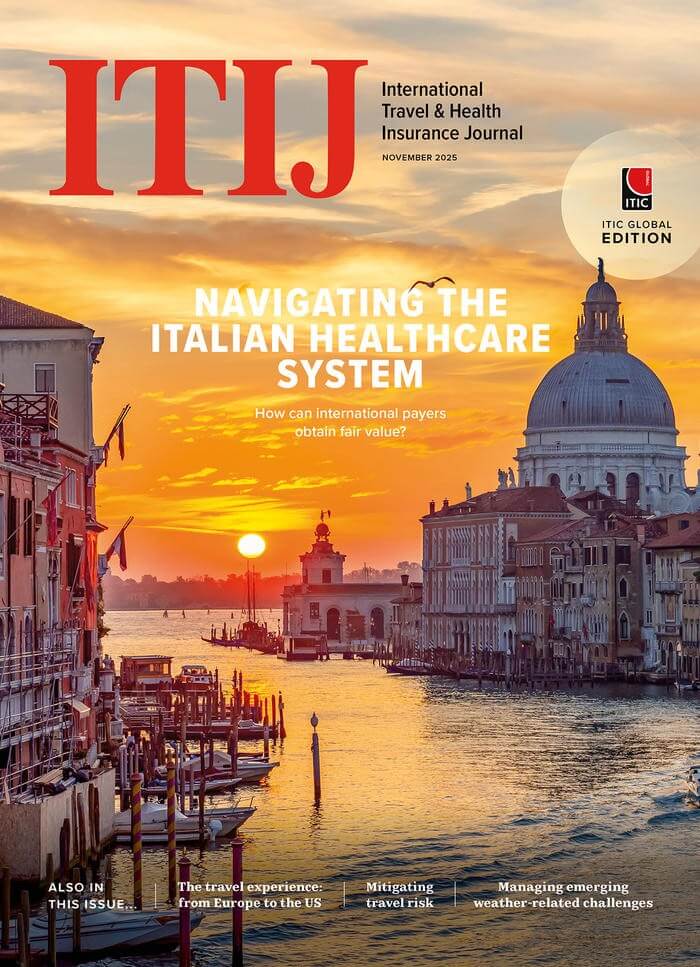
November 2025
Issue
In this issue of ITIJ we look at current travel patterns to and from the US and Europe, take a close look at the Italian healthcare system, and examine how insurers are adapting policies and coverage to manage weather-related challenges.
Editorial Team
The Editorial Team updates the ITIJ website daily, and works on features for the print edition. With expert industry knowledge and years of experience in writing about complex travel insurance issues, the Editorial Team is ready to investigate and report on the topics that matter most to ITIJ's readers.







February 2025
Issue
Offering readers a deep dive into the issues facing providers and payers of healthcare services around the world. Cost containment, international patient department development, the role of AI in healthcare delivery and more.