The global travel insurance industry adapts to Covid-19

The spread of challenges arising from the Covid-19 pandemic is vast. Clara Bullock talked to various international travel insurers to see how they’ve been responding
The Covid-19 pandemic has hit the global economy hard and will continue to contribute to its decline in the near future. With businesses closed, events cancelled and people spending less money, the International Monetary Fund has warned that the world faces its worst recession since the Great Depression of the 1930s. The international travel and health insurance community is facing challenges of its own: most countries have imposed travel bans and people all over the world are filing claims for cancelled holidays and business trips. This has led to insurers freezing sales of new coverage, with others changing the terms of their policies.
Kate Huet, Managing Director at International Travel and Healthcare Limited, a UK-based travel insurance solutions company, commented on the changes she has seen recently: “It does rather seem as if the rules under which we all work have been invisibly rewritten. Starting at the top of the ‘travel tree’, with airlines refusing to provide refunds as soon as each government’s travel advice changed, despite prevailing rules such as EU directives.
It does rather seem as if the rules under which we all work have been invisibly rewritten
“I completely understand their [airlines] need to hang on to whatever they can … but those are not the rules, and the breadth of retail travel insurance was never designed to step in when travel bans are imposed.” With all of this in mind, how are insurers coping with skyrocketing claims? How are they adapting to a world with almost no travel? And can they see a light at the end of the tunnel?
Shortly after the pandemic was announced and travel bans started to be put in place all over the world, certain insurers stopped selling new policies and others tightened up the terms on their existing contracts. Australian insurer Cover-More, for example, has suspended the sale of its cancel-for-any-reason (CFAR) add-on policy while the company assesses the add-on’s risk profile. Judith Crompton, CEO of Cover-More in the Asia-Pacific region, explained: “Cover-More is very proud of our CFAR product, which we have pioneered in Australia and New Zealand since April 2018. We have not taken this decision lightly, and we stress that we hope this suspension will enable us to keep CFAR in market in the longer term.”
In the UK, Admiral, Aviva and Direct Line are among those insurers that have stopped selling travel insurance to new customers completely. In fact, 31 insurers in the country have now suspended sales of international travel and health insurance policies, while a further 13 have made their policies more restrictive, according to consumer rights advocate Which?. Gareth Shaw, Head of Money at Which?, said: “Coronavirus has had a huge impact on the travel insurance market, with dozens of providers amending policies or pulling them altogether.” He added that, in Which?’s opinion, government, insurers and the travel industry should work together to tackle the huge challenges that have been posed by coronavirus.


Not only have some insurers stopped selling new policies to customers, but they also have to deal with an unprecedented increase in the volume of claims received. Huet does not see an immediate end to the increased workload: “It’s too soon to get a real feel for how long this will go on. There is a daily influx of new claims, and with many companies already in a backlog situation, it’s difficult to see an end in sight.”
Coronavirus has had a huge impact on the travel insurance market, with dozens of providers amending policies or pulling them all together
The Association of British Insurers (ABI) is calculating that this year’s travel insurance payouts will hit record highs; it estimates that £275 million in coronavirus claims will be paid out this year. Mark Shepherd, ABI’s Assistant Director, said: “At this unprecedented time, travel insurers are helping soften the financial blow for thousands of customers whose travel plans have been cancelled or disrupted by coronavirus. Along with compensation from sources such as airlines and credit card providers, travel insurers are helping customers get through these tough times.” Alex Sharp, Managing Director for UKbased travel insurance specialist ASUA Group, believes that because of the huge number of claims in the pipeline, not every business will be able to survive: “It is both the scale and duration of this crisis that makes it almost impossible for individual insurers – or the market as a whole – to mitigate people’s losses and disruption ... claims will take a hugely long time to settle as the travel trade struggles to work out exactly what costs can be recovered and what is lost,” he told ITIJ.
While it is obvious that travel insurers all over the world are swamped with claims, it is still unclear how long this crisis will continue and how travel insurers will hold up in the future. As Huet told ITIJ: “Quantifying the exposure at this stage is almost impossible, other than to say – colossal. I think the light won’t come into view until we know travel can once again come back onto the radar and life returns to more normal levels.”
Greg Lawson, Head of Travel Insurance at UK firm Collinson, said: “In all of this, it is important to remember to provide support for all types of companies and while it can feel like survival of the fittest at times, it is important that it is not survival of those with the biggest pockets and that we ensure that there is a broad range of companies in the industry going forward, including specialists, blue-chip and others.”

To tackle the workload as best as possible and in a way that makes the most sense, many insurers have decided to prioritise the most vulnerable cases. Additionally, some companies have decided to involve all employees in customer service, making sure the workforce is used where it is most needed.
There is a daily influx of new claims, and with many companies already in a backlog situation, it’s difficult to see an end in sight
“At this point in time,” said Ian Hughes, CEO of Consumer Intelligence, “consumers need information and clarity from their service providers, and they need empathy. Many will face financial hardship in the coming weeks and months, and people are worrying about how they are going to survive. It is imperative that all sectors maintain open lines of communication to provide peace of mind for their customers at this very difficult time. Consumers have long memories.” For that reason, the UK’s Financial Conduct Authority (FCA) has written an open letter to insurers, laying out its expectations during the pandemic. It stated that while travel insurers face a huge number of claims, the FCA still expects insurers to treat their customers fairly and to communicate with them clearly.
ABI members have pledged to ‘ensure that customers are provided with, or directed to, the most up-to-date information around the coronavirus outbreak and publish clear information at the point of sale around the valid coverage of their policies’. However, the quality of insurers’ customer service during Covid-19 has been widely criticised by regulators. Research from Consumer Intelligence looked at customer communication during the pandemic, and insurers came bottom of the list, with 35 per cent of customers saying they had received communication from their insurance provider, compared with 47 per cent for mortgage providers, 56 per cent for gyms and 62 per cent for fast food companies.

Kasara Barto is PR Manager at Squaremouth, a US travel insurance comparison engine. She believes travel insurers will ultimately gain customers in the long run: “While it is uncertain how long this situation will last, as the Covid-19 pandemic has impacted travel worldwide, more people are now aware of the existence of travel insurance. Travellers may also have different insurance needs once travel returns to normal, as many travel suppliers have begun offering refundable trips. Many travellers buy travel insurance specifically for cancellation coverage; however, that is only one of many benefits available on a comprehensive policy.”
While it can feel like survival of the fittest at times, it is important that it is not survival of those with the biggest pockets
More than that, Barto sees the pandemic as a major shift in the way that travel insurers will operate in the future: “Providers will include coverage for virus outbreaks on future policies, similar to the 9/11 attack leading to the addition of the Terrorism benefit. Prior to 9/11, the Terrorism benefit was not offered on travel insurance policies; however, upon the outpouring of traveller concern after the attack, many providers added it to their standard coverage.” Indeed, travel insurance will likely change in various ways in the future. Lawson can see insurance companies that sell travel insurance as a side product give up on travel insurance altogether: “That said, the impact will be felt hardest by the travel insurance specialists with increasing claims impact and reducing revenue month on month. Conversely, the major players in the insurance industry may well decide that this global and unpredictable travel exposure is not worth the margin return when compared to their more profitable and likely predictable general insurance portfolio.” At this stage, it is still very difficult to say how exactly travel insurance will change in the future. Most companies are reluctant to release any numbers at this time, as there are many factors that could come into play that change the ultimate outcome for them. Until the scale of the problem is quantifiable, Sharp hopes that governments and the wider insurance community will help: “The insurance industry must find solutions to help in these situations and not just go into lockdown denial mode. The scale of losses will impact hugely on future capacity; this may well mean choice of insurers is reduced, and prices go up. Just as the industry has responded to terrorism and flood claims, this is a perfect example of why a mandatory pool reinsurance arrangement with government backing needs to be established.”
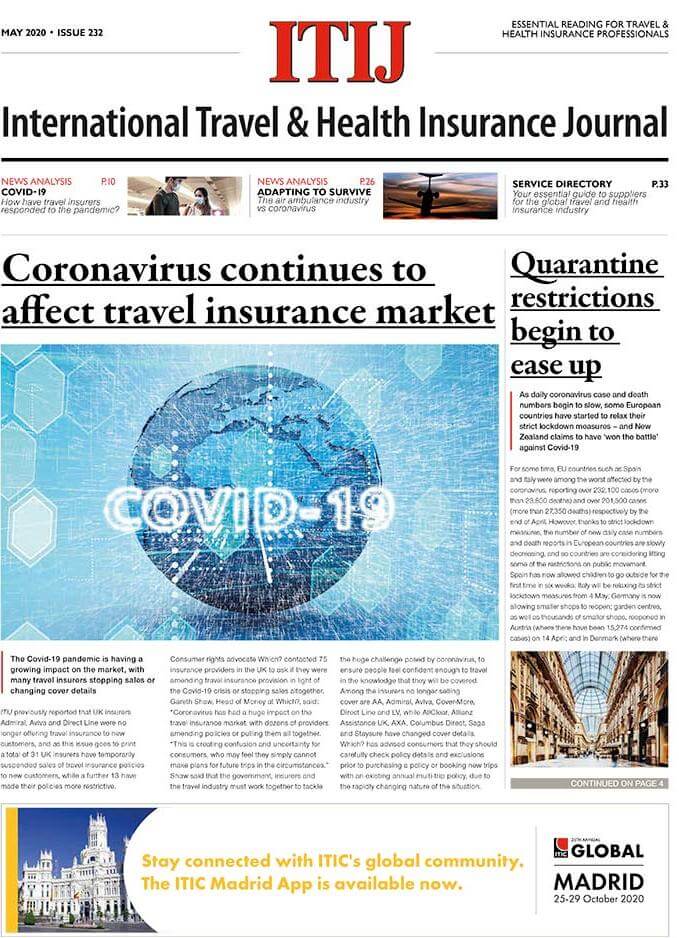
May 2020
Issue
In this issue of ITIJ, our focus is firmly on the industry’s response to Covid-19. We talk to travel insurers and air ambulance operators around the world in our two in-depth News Analysis reports to assess the impact the pandemic has had on their operations and how they have adapted. We also look at some of the digital tools that have been developed to help insurers and travellers during the coronavirus crisis, ask if insurers need to work on their communication skills at this time, and assess some of the governmental advice given to insurers and the travel trade regarding their response to Covid-19.
You might also like

Covid-19 insurance losses could surpass 9/11 claims

Covid-19: cruise operators facing class-action lawsuits

Covid-19 highlights travel policy limitations