
Unlocking success: key cultural insights for navigating the MEA region

Chloe Fox speaks with experts to explore the impact of religious factors on the Middle East and Africa insurance market and how these factors shape the region’s cultural complexities
The Middle East and Africa (MEA) presents a diverse and complex landscape for the insurance market, where regulatory frameworks, cultural customs, and religious practices significantly shape the industry. A unique aspect of the MEA market is the integration of Islamic law (sharia) into insurance products, including takaful, a cooperative and ethical alternative to conventional insurance. This article explores these regional variations, the growing role of takaful insurance, and the importance of understanding local customs and practices to succeeding in MEA markets.
Regulatory frameworks vary significantly across MEA, suggested Lara Helmi, Managing Director of CONNEX Assistance, observing that countries such as the United Arab Emirates (UAE) and Saudi Arabia have well-established insurance markets, whereas other markets, like Egypt and Morocco, though regulated, are still developing.
This approach has gained traction across MEA, not only among Muslim customers but also with those seeking transparent and ethical financial solutions
Dr Ahmed Monir, Founder of LGA Group, said: “In MEA, insurance markets are regulated by a combination of government mandates and local authorities, whereas in other regions like Europe and North America, insurance is often heavily governed by well-established national bodies, such as the Financial Conduct Authority (FCA) in the UK or state regulators in the US.”
Jonathan Cooper, Managing Director of WIS Group, highlighted that in the Gulf Cooperation Council (GCC), regulatory authorities like the Central Bank of the UAE and Saudi Central Bank (SAMA) enforce strict compliance with sharia principles and licensing requirements. In contrast, in certain parts of Africa, frameworks like the CIMA Code work to standardise regulations across several countries.
Dr Monir also noted that in MEA traditional distribution channels such as brokers or agents still dominate, although digital distribution is rising. This contrasts with regions like Europe and North America, where digital platforms and online direct sales have a more established presence and are growing rapidly.
“MEA regulators may have less uniformity compared to regions like the EU, where the Solvency II framework provides standardised oversight for insurers,” he said. In addition, “the level of regulatory oversight can vary greatly between African countries and from one Middle Eastern country to another, leading to differences in how products are marketed and sold”.
Importantly, he noted, “health insurance mandates in MEA, especially in places like the UAE and Saudi Arabia, are more focused on mandatory coverage for specific demographics, such as expatriates or employees. In many other regions, such mandates are either less widespread or don’t apply to the same extent.”
Understanding takaful: Islamic principles behind insurance practices
Helmi explained that, unlike conventional insurance, Islamic insurance – known as takaful in Arabic – operates according to financial principles rooted in Islamic law. Key principles include the prohibition of interest-based income, the requirement that profits come from halal sources, and the condition that they must not stem from activities contrary to Islamic beliefs and ethics. Additionally, a portion of the profits must be allocated to charity.
“While conventional insurance regulation most commonly focuses on consumer protection, and protection from insolvency, sharia-compliant insurance or takaful also ensures that religion-based principles of solidarity, mutual guarantee, and cooperation are adhered to,” she said.
Takaful also differs from traditional insurance in its structure. Instead of paying premiums, participants contribute to a fund based on their needs and circumstances. The fund is separate from the company’s capital, and the company is prohibited from earning interest but can invest the pool in accordance with Islamic principles. The insurer charges a fixed fee for managing the service, and profits from the fund are used to cover claims or dividends, benefiting all members through shared risk and mutual support.
Cooper noted the importance of fairness, mutual support and ethical management when it comes to takaful insurance. This is because, he said, “unlike conventional insurance, where premiums contribute to an insurer’s profits, takaful participants pool their contributions into a collective fund. This fund is managed ethically, and any surplus is either redistributed among participants or reinvested to benefit the community.”
Dr Monir said that the money in the pool is managed in accordance with Islamic principles. It must be invested in ethical and sharia-compliant sectors, such as real estate or Islamic finance products, avoiding investments in things like alcohol, gambling, or tobacco.
“This approach has gained traction across MEA, not only among Muslim customers but also with those seeking transparent and ethical financial solutions,” added Cooper. “Many multinational insurers now offer takaful alongside conventional products to meet growing demand.”
Countries like the UAE and Saudi Arabia have quite developed insurance markets, while other markets, like Egypt and Morocco, while regulated, are still evolving
Dr Monir outlined the cooperative nature of this approach. These contributions are made with the intention of helping other participants in case they need to make a claim. However, he noted, the catch is in terms of risk sharing: rather than transferring the risk to an insurance company, participants share the risk among themselves. If one participant faces a loss – for example, medical expenses – the money from the pool is used to help cover that cost.
“Takaful is not for-profit in the traditional sense, and the money pooled together by participants is used to help each other in times of need,” explained Dr Monir. The surplus, if any, is shared among the participants, which differs from conventional insurance, where the company keeps the profit.

The influence of religious factors on insurance practices in specific regions
“Religion plays an important role in shaping insurance preferences in many parts of MEA,” reflected Cooper. “In nations like Saudi Arabia and Oman, sharia-compliant takaful products are commonly preferred, aligning with local Islamic values. However, the demand is not only influenced by religion; economic and cultural factors also have a significant impact.”
For instance, he said, “in parts of Africa, limited financial literacy and traditional beliefs have historically curbed insurance penetration. However, initiatives like microinsurance programmes and education campaigns are starting to shift the needle. On the other hand, in the Gulf, the significant expat population drives demand for international-style products like travel and private health insurance.”
Cooper stressed the importance of cultural awareness and technological innovation for navigating these dynamics.
When looking at Gulf countries, approximately one-third of insurers are takaful insurers, while in Saudi Arabia it is mandatory for all companies to be sharia compliant. “That represents a considerable market share where religious considerations have already had a direct impact,” pointed out Helmi. “It is also growing at a faster rate than conventional insurance.”
Arab nations in Africa, including Egypt and Morocco, are at the forefront, but Sub-Saharan countries like Kenya and Nigeria have also experienced growth in takaful insurance, with local providers emerging over the past 10 years, observed Helmi. She suggested that takaful insurance has immense potential in African countries with significant Muslim populations as religious beliefs drive demand: “As regulatory frameworks improve and awareness increases, takaful is likely to become a vital component of Africa’s insurance landscape.”
The importance of understanding regional customs and practices in MEA markets
Helmi stressed that a deep understanding of different customs and practices is critical for any business entering new markets, in any sector. “Understanding the culture embedded in the local business landscape builds trust in the relationship, but also expertise in that specific sector,” she explained. “It allows a business to build better products, communicate more effectively, and generally make more informed decisions.”
Helmi went on to point out that customs and practices in Gulf countries differ from those in North African Arab countries, which are influenced by British and French histories. Furthermore, while African business culture is distinct from Arab culture, it is also diverse within its own regions. Language also plays a crucial role, she said: for instance, French is widely spoken in North Africa, while Arabic is vital in the Gulf.
Takaful insurance has immense potential in African countries with significant Muslim populations as religious beliefs drive demand
“Developing a deep understanding of customs and practices is critical, but success often begins with deliberate, small steps to build trust and cultural competence,” stated cultural differences expert Marco Ambrogio. He noted that engaging an international advisory team with specific people and culture expertise during these early stages can significantly enhance this process.

Ambrogio pointed out that in regions like MEA, relationships are
at the heart of business interactions: “Taking the time to learn the basics – such as key greetings, etiquette, and respectful communication – can serve as essential first steps.” He advised that this approach could guide businesses through these early stages, offering tailored insights into local norms and behaviours, which demonstrate sincerity, respect, and a willingness to adapt.
Gradually expanding an understanding is equally crucial, he added: “With the appropriate expertise, businesses can navigate hierarchical structures in African contexts or honour hospitality norms in the Middle East more effectively. Small gestures, like observing local holidays or accommodating religious practices, can have a profound impact on relationship-building and reputation.”
Dr Monir emphasised that understanding local customs, religious practices, communication styles, and business etiquette is key to building trust, navigating regulations, and thriving in these diverse markets. He warned that ignoring these factors can lead to misunderstandings and missed opportunities. Finally, he added that respect for hierarchical structures is critical in MEA: “Business decisions may involve key family members, religious leaders, or community influencers, and how you engage with them can greatly impact outcomes.”
Establishing trust and personal relationships is key to conducting business
Helmi advised that technology can also be a powerful tool: by integrating insurance products directly into platforms that customers already use, businesses can navigate traditional barriers while still offering tailored, localised experiences.
In conclusion, the insurance markets across MEA are shaped by a unique blend of regulatory frameworks, cultural influences, and religious principles, which create both challenges and opportunities for businesses looking to enter these regions. The rise of takaful insurance demonstrates the growing demand for ethical and cooperative insurance models that align with local values. As countries in the Gulf and Africa continue to develop their regulatory environments, it is crucial for insurers to understand the regional customs, religious practices, and cultural nuances that impact the market. Success in these diverse markets hinges on a deep respect for local traditions, a commitment to ethical business practices, and an ability to adapt to both the traditional and emerging trends in insurance. By building trust and fostering cultural competence, companies can navigate the complexities of the MEA region and tap into its vast growth potential.
May 2025
Issue
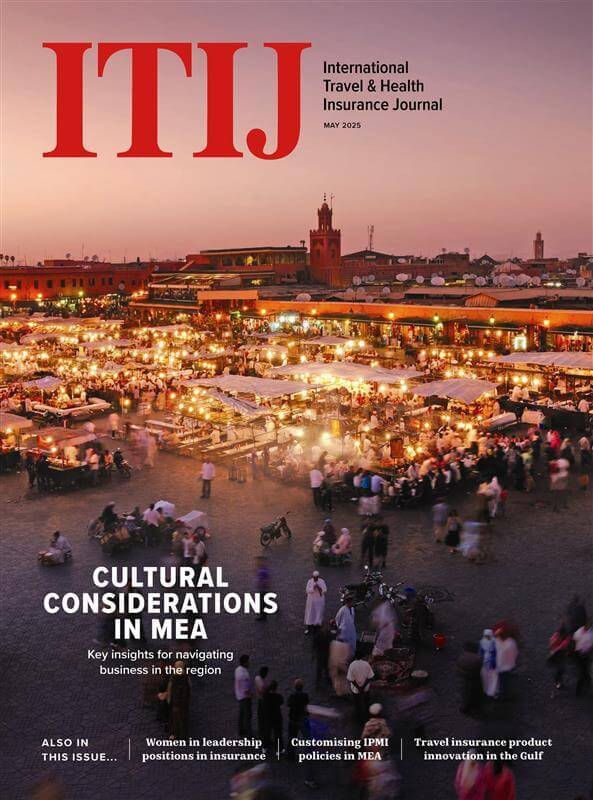
In this issue of ITIJ we consider cultural considerations and understanding in the Middle East and Africa; look at IPMI in the MEA region and the customisation of policies; and gain insights from woman in leadership positions who share the obstacles and opportunities they have encountered.
Chloe Fox
Chloe Fox is an Editorial Assistant for Voyageur Group, joining in 2024. She writes for ITIJ and AirMed&Rescue, covering a range of topics including international travel and health insurance, medical assistance provision, and air medical transportation. Chloe holds a BA (Hons) in English and an MA in English Literature from the University of Bristol.