
Geopolitical risks and their impact on travel

Oliver Cuenca talks to experts from across the risk management sector about the geopolitical challenges facing travellers this year – and how to manage them
In recent years, the challenges faced by international travellers have only grown, as conflict is driven by rising geopolitical turbulence that makes it hard to predict what may be around the corner.
The looming threat of war
For Jonathon Keymer, Director, Intelligence, Crisis24, the biggest challenge currently is “growing strategic polarisation”, made more apparent by the ongoing conflicts in the Middle East and Ukraine.
In particular, he highlighted the escalation of the Israel-Hamas war, which has drawn in groups from the surrounding areas, such as Hezbollah in Lebanon, the Houthis in Yemen, and a range of Iran-backed militias in Iraq.
“We are witnessing the most significant shift in the international security landscape since the end of the Cold War,” said Keymer. “Both conflicts appear to reflect a new geopolitical fault line – with Russia, Iran, Iranian proxies, and North Korea on one side, and the West and its allies on the other.”
In a polycrisis, the line between global and local issues is increasingly blurred
Beyond this, he added, other “powerful and influential actors”, such as China and India, are attempting to take a neutral stance – something which he noted is “further complicating the global balance”.
“Both conflicts are having far-reaching global consequences, from food security concerns stemming from disruptions in agricultural exports from Ukraine and Russia, to threats to maritime shipping in the Red Sea that are jeopardising international supply chains,” he said.
Sally Llewellyn, Global Security Director, Information and Analysis, at International SOS, agreed, saying her company was “closely monitoring conflicts in the Middle East and Ukraine”.
“Both have global significance and repercussions as geopolitical shifts and changes of allegiance between major and middle powers directly impact their trajectory,” she explained, adding that, beyond this: “We also closely analyse impacts of lesser-known conflicts in Sudan, Myanmar and other parts of the world. Each will play out against a change in administration in the White House, which is likely to have far-reaching impacts in 2025.”
Abstract threats and “polycrisis”
Kate Fitzpatrick, Regional Security Director EMEA, World Travel Protection, added that on top of conventional warfare, other geopolitical challenges currently being faced include “the threat of ransomware and cyberattacks … unpredictable inflation spikes, and the rise of protectionist trade policies”.
Looking ahead: “Geopolitical trade wars, such as potential tariffs by [President] Donald Trump on China, could escalate in 2025, sparking retaliatory measures and widespread economic harm,” she said. “The possible ripple effects – reduced spending power, weakened currencies, and strained trade relationships – may limit leisure and corporate travel and at the local level could drive poverty, mental health challenges, and, in some cases, increased crime or radicalisation.”
The Israel-Hamas conflict has caused polarisation not just in the Middle East, but also in cities across North America, Europe, and beyond
Zev Faintuch, Head of Research and Intelligence at Global Guardian, argued that “all” the current geopolitical issues currently being faced ultimately stem from the “ending of the US-led international order or unipolar moment” that occurred immediately after the end of the Cold War.
Faintuch argued that the state of the world could in many ways be summed up in a word: “polycrisis”. She defined this as “the culmination of a fast-moving local trigger event, intersecting with one or more slow-moving global stressors, such as climate change, great power competition, transnational crime, or inflation”.
In a polycrisis, “the line between global and local issues is increasingly blurred”, with the effects of conflicts no longer being localised to a certain country or region, and often leading to higher risks for multinational organisations than their leaders realise.
Beyond this, Faintuch noted that many governments around the world have slowly been working to reduce their reliance on trade with China, particularly since the Covid-19 pandemic. This, she suggested, could ultimately lead to a world “where doing business with America or China becomes mutually exclusive”. This may accentuate political crises between the two nations, particularly surrounding the sovereignty of Taiwan.
Additionally, Faintuch warned that due to the heightened political tensions between nations, there is a possibility that rising nuclear brinkmanship may lead to a potential “inflection point” due to the “use of this type of destructive device”.
Keymer agreed, noting that while the regions directly involved in these wars face by far the worst impact from them, wider consequences of them “are global in scope”, particularly as they have become proxies for specific nations and political movements.
For example: “The Israel-Hamas conflict … has caused polarisation not just in the Middle East, but also in cities across North America, Europe, and beyond.
“We’ve witnessed large, sometimes violent protests, highlighting the extent to which these issues are dividing societies,” he continued. “A recent example occurred in Amsterdam, where violence erupted against Israeli football fans – a clear reflection of how the geopolitical fault line extends far beyond the immediate combat zones.”
Such problems are most likely to manifest in countries with existing internal divisions. This can be accentuated by “state-driven misinformation and disinformation campaigns [that] seek to exploit and deepen social fractures”, Keymer said, and that ultimately “aim to weaken the resolve and cohesion of governments”.
Keymer compared the political situation to the aftermath of the Iraq War, warning that if these conflicts persist, they could result in increased domestic radicalisation in the West, North Africa, and parts of Asia.
The impact of geopolitical threats
When a crisis occurs, it can have major economic and social ramifications on the country or region affected – both in the short and longer term.
Crises can have “real consequences for travellers”, such as disruption to critical infrastructure, compromised food and water, and the disruption to medical and energy services, said Fitzpatrick.
“Even beyond direct conflict zones, travellers can feel the effects,” she continued. “The pandemic gave us a taste of this – places that were familiar could become unexpectedly risky, with rising crime rates targeting tourists and business travellers. After travel resumed, we had to remind clients to be extra cautious, as those seemingly routine destinations had changed, and so had the vigilance needed to stay safe.”
Lloyd Figgins, CEO of the Travel Risk & Incident Prevention (TRIP) Group, agreed, emphasising that “there is always an economic impact from a geopolitical event”.
“This could be through increased accommodation costs, food and water shortages, communication failures and power outages,” he continued. “All of these elements will make the role of assistance providers more challenging and therefore emergency planning is essential. Training travellers and running crisis simulation exercises should all form part of an organisational travel risk management strategy.”
Llewellyn added that when responding to a serious crisis, “border, airspace, or airport closures can occur with little warning”, while “sudden changes can leave travellers exposed to related risks but also basic concerns like lack of access to daily medications or essential supplies”.
Additionally, Keymer explained: “When a country suffers a blow to its reputation as a safe destination, the economic fallout can be significant. Economic hardship often correlates with an increase in criminal activity, as well as a surge in protest movements and disruptive industrial actions, [while] the divide between the wealthy and the impoverished widens.”
The result, for individual travellers, is that “as perceived outsiders, travellers may be seen as relatively wealthy targets” for crime, while their plans may be disrupted by various forms of civil unrest.
Managing geopolitical threats
It is clear that the geopolitical challenge in 2025 is significant – but how can travellers, and those who provide support to them, navigate these risks?
For Figgins, it is critical that when assessing a potential threat, those doing the assessing do not rely on “just one source of information”.
A hurricane in the Caribbean, a coup in Africa, conflict in the Middle East, or an election result can all have an impact that affects the rest of the world
“It’s important to combine a number of intelligence sources, including open source intelligence (OSINT), and human intelligence (HUMINT),” he said. However, he added: “Nothing is totally infallible, so it’s also important to apply time and resources to emergency response planning.”
Figgins emphasised the fluidity of geopolitics, noting that “anywhere, at any time, can be impacted” by a crisis.
“A hurricane in the Caribbean, a coup in Africa, conflict in the Middle East, or an election result can all have an impact that affects the rest of the world,” he said. “To focus on one or two regions is an unwise strategy and organisations need to have the ability to be horizon scanning on a global level.”
He highlighted the 2023 coup in Niger, which “very few people predicted … and as a result, many organisations and governments were caught off-guard. Monitoring events and reacting to them are two completely different disciplines – and organisations need to be proficient in both.”
Fitzpatrick agreed, emphasising the importance of diligent research and preparation prior to embarking on travel. “Assessing the security and political landscape of destinations and equipping travellers with knowledge about potential dangers are essential steps in minimising risks to ensure that business-critical travel can continue seamlessly,” she said.
She explained that World Travel Protection assessed the threat posed by certain destinations using its “foreseeability of risk model”, which focuses on three different categories: the traveller, the destination, and the activity.
“We use official government travel advisories, well-respected global news platforms and social media, in addition to our well-trusted contacts on the ground to establish risk mitigation measures,” she said. Additionally: “We closely examine a country or region’s safety and security conditions, considering factors like political stability, crime rates, terrorism threats, health risks, natural disasters, as well as local laws, customs and cultural norms, to avoid any misunderstandings or conflicts.”
Llewellyn explained that from International SOS’s perspective, the approach to planning for potential travel risks should remain consistent regardless of how a risk unfolds, whether that is a human-made crisis, or a naturally occurring one such as a pandemic.
Beyond monitoring for potential risks, responding to geopolitical crises involves “planning for realistic scenarios [in advance], including potential new conflicts, terrorist attacks, coups, sharp increases in unrest, and natural disasters,” she explained. “The goal is effective preparation for any crisis to enable sound, risk-based decisions should organisations need to react.”
However, Keymer added that when assessing threats, the traveller had to be at the centre of the analysis – particularly noting any attributes such as “experience, familiarity, gender, ethnicity, or the specific business sector in which someone operates” that may affect their level of risk.

Conclusion
While the exact outcome and location of a geopolitical flashpoint may be hard to predict, many crises follow existing long-term trends. The likely impact on social and economic stability is also fairly predictable, and travel risk management firms can use this framework to manage threats and help ensure the safety of their clients.
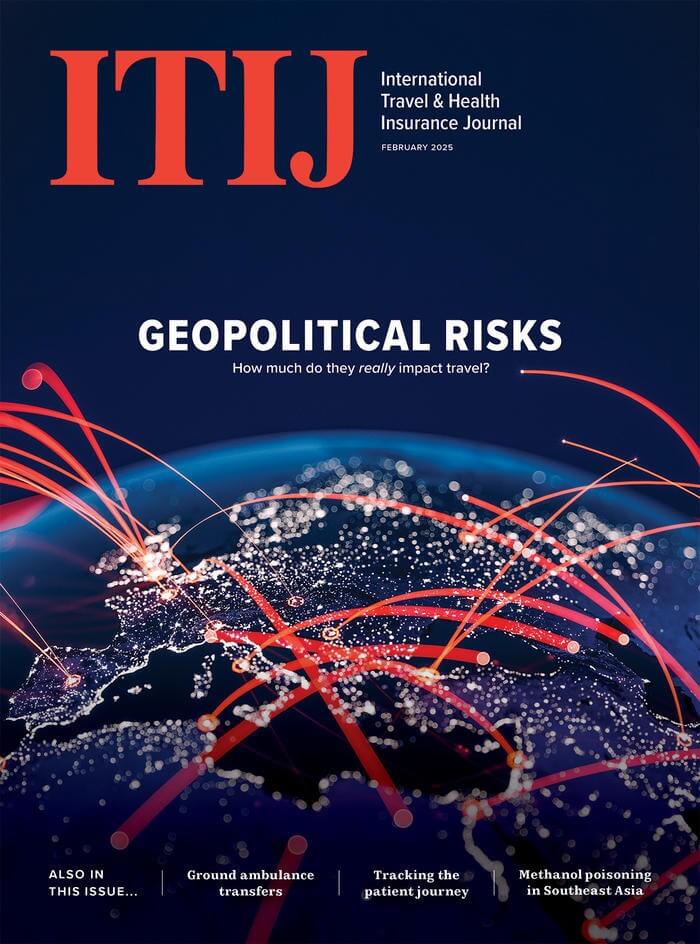
February 2025
Issue
In the February issue of ITIJ we examine current geopolitical risks and their impact on travel; look at ground ambulance provision and how it is meeting customer needs; and explore the use of technology in the patient journey – looking at the efficiency of services.