Transport of heavyweight patients in air ambulances

FAI Air Ambulance recently transported a 61-year-old, ventilated intensive care patient with a weight of 189kg and a height of 183cm (shoulder-toshoulder: 67cm/hip-to-hip: 71cm) from Thailand to Norway for ongoing intensive medical care.
Fundamental issues in transporting heavyweight patients
• Limitation of transport stretchers. The lying surface and load capacity of common patient stretchers are typically designed for the transport of an average, normal-weight patient and not for heavyweight individuals
• Loading and unloading of patients. The physical demands are signifi cant. Depending on the aircraft model used, standard procedures may reach their limits due to factors such as door size and loading heights. Conventional carrying and loading systems may not always be approved or suitable for the weight and size of these patients
• Medical care and nursing. Air ambulances are limited in available space and resources, making effective care more challenging. Heavyweight patients often require more intensive medical care and, especially, nursing. Depending the flight, it may be necessary to reposition the patient more frequently (decubitus prophylaxis). Various body regions may be inaccessible due to soft tissue conditions; vein conditions are poor, and intubation is only feasible under challenging conditions
• Safety aspects. The transport poses safety risks for both the patient and medical personnel. Inadequate safety measures during loading and unloading, takeoff, landing, and turbulence during the flight can lead to injuries.
Approaches to solutions
• Mission preparation. Careful planning and communication are crucial before transporting a heavyweight patient to ensure the safety of all parties involved, the patient's comfort, and transport effi ciency:
-Medical assessment and evaluation of fl ight capability -Accurate measurement of body dimensions -Selection of a suitable aircraft model
-Availability of specialized equipment
-Deployment of qualifi ed and regularly trained personnel
-Examination of necessary additional safety measures
-Emergency plan for transport considering possible complications
-Close collaboration and communication with all stakeholders
• Use of heavyweight stretchers. The use of heavyweight stretchers is essential. Wider lying surfaces and increased load-bearing capacity provide more comfort. Special strap systems minimise safety risks. However, relevant international aviation regulations and safety standards must be strictly followed:
-Unrestricted access to emergency exits and emergency equipment
-Aisles must not be blocked
-Adaptation and approval of floor plans
-Clarification of whether a Supplemental Type Certificate (STC) is required for the used heavyweight stretcher or if it is considered standalone equipment Generally, standardised med walls cannot be used in parallel with a heavyweight stretcher for securing medical devices and equipment. This can be compensated for by installing med containers or a second supply unit (Med Base).
• Loading and unloading of patients. The loading and unloading of a patient, as well as the selection of assistive devices, vary depending on the patient's mobility, individual circumstances, and the type of air ambulance.
Safety considerations for both patients and staff should always be the top priority. In addition to patient education, attention must be paid to the presence and use of strap systems. Possible assistive devices include:
-Loading ramps
-Lift systems
-Heavyweight blanket / Heavyweight vacuum mattress
-Transfer chair
-Highlifter
However, it is usually essential to use ground support (airport personnel, airport fi re department, ground service providers, etc.) for the smooth transfer of the patient. A detailed briefi ng in advance is necessary to ensure a safe and efficient process.
Summary
Transporting heavyweight patients in air ambulances requires careful consideration of technical, logistical, medical, and safety-related aspects. To ensure safe and effective transport, it is necessary for providers to implement internal standards. These should include equipment selection, staff training, mission preparation, communication, and regular reviews.
Nico Raab, Head of Medical Department | FAI Air Ambulance
Nico brings not only an impressive 20 years of experience as a Flight Paramedic but also a background as a merchant and auditor, and has extensive training in quality management. His relentless pursuit of the highest quality and continuous improvement defi nes his professional dedication to air ambulance.
FAI Air Ambulance
FAI's Air Ambulance Jets operate 24/7, boasting cutting-edge medical technology and expert staff for swift evacuations. Our service offers seamless bedside-to-bedside support at no additional cost. Elevate your medical transport expectations with FAI, delivering excellence in line with the highest global standards.
February 2024
Issue
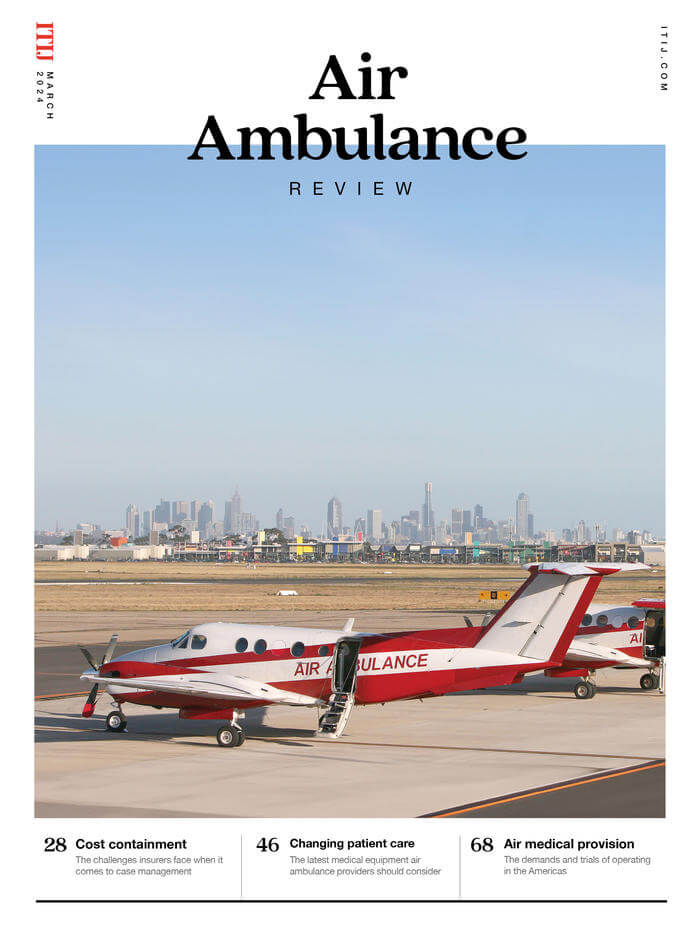
In the first Air Ambulance Review of 2024 we showcase the new equipment air ambulance providers should be considering; examine cost containment in air medical transfers; give an accreditation update for the past year; and explore the challenges of operating in Latin America.
Editorial Team
The Editorial Team updates the ITIJ website daily, and works on features for the print edition. With expert industry knowledge and years of experience in writing about complex travel insurance issues, the Editorial Team is ready to investigate and report on the topics that matter most to ITIJ's readers.