
Keeping costs low and quality high

With costs of aircraft, fuel, staffing, and equipment all rising, how are providers balancing increasing costs with maintaining the highest quality?
Inflation is affecting industries across the globe, and the air ambulance sector is no exception. The cost of delivering safe, high-quality patient transport continues to rise as operators contend with escalating fuel prices, increasing aircraft acquisition and maintenance costs, staffing shortages, and growing regulatory requirements. At the same time, expectations around clinical excellence, operational reliability, and patient experience remain as high as ever.
For providers, the challenge lies in finding sustainable ways
to improve efficiency without compromising the quality of care. We spoke to industry leaders about the financial pressures facing the sector, the strategies they are adopting to remain competitive, and whether greater transparency and standardisation could help the sector in the future.
The biggest financial pressures
For many providers, aviation-related expenses continue to present the greatest financial pressures.
Vinod Nair, Chief Executive Officer at Bluedot Air Ambulance, explained that rising aviation fuel prices, aircraft maintenance, spare parts, crew costs, insurance, regulatory compliance, and the need to maintain highly specialised medical equipment and clinical teams were all contributing to increased operating costs.
He said: “Another significant challenge is the increasing delay in receivables from insurers, assistance companies, and payers. Extended payment cycles impact cash flow, making it more difficult for providers to sustain day-to-day operations, invest in technology, and maintain standby readiness. Since air ambulance operations are highly capital-intensive, timely reimbursement remains critical to ensuring operational continuity and service availability.”
Nicola Høgh Spagnolo, Operations Control Centre (OCC) Manager at SmuuthCare, also named aircraft maintenance as one of the “clearest pressure points”, explaining: “With a small fleet, there’s no room to spread the cost of major inspections or component replacements across a larger number of aircraft, so each one lands as a significant, concentrated expense rather than something absorbed gradually across the operation.”

Extended payment cycles impact cash flow, making it more difficult for providers to sustain day-to-day operations, invest in technology, and maintain standby readiness
Volker Lemke, Managing Director of FAI Medical Services, said: “Essentially, all cost areas have risen sharply in recent years. These include increased staff costs due to ever-increasing training requirements, airway and handling charges – which have risen by around 15% for us – and maintenance costs relating to staff deployment and spare parts, which have risen by around 20% over the last 12 months. And last but not least, of course, the price of aviation fuel, which has risen by at least 30% or even by over 130%, depending on the region.”
Protecting quality while controlling costs
With cost pressures mounting across every aspect of their operations, providers are having to find new ways to improve efficiency without compromising the quality of care, patient safety or clinical standards. “Customers expect the same high level of quality and service regardless, so the challenge isn’t just rising costs on their own; it’s absorbing them without compromising on standards or passing on price increases,” said Høgh Spagnolo.
Instead, the focus is on streamlining operations, strengthening strategic planning, and ensuring pricing accurately reflects the true cost of delivering specialist medical transport.
Høgh Spagnolo explained: “We don’t see cost control and clinical quality as competing priorities; the two must be managed together. Quality and service are areas we don’t compromise on, so our approach to managing cost is focused elsewhere: keeping the organisation lean, decision-making fast, and workflows streamlined, so we’re not carrying unnecessary overhead.”
Additionally, Høgh Spagnolo said that SmuuthCare’s medical personnel work through a dedicated aeromedical medical partner with strong specialist expertise, which allows the organisation to maintain a high clinical standard without having to build and carry that capability entirely in-house.
Nair emphasised that the “responsible approach is not to reduce clinical quality or safety standards, but to improve planning, utilisation, and operational discipline.
“Providers are focusing on better aircraft utilisation, stronger case triage, more efficient routing, preferred vendor agreements, fuel planning, and tighter coordination between medical, aviation, and commercial teams,” he explained. “Patient safety cannot be treated as a cost-saving area. The balance must come from removing inefficiencies rather than compromising the quality of care.”

Nair discussed the benefits of an integrated service model, explaining that at Bluedot, integrating multiple services – including air ambulance, commercial flight stretcher and medical assistance – under one organisation allows the company to manage the patient’s entire journey through a single platform. He said this reduces unnecessary cost layers created when multiple vendors are involved in different stages of care. Beyond cost efficiency, he said additional benefits include improved communication, stronger operational coordination, greater continuity of care, and the potential for improved patient outcomes.
Mustapha Hmoud, Sales and Development Manager at Air Ocean Maroc Air Ambulance (AOM Air Ambulance), highlighted the importance of having the right aircraft for each mission and maintaining a diverse fleet. He said the company’s fleet includes three Learjet 45 aircraft for medium-range medical evacuations as well as larger aircraft for long-haul missions. “This diversified fleet allows us to deploy the most appropriate aircraft for each mission, improving efficiency while ensuring patients receive the highest level of care,” he explained.
Lemke noted: “To maintain our high standards and quality requirements, we must, of course, factor the increased
costs into our price calculations and pass them on to our clients. This necessitates rigorous cost control to ensure that precise details are incorporated into the calculation and that we do not end up appearing too expensive to the payer as a result of relying on ‘estimates’.”
Rather than relying on estimates, Lemke explained that FAI continually monitors its operating costs, including weekly assessments of global fuel prices, allowing fuel surcharges to be adjusted in line with changing market conditions.
Alongside accurate pricing and continuously updated pricing models, he highlighted efficient logistics as another key factor in managing costs. “The logistics aspect remains the most effective means of ultimately continuing to offer attractive prices through optimised flight combinations, whilst at the same time covering costs and operating successfully,” he said.
Technology helping drive efficiency
Technology is becoming an increasingly important tool in helping providers improve efficiency while maintaining service quality.
Nair identified digital transformation and process automation as two of the most effective long-term strategies for improving efficiency. He said organisations should continually review operational workflows, identify bottlenecks, and redesign processes to eliminate delays and streamline operations. “Technology plays a critical role in integrating multiple stakeholders, automating routine tasks, reducing manual intervention, and providing real-time visibility across operations.”
Nair explained that at Bluedot, they have introduced an automated digital backend across several operational workflows, enabling more seamless process management, reducing manual errors, improving communication, and shortening turnaround times. “Automation not only enhances operational efficiency but also allows clinical and operational teams to focus on delivering high-quality patient care rather than administrative tasks,” he said. “As demand continues to grow, automation will be a key differentiator for providers seeking to scale while maintaining quality and reliability.”
Clear honest communication and a transparent approach remain the fundamental principles of building trust and ultimately winning business
Keep on reading

Ready before every second counts
Sponsored by REVA

When every hour counts: aeromedical evacuation for severe burns
Sponsored by European Air Ambulance
Hmoud said the digitalisation of operational processes had been one of the most “valuable innovations”. Reflecting on its implementation at AOM Air Ambulance, he explained: “We have developed a paperless patient handover system that enables secure sharing of medical information between the referring hospital, our aeromedical team, and the receiving medical facility. This reduces administrative delays, improves communication, and supports better clinical decision-making throughout the patient journey.”
He added: “Real-time operational coordination, electronic medical documentation, and enhanced communication between dispatch, medical teams, and assistance companies have also significantly improved efficiency. These innovations not only reduce response times but also minimise errors while allowing clinicians to focus on patient care.”
Høgh Spagnolo concluded that streamlined procedures could reduce inefficiencies across the whole mission workflow, from initial quotation through to post-flight reporting. Continued improvements to the company’s electronic reporting and the digital transport journal have also helped speed up documentation, improve information sharing, and reduce the administrative burden on crew and operations staff. “Together, these improvements let us handle a growing mission volume without a proportional increase in overhead.”
Building trust through transparency
Managing costs effectively is only one part of the equation. Transparency also has an important role to play in helping providers, clients, insurers, and assistance companies better understand the factors that influence operational costs, pricing, and service delivery.
Hmoud emphasised that transparency starts with recognising that every air ambulance mission is “unique”. “Costs vary depending on aircraft type, medical complexity, airport infrastructure, permits, flight distance, and local logistics.
Better education for clients and stakeholders regarding these variables would improve understanding of pricing,” he said.
Nair highlighted the importance of clear communication and understanding between providers and stakeholders. He explained: “Providers should ensure that clients understand what is included in an air ambulance quotation, the external factors that influence pricing, and how the patient’s medical condition can affect operational requirements and overall costs.
Equally important is setting realistic expectations regarding service delivery, timelines, and clinical processes. Clear, honest communication and a transparent approach remain the fundamental principles of building trust and ultimately winning business.”
Building on this, Høgh Spagnolo stated: “Customers, particularly insurers and assistance companies, are very price-driven, but they don’t always have a clear way to compare what’s actually included in a quoted price versus what can be added on top, such as airport opening or extension fees, special medical equipment, or ground ambulances. The level of care and medical personnel included in the quote also has a direct impact on price, as does the scope of the mission itself, whether it’s a hospital-to-hospital transfer or a tarmac-to-tarmac transfer, and that difference isn’t always clear to a buyer comparing quotes side by side.”
Høgh Spagnolo said that a more consistent approach to presenting pricing would help buyers better understand what is included in a base price and which factors can influence the final cost, making it easier to compare providers fairly rather than relying on headline price alone.
Hmoud added that the industry could also benefit from greater sharing of operational performance indicators, patient safety metrics, and quality standards through internationally recognised accreditation programmes. “Transparent reporting builds confidence among insurers, assistance companies, and patients while encouraging continuous improvement across the sector,” he said.
Lemke suggested that an annual questionnaire distributed to all operators could provide valuable insight into different business models, regional characteristics, and key operational metrics. He said publishing the findings could gradually improve transparency and understanding across the sector.

Would greater standardisation benefit the sector?
Measuring performance consistently across the air ambulance sector remains complex, with providers operating across different regions, regulatory environments, and service models.
Nair stated: “Greater standardisation would enable payers, assistance companies, healthcare providers, and patients to evaluate providers based on quality, safety, operational performance, and value – not solely on price. Common benchmarks for response times, clinical governance, operational readiness, crew competency, patient outcomes, and service quality would improve consistency across the industry.”
He recognised that accreditation bodies already play an important role in promoting internationally recognised quality standards, but said the industry would further benefit from more standardised operational and performance metrics that improve transparency and comparability.
Hmoud similarly noted that while pricing will always vary depending on mission complexity and geography, common performance indicators – such as response times, patient safety outcomes, clinical governance, accreditation status, and service reliability – could help clients make more informed decisions based on value rather than cost alone.
He also acknowledged that accreditation programmes such as EURAMI “already provide an excellent framework for measuring quality and clinical excellence”, but concluded that “expanding the adoption of recognised international standards across the industry would further strengthen transparency, improve consistency, and ultimately enhance patient care worldwide”.
The industry can further benefit from standardised operational and performance metrics that provide greater transparency and comparability
Lemke agreed that standardised collection of key performance indicators would be beneficial but raised questions around industry-wide participation and transparency. “Standardised collection of key performance indicators would be important, but the question remains as to whether everyone will participate and provide ‘honest’ figures,” he said, highlighting that the success of any benchmarking approach depended on consistent and reliable data sharing across the sector.
Looking ahead
While operating costs show little sign of easing, one message is clear: reducing clinical quality or compromising patient safety is not an option. Instead, organisations are adapting by enhancing operational efficiency, embracing digital technologies, refining pricing strategies, and strengthening collaboration across medical and aviation teams.
Clear communication across the industry is also key, particularly between clients, providers, and other stakeholders, to ensure a better understanding of what is included in a transport and which factors can affect the final cost. Greater standardisation could further strengthen transparency across the sector and support more consistent approaches to measuring cost, quality, and operational performance.
Ultimately, innovation, operational excellence, and an unwavering commitment to clinical quality will be essential as the sector continues to navigate rising costs. Providers are demonstrating that greater efficiency can be achieved without compromising what matters most: delivering safe, reliable, and high-quality patient care.
September 2026
Issue
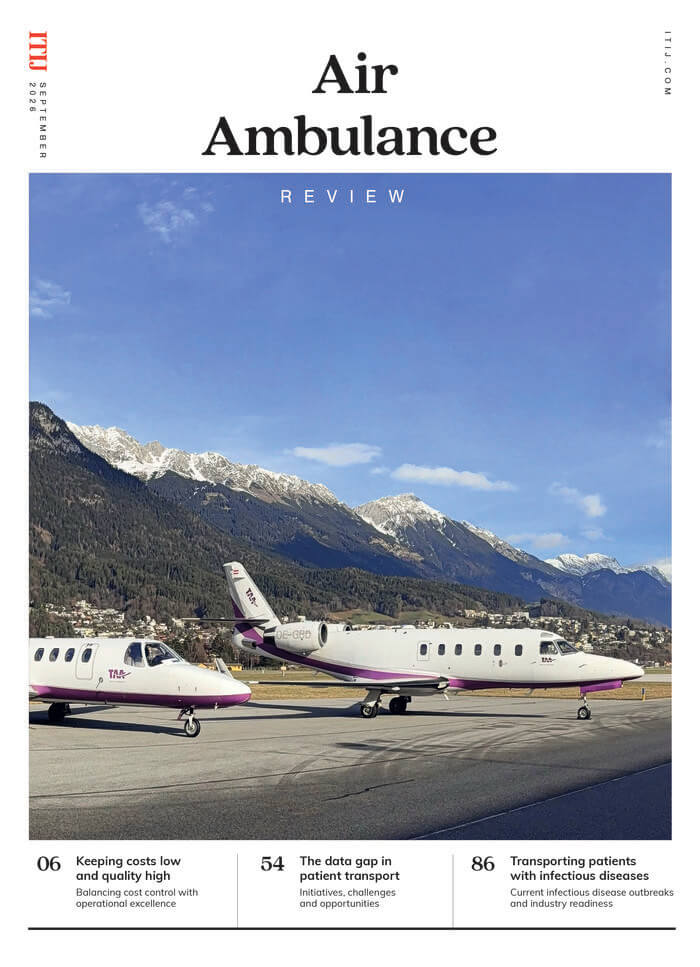
This issue we focus on the problems that rising costs are having on the industry. Air ambulance providers are facing costs across fuel, aircraft maintenance, staffing, insurance, regulatory compliance, and specialist medical equipment. As if that wasn’t enough, delayed payments from insurers are adding further financial pressure. Despite these challenges, providers agree that patient safety and clinical quality must not be compromised.
Alysia Cameron-Davies
Alysia is a copy writer for Voyageur Publishing.