Ready before every second counts

REVA’s Douglas Weisz on readiness and risk management
In air ambulance operations, readiness is tested in moments when every second counts. When a call comes in, there is no margin for hesitation. Aircraft, crews, and medical teams must move quickly and with confidence, often across borders, regulatory environments, and complex clinical situations, with a patient’s outcome depending on how well those decisions are made.
True readiness is the result of disciplined preparation, clear decision-making, and systems designed to perform reliably under pressure.
Clarity before commitment
At REVA, readiness begins with a structured pre-mission assessment before any commitment is made. Each potential mission is evaluated using a consistent framework that considers NOTAMs, weather, permitting requirements, aircraft availability, flight crew availability, and medical crew availability.
In parallel, REVA’s 24-hour Medical Desk obtains a pre-flight medical report to confirm that the patient is fit to fly and to ensure the mission is assigned to the most appropriate clinical team. This clinical review helps align aircraft capability, crew composition, and patient needs before execution begins.
The goal is accurate availability, not optimistic promises. Establishing clarity at the outset allows teams to move decisively once a mission is accepted.
Predictable staffing – faster response
Operational readiness depends on human readiness. To minimise fatigue and uncertainty, REVA does not rely on a rolling rest model. Crews are scheduled in advance and know exactly when their duty day begins and ends.
This predictability allows fatigue to be managed proactively and provides a clear understanding of who is available, when they can start, and when their duty period ends. Properly rested, experienced crews move faster, make better decisions, and respond with confidence when conditions change.
Risk assessment with defined escalation
Every mission includes formal flight and medical risk assessments performed by the crew prior to departure. These assessments account for factors such as time of day, previous duty rest, pilot experience, and patient-specific clinical considerations.
If risk thresholds are exceeded, escalation is mandatory. Cases are reviewed at the operational leadership level, and risks are mitigated through reassignment, delay, or adjustment when necessary. This ensures urgency is supported by structure and that speed does not come at the expense of safety.
Alignment before execution
Beyond individual risk assessments, each mission includes a structured pre-flight brief involving dispatch, operations control, medical coordination, the pilot in command, and the medical crew. During this discussion, the proposed plan is reviewed, and potential challenges are surfaced early. Clinical concerns, weather implications, routing considerations, or possible fuel stops are addressed before execution. This shared understanding allows the operations centre to prepare contingencies in advance and communicate proactively with clients, rather than reacting mid mission.
Consistency at scale
As operations grow, readiness becomes harder to maintain. When multiple missions are active simultaneously, confirmed, dispatched, in flight, or at bedside, even small gaps in process can quickly create risk.
Structured, repeatable systems provide assurance that critical steps have not been missed. Consistency across regions, teams, and shifts allows readiness to hold even as volume and complexity increase.
Experience that informs judgement
Experience is a core driver of readiness. With 37 years of operations and more than 35,000 patients safely transported worldwide, REVA has developed the insight to anticipate challenges before they occur. This depth of experience strengthens judgement, sharpens pattern recognition, and builds the confidence needed to make rapid, sound decisions when time is limited.
Being ready when every second counts is not a single capability. It is a discipline sustained every day, through preparation, alignment, and clarity long before the activation arrives.
Douglas Weisz, Senior Director of Business Development at REVA, one of the largest fixed-wing air ambulance providers worldwide, is a recognised leader in the air medical transport industry. With 20 years of experience, he drives global strategy and growth, building partnerships with international payers, travel assistance organisations, and healthcare leaders.
As one of the world’s premier fixedwing air ambulance providers, REVA delivers trusted medical transport. Operating from bases in the Americas and Europe, REVA provides 24/7 service, safely returning patients from around the globe with precision, compassion, and a steadfast commitment to safety and clinical excellence.
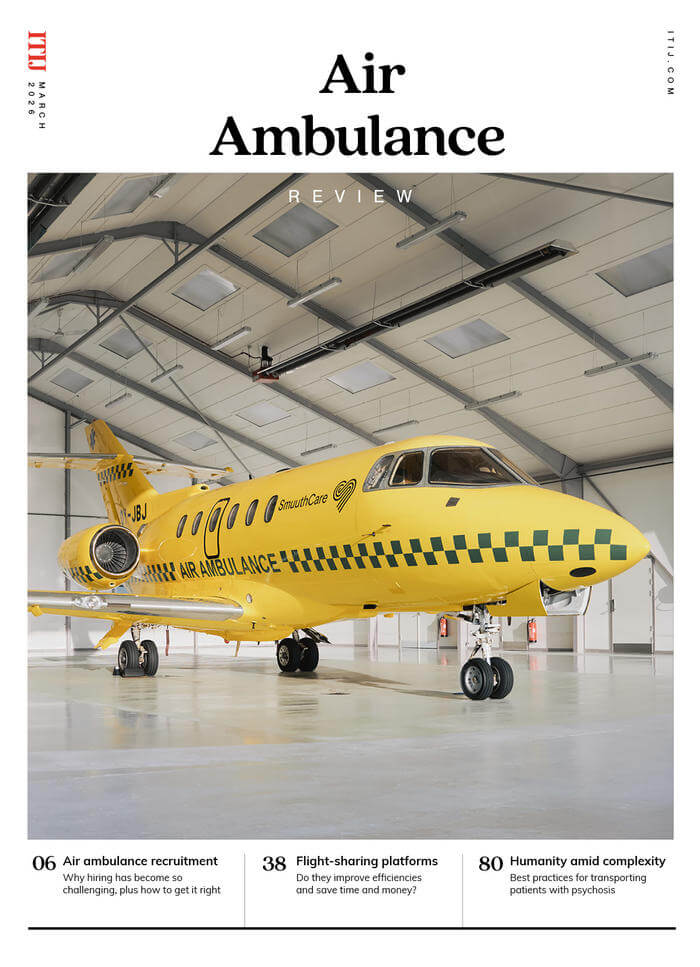
March 2026
Issue
In this issue of Air Ambulance Review we examine the challenges facing air ambulance providers when it comes to recruitment; look at flight-sharing platforms and ask if they can improve efficiencies; and we delve into the latest medications, protocols and best practices for transferring vulnerable patients with psychosis.
Editorial Team
The Editorial Team updates the ITIJ website daily, and works on features for the print edition. With expert industry knowledge and years of experience in writing about complex travel insurance issues, the Editorial Team is ready to investigate and report on the topics that matter most to ITIJ's readers.