
How much blood do we want to pass through the lung?

Alex Veldman, Medical Director of Unicair, recounts the transportation of a child from Pakistan to the UK
As one of the world’s leading fully integrated air ambulance providers, Unicair was tasked to transport a two-and-a-half-year-old girl from Lahore in Pakistan to Bristol in the UK for cardiac surgery. The child suffered from a large ventricular septal defect (VSD) and pulmonary artery hypertension (PAH). She was a refugee in Pakistan and seen by a paediatric cardiologist in an outpatient clinic while in the country. She was treated with Captopril, her oxygen saturation (SaO2) on ground in room air was around 88–90%. She presented with a marked failure to thrive, a body weight of around 7kg and no ability to walk or crawl.
Unicair, with a fleet of 12 dedicated aeromedical jets, dispatched one of its three long-range, multi-patient configured Challenger 604 aircraft with a paediatric cardiologist and a PICU nurse for this transport. The Unicair operations team, highly experienced in coordinating complex missions around the world, dealt with the necessity to circumnavigate Afghan airspace.
The patient and parents arrived from their residence at the airport without a medical transport team. Prior to take-off, the aforementioned diagnosis was confirmed with Point-of-Care (PoC) ultrasound. The scan showed a very large inlet VSD with bi-directional shunting. After take-off, SaO2 dropped to 70% and a repeat scan showed a now predominantly right-to-left shunt. With oxygen at 2l/min, SaO2 rapidly increased to 100%. To prevent pulmonary over-circulation, oxygen was titrated to 0.5 l/min which achieved SaO2 around 90% on cruise level altitude. In-flight echocardiography confirmed continued bi-directional shunting over the VSD.
Further interventions did not become necessary, blood gas analysis remained normal and urine output (as a surrogate for systemic perfusion) was sufficient during transport. Upon arrival in the UK, oxygen supplementation could be ceased and the child was accompanied to the admitting hospital by the Unicair Medical Team.
In children with large VSDs, shunting normally occurs along the pressure gradient from the left ventricle (systemic blood pressure) into the right ventricle (pulmonary artery pressure) – i.e. a left-to-right shunt with clinical signs of heart failure, resulting in pulmonary over-circulation and reduced systemic perfusion.
PAH can mitigate that shunt by reducing the pressure gradient or even reversing it (bidirectional or right-to-left shunting with resulting cyanosis). While hypoxia is a pulmonary vasoconstrictor, oxygen results in a pulmonary vasodilatation. Other pharmacologic interventions to reduce pulmonary vascular resistance include sildenafil (available as oral suspension and as intravenous medication (Revatio) on board of Unicair aircraft) and inhaled nitric oxide in ventilated patients (iNO, available on Unicair aircraft on request).
Too much pulmonary blood flow Clinical:
- high SaO2
- reduced urine output
- metabolic acidosis
Intervention:
- Reduce SVR (ACE Inhib., ß-Blocker)
- Reduce FiO2
Too little pulmonary blood flow Clinical:
- low SaO2
- good urine output
- low arterial pO2
Intervention:
- Reduce PVR (Sildenafil, iNO)
- increase FiO2
- Increase SVR (Noradrenaline)
In conclusion, a good understanding of the physiology and hemodynamics is of critical importance when transporting children with congenital heart disease in an air ambulance. PoC ultrasound/echocardiography and blood gas analysis does enable the team to tailor therapy as needed by the individual patient.
Alex Veldman, Chief Medical Officer,
Unicair Alex Veldman is board certified in Pediatrics, Neonatology and Pediatric Cardiology. He has been actively involved in aeromedical transportation since 1993 and is currently Chief Medical Officer of Unicair, with previous leadership roles at Jetcall as co-founder and Medical Director. Alex has published more than 100 papers in peer reviewed medical journals
Unicair
Unicair is one of the world’s largest, fully integrated air ambulance providers based in Europe. With 12 dedicated jets, Unicair conducts complex missions around the globe via its bases in Cologne and Vienna. Aviation safety and clinical governance are why Unicair is the preferred choice in critical care patient transfers.
February 2024
Issue
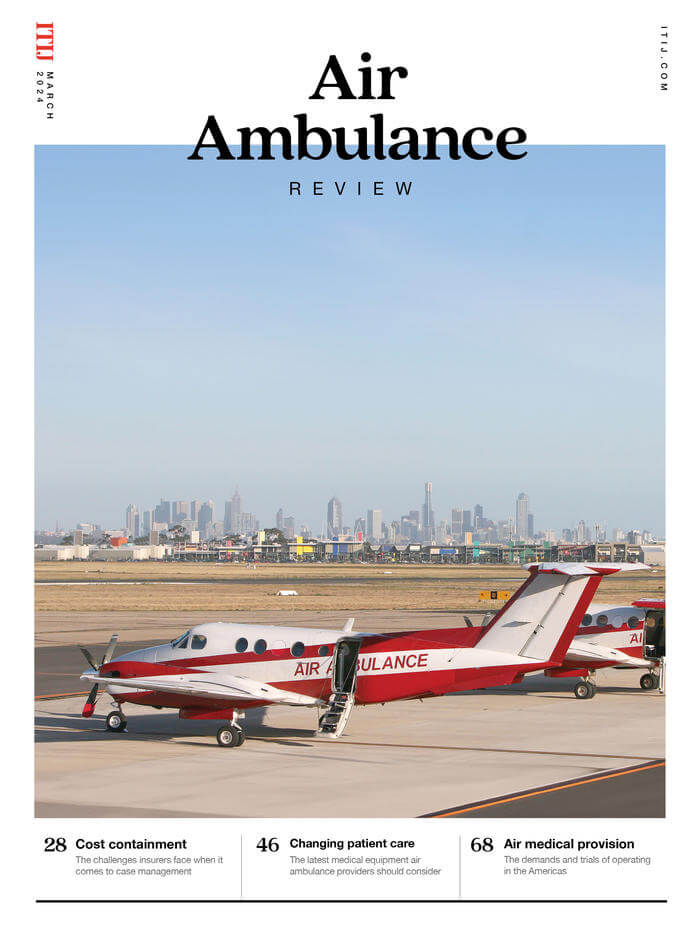
In the first Air Ambulance Review of 2024 we showcase the new equipment air ambulance providers should be considering; examine cost containment in air medical transfers; give an accreditation update for the past year; and explore the challenges of operating in Latin America.
Editorial Team
The Editorial Team updates the ITIJ website daily, and works on features for the print edition. With expert industry knowledge and years of experience in writing about complex travel insurance issues, the Editorial Team is ready to investigate and report on the topics that matter most to ITIJ's readers.
