
Global travel predictions for 2025

Alfie Jake Thomson examines global tourism, expatriation, sustainability and political unrest, and considers how the travel industry will progress in the next year
Last year saw the global travel industry face continued unease and uncertainty. Despite sustained and near worldwide recovery from the impacts of Covid-19, the backdrop of conflict and instability seemed far-reaching and inescapable.
Much of Europe felt the impacts of the Ukraine invasion, and tensions continue to escalate throughout the Middle East due to Israel’s war against Hamas. The rise in nations adopting more conservative policies when tackling the issue of migration, and a sizeable shift in attitudes towards tourists in hotspots across Europe, has left many weary travellers forced to carefully review much anticipated travel plans.
There are “broader forces to be watched” in relation to their potential impacts on the economy at a global, regional and organisational level, confirmed Catherine Logan, Regional Senior Vice President, EMEA and APAC, at the Global Business Travel Association (GBTA). Be it inflation or rising interest rates, these remain the key “driving forces that will continue to shape the industry” for the year ahead, she said.
Geopolitical instability continues to dampen travel sentiments and budgets, with Logan raising the crucial importance of utilising “flexibility and risk management” for travellers. Despite these challenges, she was keen to praise the “robust path ahead” for business travel especially. The Global Business Travel Index, issued by the GBTA, projected that business travel spending globally would reach US$1.48 trillion by the end of 2024 – a $0.05 trillion increase from 2019 – and would continue to grow to a record $2.0 trillion by 2028.
UN Tourism, the United Nations agency, has likewise emphasised both the continued resilience of the industry and humans’ insatiable passion for travel as proof that global tourism is nearly back on the path of normality, with arrivals hitting 96% of pre-pandemic levels in the first half of 2024.
Isolated incidents, or signs of a disgruntled Europe?
Anti-tourism demonstrations across Europe last year saw many travellers face disruption in some of the continent’s most famous destinations. Cruise ships and their unaware passengers found their routes delayed from many ports out of fear of protests aimed at passengers. Such protest was often delivered in colourful fashion – in Brittany and Marseille, members of pressure group Stop Croisières (Stop Cruises) adorned masks resembling polar bears and formed floating barricades of dinghies around ports to prevent dockings.
Much of Europe felt the impacts of the Ukraine invasion, and tensions continue to escalate throughout the Middle East due to Israel’s war against Hamas
In Barcelona, where discontent towards tourists was arguably the most visible throughout 2024, unsuspecting tourists settling down for lunch found themselves met with attacks from water pistols, and greeted not with hospitality but with chants from demonstrators. These protests sparked conversation about the abuse of natural, and increasingly finite, resources by many of Barcelona’s visitors and have been linked to the devastating effects of climate change upon the region. The excess consumption of water, particularly by tourists in comparison to locals, is a statistic difficult for the tourism industry to ignore: average Barcelona households were reported to use 99 litres of water per person a day, whereas those staying in hotels use over 163 litres per day – a stark contrast.
Natural disasters like droughts and flooding have fuelled arguments around the use of the term ‘overtourism’ throughout Europe. Last July, hotels in Agrigento in Sicily were reported to be turning away tourists for the first time in decades because historical aqueducts were running dry and water consumption was subject to rationing of almost 45%. Such grave situations impact the entire tourism sector and help to exacerbate pre-existing economic problems, with tourism accounting for 6.2% of gross value added (GVA) in Italy in 2023.
A fine balance
Sustainability experts have been keen to stress how the anti-tourism movement is one that is structural and not personal. Angered residents have been non-violent in their cause and have used demonstrations to raise awareness of issues in areas like housing. A 70% increase in rents over 10 years has been linked to the rise of short-term rental sites like Airbnb, creating a uniquely harmful paradox for locals. Of the 150,000 of Barcelona’s residents who work in tourism and hospitality, few are able to secure affordable housing and often find themselves living outside of the city. Last summer’s demonstrations are therefore – as Eduardo Santander, CEO of the European Travel Commission, told CNN – “isolated” incidents that do not “reflect the complete reality of Spain or Europe”, but instead are the consequences of a tourism industry that is not sustainably managed.
Logan raised to ITIJ how, as the world becomes “ever more globally interconnected”, considerations around the planet and the need for climate action must force government, industry leaders and travellers to adapt and accelerate “greener options” which will “shape how we travel”, not just into the new year but in the wider future ahead.
Natural disasters like droughts and flooding have fuelled arguments around the use of the term ‘overtourism’
Experts said a renewed focus must be placed on balancing economic growth with environmental responsibility, allowing for a preservation of local communities, cultures and the often-fragile environments and ecosystems they all co-exist within. Often a difficult balance to strike, but one Logan called “paramount” in ensuring that sustainably managed travel continues to be a “driving force for good”.
The CEO of the Global Sustainable Tourism Council (GSTC), Randy Durband, told ITIJ how “integrating sustainable practices into every stage of operations” can help create and strengthen businesses that work not only to safeguard the environment but also “foster innovation, build stronger communities, and ensure long-term profitability” in the process of doing so.
Durband went on to emphasise how sustainability must be at the “core of our operation, with sustainable practices at the heart of everything we do”, so that companies can make effective and meaningful long-term decisions concerning the use of the environment, with consequences for those that fail to progress. “Companies that fail to adapt risk falling behind, as consumers, governments, and stakeholders increasingly demand accountability and action,” he said.
Logan was in similar agreement, highlighting how with “clear standards and a process of increased harmonisation” for both business and leisure travel, innovation in sustainable travel will thrive.
The GSTC and GBTA have both devised lists of criteria to measure compliance with global standards for sustainability in travel and tourism.
The GSTC Criteria are utilised for education and awareness-raising, as a source for policymaking for businesses and government agencies, and to allow for measurement and evaluation. They work similarly as a basis for certification. Such criteria, Durband argued, help establish and set out the minimum standards businesses, governments, and destinations should strive for to ensure “social, environmental, cultural, and economic sustainability” across Europe and the world.
To aid global business travel, the GBTA has established the GBTA Sustainable Procurement Standards. Acting as an educational resource for corporate travel buyers worldwide, these are used to ensure “informed procurement decisions” are made regarding employee travel programmes, and to deliver unique organisational objectives with sustainability at their forefront.
Expatriation: emerging destinations and shifting policies
With prevailing economic and political crises across the globe, expatriation remains on the rise and is a popular lifestyle decision for many seeking a higher salary, better quality of life or even rights and freedoms not found in their country of origin. Even amid the rise of legislation restricting migration, it appears statistically that little has ceased the appetite of millions chasing a better life abroad. Latin America has been praised by respondents of the Expat Insider survey, particularly Panama and Mexico, which took the top spots as countries to live and work in for 2024.
A renewed focus must be placed on balancing economic growth with environmental responsibility, allowing for a preservation of local communities, cultures and often-fragile environments and ecosystems
With cost of living issues plaguing much of the UK and the US, the countries praised were cited for their low costs of living, high levels of disposable income, and affordability of property. The United Arab Emirates maintains an international attraction, especially to those in the West, with over 30,000 British workers and investors expected to move there in the coming year, thanks to the availability of high-income jobs and expat-friendly policies. For those places ranked most negatively among expats, such as Turkey, elements like negative political stability, excessive bureaucracy, and poor availability of jobs were highlighted.
The American market has seen similar increases in interest for international travel planned for 2025, and a rise in travellers seeking to head north. Surveys conducted by travel insurer Squaremouth have found that trips to Canada are up by nearly 10%, whereas travel to Mexico is down 19%, perhaps reflecting both a shift in American travellers’ growing safety concerns and helping enshrine Canada’s position as one of the safest destinations in the world for travellers.


Travel trends and putting family first
Many new travel trends have dominated the past year. Regarding leisure travel, many insurers and providers have pointed to the rise of multi-generational vacations, especially within the UK and US travel markets.
Speaking with ITIJ, Jenna Hummer, Public Relations Director of Squaremouth, discussed how travellers were “putting family first” for 2025. Citing a recent survey that polled over 1,000 of its customers, Hummer pointed to the over 47% of respondents who were opting to embark on multi-generational or family-centred trips in 2025, figures surpassing all other types of group trips.
Such data throws light on a segment of leisure travel that has seen a 17% increase in interest since Squaremouth’s last survey conducted in 2024. This increase is attributable to numerous factors: these types of trips appeal to numerous age brackets, offer a diverse range of leisure activities, cater to the mobility concerns of older travellers, and accommodate the varying budget expectations of different families.
With prevailing economic and political crises across the globe, expatriation remains on the rise and is a popular lifestyle decision for many
This is all in stark contrast to the rapidly declining popularity of solo travel, where the survey conducted found an interest at only 12% – a decrease of 72% from the 42% who were interviewed in 2024. However, ‘bucket list’ post-pandemic travel remains at full speed, with 40% confirming a big-ticket trip for 2025. Hummer argued that this proved that despite the “ever-rising cost of travel, spikes in bucket list travel have surprisingly not lost any steam”.
Once a strong feature of the post-pandemic travel world, blended or ‘bleisure’ travel, which combines business and leisure, also seems on the decline. Hummer pointed to the 85% who opted to forgo this combination, with many of those interviewed citing the need to keep their work and vacation time separate – a decrease in interest of 60% from the previous year.
Within business travel, more mindful approaches have been highlighted, reflecting travellers who frequently opt for longer and more multi-purposed trips, allowing for the achievement of several, rather than singular, business objectives. In a 2022 survey conducted by the GBTA, the average business traveller reported taking an average of 4.1 days for a trip, up from the 3.3-day average in 2017. This, Logan said, showed signs of significant waning of the appeal of the “one-day business trip”, as travellers try to combine efforts in improving not only productivity, but also sustainability and their personal wellness.
Conclusion
More so than ever, travellers, organisers and insurers must work to mitigate the risks present globally through heightened processes of research, on-the-ground intelligence, and international cooperation wherever possible.
Logan said, when it comes to the climate crisis going forward, “no one can stand by as a spectator”. A collective effort worldwide must come to fruition, working in partnership and in innovative sustainable practices to ensure further progress.
Durband concluded that travel in the next era of post-pandemic stabilisation appears to remain on a “continued trajectory of strength”.
January 2025
Issue
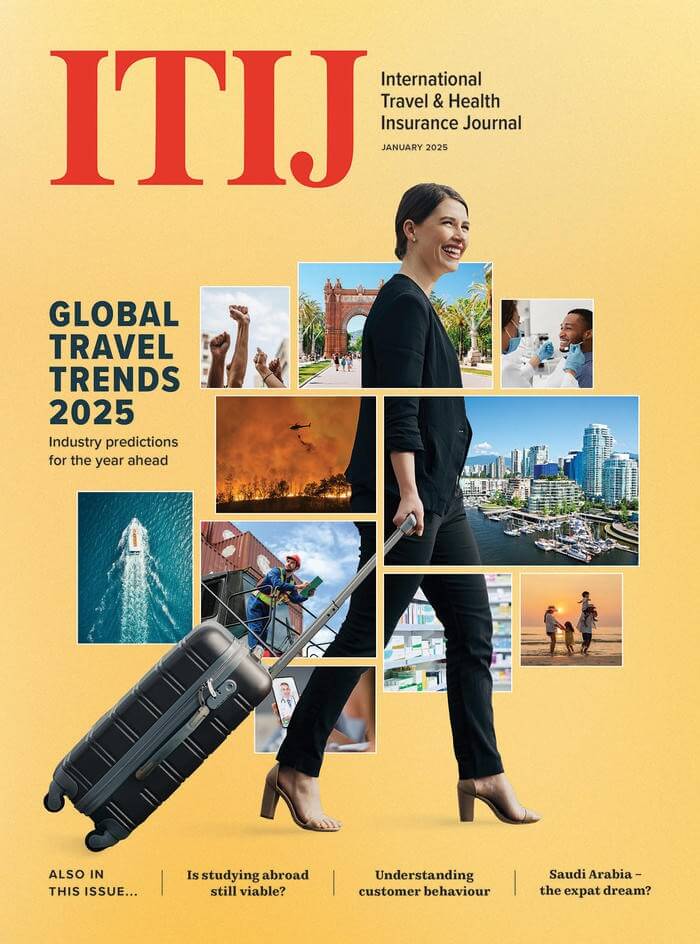
In this issue we look at worldwide travel trends for the year ahead; speak to insurance experts about how they go about understanding their customers; examine the pros and cons of living and working in Saudi Arabia; and look at the shift in the international student community.