
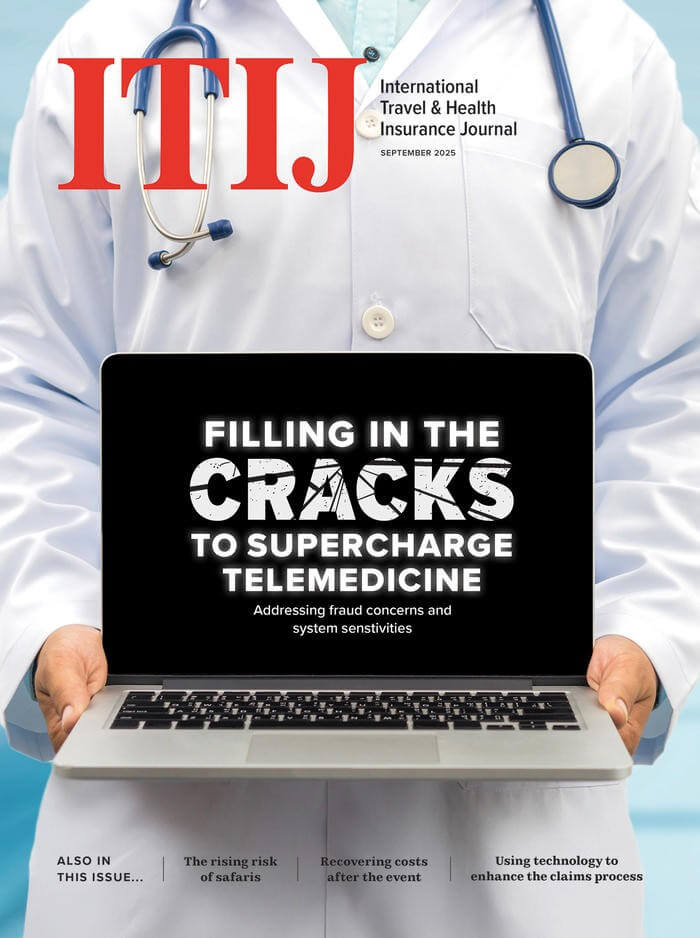
Filling in the cracks to supercharge telemedicine

Telemedicine use soared during the Covid-19 pandemic, but this exposed vulnerabilities. Experts share with Lauren Haigh how fraud concerns and system sensitivities are being addressed
Telemedicine removes financial and physical barriers to healthcare, reducing out-of-pocket costs and enabling patients in remote areas, or those who are unable to travel to appointments, to access care. However, despite the obvious and numerous benefits for patients and healthcare professionals alike, there are vulnerabilities associated with telemedicine, including the risk of data breaches, privacy concerns, third-party risks and fraud concerns. “Since Covid-19, telemedicine fraud has grown more complex, shifting from simple billing scams to sophisticated, global schemes,” said Dr Ilya Rapoport, Medical Director at AP Companies. “The rapid adoption of telehealth exposed vulnerabilities in unprepared systems.”
Indeed, the Covid-19 pandemic caused a rapid shift from in-person care to the use of virtual consultations. Statistics show that online doctor consultations increased by around 57 million between 2019 and 2024. One 2023 study found that in nine Organisation for Economic Co-operation and Development (OECD) countries, teleconsultations represented 21% of all doctor consultations in 2020, up from 11% in 2019. While this shift occurred out of necessity as in-person consultations were unsafe, the practicality and affordability offered by telemedicine meant that virtual doctor consultations became a mainstream element of healthcare delivery. Indeed, a report by McKinsey & Company found that, in 2021, the use of telehealth had stabilised at levels 38 times higher than pre-pandemic times.

Fraudsters now operate across borders, often using international telemarketing networks
Fraud alert
Back in 2022, the US Department of Health and Human Services’ Office of Inspector General (HHS-OIG) issued a special fraud alert for providers entering into arrangements with “purported telemedicine companies”. “This fraud alert coincided with the Department of Justice (DOJ) announcing a US$1.2 billion enforcement action,” Dr Ferial Ladak, Director of Global Medical Affairs at Global Excel Management, told ITIJ. “The Centers for Medicare & Medicaid Services (CMS) also took action against 52 providers involved in fraudulent referrals. In February 2024, the DOJ’s Health Care Fraud Unit issued an annual report for the last fiscal year, identifying telemedicine fraud as a priority. Medicare detected fraud through HHS-OIG investigations, suspicious billing patterns, and reports. Key red flags included billing for unnecessary services for both telehealth and facility fees.”
Dr Ladak said that fraud examples included telemedicine companies paying kickbacks to providers for unnecessary prescriptions, and doctors billing Medicare for fake consultations or targeting patients for items like braces without proper contact. “Although telemedicine offers increased healthcare access, its flexibility has also led to weaker oversight in some areas, allowing fraud to proliferate,” she underlined.
Dr Rapoport shared several key trends that AP Companies had observed related to the evolution of telemedicine fraud since the pandemic: “First, global expansion: fraudsters now operate across borders, often using international telemarketing networks; second, exploiting relaxed rules: temporary pandemic policies (e.g. reduced medical reviews) allowed fake or unnecessary billing; and third, advanced technology: AI and digital tools help criminals hide fraud, making detection harder.”
A first step, not a solution
In addition to these risks, there are limitations to telemedicine that the practice must overcome in order to operate effectively and sustainably. “Telemedicine is a great tool to give clients a first medical opinion,” commented Federico Tarling, Chief Service Officer at Assist Card. “However, given the limitations that a videoconference has in terms of getting all the required clinical information to reach a diagnosis, it is, for the most part, a first step to improve the steering of the patient rather than a solution to the medical inconvenience. Further improvements in technology that will allow doctors to have reliable vital signs information will improve the quality of care provided by telemedicine.”
Indeed, improving how vital signs are measured and transmitted remotely is a key area for the advancement of telemedicine, and research is underway to this end. For example, in a March 2025 study, researchers explored how advanced machine-learning algorithms could improve the prediction of heart illness from electrocardiogram (ECG) sensor data. Another study, from 2024, investigated how the Internet of Things (IoT) could be integrated into wearable healthcare devices to enable remote patient monitoring, personalised care and efficient data transmission. “In the future, I’m sure telemedicine platforms will be able to interact with wearables (smartwatches, for example, that more and more people wear today) to have a better idea of vital signs that will, in turn, improve the quality of care provided by teledoctors,” Tarling stated.
Not only do technological advancements hold the potential to improve telemedicine, they also hold the key to combating fraud. Dr Rapoport is concerned that current anti-fraud measures fall short. “At AP Companies we advocate for proactive global policies, as laws often react too slowly, and the use of advanced tools such as artificial intelligence (AI), blockchain and biometric IDs to reduce risks.”
Dr Ladak agreed that while current anti-fraud measures were improving, they may not be enough as telemedicine fraud becomes more sophisticated. “There’s a growing need for real-time fraud detection with AI that can spot fraud as it happens; blockchain technology to provide immutable records for telemedicine consultations, making it harder for fraudulent claims to go unnoticed; and data-sharing between providers and insurers, as increased collaboration can help identify fraud more quickly and prevent its spread,” she highlighted.

Telemedicine patterns
When it comes to patterns of telemedicine use post-pandemic, different insurers have seen different patterns. Tarling said that he had observed growth in the adoption of telemedicine in travel. “Many factors have influenced this,” he told ITIJ. “First of all, telemedicine has grown exponentially for non-travelling patients, so it is only natural that it will also be adopted when travelling. Additionally, travelling with smartphones is as common today as travelling with a suitcase, and because roaming is cheaper than before and Wi-Fi availability is wider, connectivity is no longer an issue. No less important is the fact that the traveller is connected to a doctor in just a few minutes and that is a great incentive to make telemedicine the first choice for our clients in terms of medical assistance.”
ITIJ spoke with Noelle Weinrich, Director of Product at GeoBlue, who has also witnessed growth in this area. “GeoBlue has seen an increase in telemedicine adoption, with some of our segments seeing a twofold increase in usage of this service. We have found that ongoing and contextually relevant promotion (e.g. reminder in explanation of benefits; on phone interactive voice response (IVR) messaging, etc.) of this service has contributed to the high engagement of our members with telemedicine.”
While current anti-fraud measures were improving, they may not be enough as telemedicine fraud becomes more sophisticated
On the other hand, Dr Ladak believes that, after its rapid growth during the pandemic, telemedicine adoption has slowed for several reasons, including patient and provider reluctance, regulatory uncertainty, technological and infrastructure challenges, and reimbursement issues. “Some patients and providers prefer in-person visits due to familiarity or concerns about the effectiveness of remote care, especially for sensitive health issues,” she said. “During the pandemic, many countries and insurers expanded telemedicine coverage. As policies roll back, providers may not be set up for virtual visits, since coverage may no longer be available for their citizens, [which] makes access for the traveller less likely. Furthermore, limited internet access and technology barriers in remote regions remain a significant obstacle. Finally, out-of-network telemedicine providers can be harder to arrange and verify.”
Tarling agreed that removing internet restrictions would help the adoption of telemedicine to further advance: “[For] countries such as China, having less restrictions on internet usage would positively affect customers’ access to telemedicine platforms.”
Among the measures that can help boost the uptake of telemedicine are technological improvements to reduce potential technical issues. Indeed, a 2022 study published in Telematics and Informatics Reports found that technical issues, such as connectivity errors and video and audio lags, represented the most crucial problem faced by the participants. “Highlighting the convenience of telemedicine, especially for travellers who can access consultations, prescriptions and sometimes even medication delivery without leaving their home or hotel room, would help sustain growth,” said Dr Ladak. “Another enhancement is to improve the user experience by offering secure and easy-to-use platforms for patients to interact with providers.”
The gold standard
In-person appointments remain the gold standard for comprehensive diagnosis. A 2021 survey by NPR found that 64% of households using telehealth would have preferred an in-person visit. Looking ahead, Dr Rapoport believes telemedicine will become a core part of hybrid healthcare, complementing in-person visits: “The benefits of this include continuity of care, with AP Companies using telehealth for long-term treatment monitoring, reducing gaps in care, and emergency triage, as our telemedicine services on ships/aircraft determine if evacuations are needed, saving lives and costs.”
Weinrich noted that, within the telehealth space, GeoBlue is seeing more specialty providers who focus on specific conditions or demographics, but there are challenges related to regulatory compliance. “For example, those focused on women’s health, psychiatry services and chronic condition support, such as musculoskeletal (MSK) and diabetes – the regulatory environment globally has not yet caught up with the advancement in access to these specialty care services,” she explained.
“In situations where medical devices are involved with supporting remote treatment that integrates with telehealth, that also involves another layer of regulatory compliance. Nonetheless, these solutions are increasingly becoming an important part of care delivery, both domestically and globally. Additionally, as virtual and remote healthcare treatment is more widely available and adopted, the landscape of healthcare facilities and options may also change. Traditional brick-and-mortar hospitals may become more narrowly focused on emergency and critical care, and there could be a resulting increase in outpatient centres for less complex cases and surgeries.”
During the pandemic, many countries and insurers expanded telemedicine coverage. As policies roll back, providers may not be set up for virtual visits
Dr Ladak has also seen the challenges presented by setbacks in the regulatory world. “Creating regulatory frameworks that balance fraud resistance and accessibility can be challenging on a global scale,” she stated. “However, some potential regulatory changes include collaboration with technology companies – governments should work closely with tech providers to ensure that telemedicine platforms are secure and adhere to anti-fraud standards and cybersecurity best practices, and clear, comprehensive rules. Establishing consistent telemedicine regulations can help ensure transparent practices across borders, reducing opportunities for fraud while maintaining accessibility. By setting clear and standardised regulations, telemedicine can continue to grow while reducing fraudulent activity.”
Indeed, unclear or inconsistent regulations have exacerbated fraud concerns. Dr Rapoport outlined the regulatory changes needed to help make telemedicine more fraud resistant: “Key improvements are clear, unified rules, with simplified guidelines for providers/patients; stronger data security; and cross-border cooperation with international standards to prevent fraudsters from exploiting gaps.”
Differentiating between legitimate and fraudulent telemedicine claims is a complex process for insurers, involving advanced data analytics to detect anomalies in billing patterns, AI algorithms to flag inconsistencies, and communicating only through approved telemedicine platforms that meet strict standards. “AI and machine learning algorithms are deployed to identify suspicious patterns, such as frequent consultations with the same provider, or inconsistent billing codes,” said Dr Ladak. “Patient feedback is also important, as following up with patients can confirm whether a consultation took place and if billed services were provided. Another key technique is provider verification, whereby insurers check whether providers are licensed, credentialed, and operating within legal frameworks to safeguard against fraud.”
Despite these tools, challenges still remain, as Dr Rapoport explained: “AI analysis flags unusual claims (e.g. excessive patients per hour) and, when it comes to data cross-checking, inconsistent global standards complicate verification.”
The future of telemedicine undoubtedly holds continued convenience, accessibility and affordability, but it is crucial to address new and ongoing fraud risks and other system vulnerabilities. “Enhancing fraud detection and prevention strategies is crucial as fraudulent tactics evolve,” underlined Dr Ladak. One key vulnerability concerns regulatory oversight, with a need for uniform standards across countries. With AI and analytics for fraud detection, and multi-stakeholder collaboration to spot red flags and develop unified guidelines and anti-fraud protocols, the practice can flourish safely, minimising the gaps that can be exploited.
September 2025
Issue
This month we examine fraud in telemedicine, which has become an increasingly big issue for the industry. We also look at parametric solutions to enhance the claims process.Experts share their insights into cost recovery across borders, and our News Analysis investigates policies for those going on safari.
Lauren Haigh
Lauren Haigh is a freelance writer for ITIJ.