
Ethics and transparency in the aeromedical sector

Do you ask for 100% payment upfront? Or request a deposit and then the balance on patient delivery? Air ambulance commissioning is resource intensive and terms and conditions can vary. ITIJ tries to open the Pandora’s box of air ambulance payments
For insurers and for private pay patients, understanding what it is you are paying tens of thousands of dollars for when it comes to air ambulance transports is essential. For private patients, the decision to engage an air ambulance provider is often emotionally charged. They are trying to fly a loved one home for treatment, or for palliative care, and they have no scope of judgement or understanding about how much an air ambulance flight might cost.
For an assistance company, the air ambulance commissioning process must follow a series of pre-agreed steps
Indeed, some might argue that there are those in the medical assistance sector whose understanding of the process could be deeper than it is. Multiple factors are taken into account by the air ambulance provider, including:
• The location of the patient and their destination – not just how long the flight will take and therefore the cost of fuel, but landing fees and permits can vary enormously in their cost. Patient location is also a factor if it is determined that the aircraft and crew need to be pre-positioned in order to optimise the flight the following day
• Aircraft type – jet or turboprop
• Flight crew – multiple crews could be needed in order not to exceed duty time
• Medical crew – which specialists are needed in order to provide the right level of care
• Specialist equipment – incubator, isolation tent, intensive care unit (ICU), etc. Below is an at-a-glance example of an air ambulance mission to repatriate a client from New York, US, to Munich, Germany.
Below is an at-a-glance example of an air ambulance mission to repatriate a client from New York, US, to Munich, Germany.
|
Calculate pricing |
Amount/details |
Amount/details |
|---|---|---|
|
Aircraft type |
Challenger 604 |
|
|
Total hours’ flight time |
19hrs 20mins |
105,500 |
|
Fuel stop(s) |
2 |
Included |
|
Night stop(s) |
1 |
1,000 |
|
Medical crew |
2 (paramedic, MD) |
6,000 |
|
Pilot crew |
2 |
Included |
|
Landing fee |
4 |
4,500 |
|
Permission fee |
All |
1,000 |
|
Fuel costs |
Fuel stop |
Included |
|
Accommodation costs |
4 |
1,400 |
|
De-icing |
Not necessary |
0 |
|
Parking |
2 days |
3,000 |
|
Turnaround in hangar |
Not requested |
0 |
|
Ground ambulance |
New York, Munich |
3,500 |
|
Specialised equipment |
Not necessary |
0 |
|
Extended crew |
Not necessary |
0 |
|
Total costs: |
125,900 |
Commissioning process
For an assistance company, the air ambulance commissioning process must follow a series of pre-agreed steps, and for the air ambulance operator, this involves the following considerations:
• Confirmation of aircraft and crew availability
• Confirmation of medical crew availability
• Confirmation of specialised equipment
• Confirmation of flight routing
• Confirmation of airport compatibility
• Need for de-icing and hangar turnaround
• Calculation of flight time and ground transport
• Need for prepositioning aircraft and crew.
So, even before the quote has been accepted, time and money have gone into planning the mission. Resources have been spent and more allocated and blocked to ensure availability should the quote be accepted.
And here’s an interesting point. Costs have already been incurred by the air ambulance company by putting together a quote with as much detail as possible for the assistance company to make an informed decision. And sometimes these have to be done in under 60 minutes in order to get back to the assistance company within an agreed time frame under their contract.
Let’s say the assistance company accepts the quote. What happens next? When does money start to change hands?

Payment terms and conditions
Daniela Wilson, Director of Aviation at Airlec Ambulance in France, shared Airlec’s approach when working with an assistance company: “We only take full upfront payment if this is a first-time customer; normally we have signed case to-case agreements or full agreement signed, which means our partner will get 30 days to pay after the invoice has been posted.” This changes, though, when it’s a private pay customer: “Private clients will have to pay the full amount upfront; I think all air ambulance providers operate this way, or at least they block the credit card (CC) for the amount and once the money is transferred and in the bank account the blockage is released (but sometimes the CC is not covered and then you have a problem to get the money afterwards). Assistance companies do not pay any percentage upfront – at least not with us.”
We only take full upfront payment if this is a first-time customer
Anne Rodenburg from USMX AirLink Air Ambulance said that the only consideration when it came to payments was creditworthiness: “We evaluate creditworthiness, and set limits to the amounts a client can have outstanding based on that evaluation. In the case of our insurance and medical assistance company clients, we extend credit to almost all of them.” As with Airlec, this all changes when it comes to working with a private client where there is no pre-existing relationship: “In the case of private repatriation, we extend credit to almost none of them because of the lack of information needed to evaluate creditworthiness. With private repatriations, we accept credit cards to guarantee payment.”

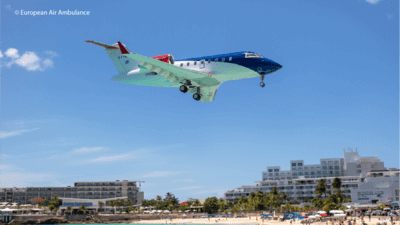
Relationship management is essential in this business – a fact reaffirmed by Jérôme Pin of European Air Ambulance, who told ITIJ: “As European Air Ambulance has been in operation for over 35 years, we are fortunate to maintain long-standing and trusted relationships with most of our partners. For these established clients, we generally do not require full prepayment prior to initiating an air ambulance mission.” All contractual terms must be upheld, and for new relationships and business partnerships to flourish, that trust in the contract needs to be built. “For new clients,” said Pin, “we typically request advance payment for the first few missions. Following a successful initial collaboration, we reassess the arrangement and, in most cases, grant credit terms – starting with 15 days, which may then be extended to 30 days, depending on the client’s reliability and payment history.”
Private repatriations are a different conversation. For those, prior payment terms are the same for EAA as they are for USMX AirLink and Airlec – i.e. full payment upfront is required. “This approach is based on experience, which has shown that without upfront payment, there is a significant risk of delayed payments – or, in the worst-case scenario, not receiving payment at all. We believe this is the most secure and transparent process for both parties, ensuring clarity and commitment from the start,” said Pin.

No flight, but a lot of work
As highlighted above, mustering the resources for an air ambulance mission takes a significant amount of time and effort on the part of the operator. Thus, cancellation fees do come into play should the flight be cancelled at the last moment – for example, if the patient’s condition deteriorates. Pin said: “We have standard cancellation fees outlined in our terms and conditions, which cover various scenarios related to the cancellation of air ambulance flights. While we understand that each case may differ in its circumstances, once an aircraft, crew, and medical team are mobilised, significant resources are committed. At that point, it becomes difficult – if not impossible – to reassign those assets on short notice, not to mention the costs already incurred.” That said, a lot ultimately comes down to long-standing relationships and personal communication, and a fair solution that works out in the best interests of payer and provider can usually be found.
Wilson said: “If by all means we cannot do the flight due to unforeseen circumstances, we will only deduct costs which were accumulated, like permit request or indeed pre-positioning, or any other work which we have to pay to partners. We will pay back the full amount if none of these services have been put in place.”
Rodenburg concurred, saying that the company would refund 100% of the payment taken if the flight didn’t happen. If the aircraft has already been dispatched, then costs incurred will be recuperated
We evaluate creditworthiness, and set limits to the amounts a client can have outstanding based on that evaluation

Brokers’ involvement
Air ambulances are sometimes commissioned by a third party broker, and, in these situations, do the agreements regarding payments change? “Not really,” said Rodenburg. “The credit decision is made on the basis of who the payer to us will be and their creditworthiness. In some cases, the broker is responsible for payment and the broker takes any credit risk related to the final customer. In other cases, the broker will ask us to collect from the final customer and we make the credit decision.”
Following a successful initial collaboration, we reassess the arrangement and, in most cases, grant credit terms
A broker doesn’t have to make the payment process more complicated, said Pin. It depends on who the broker is: “We have some long-standing commercial relationships with brokers where prior payment is not required. For others – especially those we do not know well or have not worked with before – we apply the same conditions as we do for private clients, meaning prior payment and a signed contract are required.”
September 2025
Issue
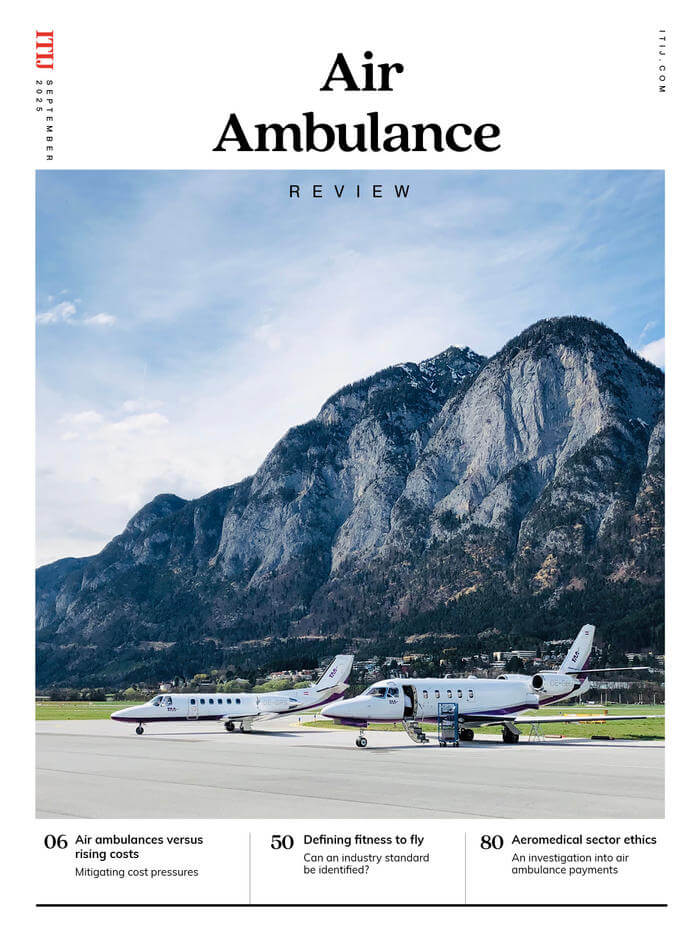
We include an examination on defining ‘fitness to fly’, and ask if an industry standard can be identified, and what that would involve. We also look at capacity in the aeromedical market and experts share their insights. Ethics and transparency in the aeromedical sector is a big issue, and we include an investigation into air ambulance payments.
Mandy Langfield
Mandy Langfield is a Director of Palladium Media Partners and former Publishing Director at Voyageur Group. She has written extensively on international travel and health insurance, medical assistance provision, and air medical transportation.