
The role of brokers in the air ambulance industry

Chloe Fox speaks to experts in assistance and medical transport about the changing role of air ambulance brokers in the current industry climate
Each day air ambulances play a vital role in saving lives by providing access to the farthest-reaching corners of the world. In the event of an emergency, someone in need of an air ambulance might find themselves booking through a broker to help locate a medical transport service able to meet their unique requirements.
Effective mediation between those in need and the response team is essential for enabling access to a variety of operators, ensuring payers are getting a comprehensive choice of fair quotes. Brokers often have connections with a range of companies, meaning they can organise the set-up of an air ambulance.
Typically, a broker will take a call from a person in need based on a referral from a hospital or doctor, or even use the internet to attract business. Since the broker acts as a middleman without an aircraft of their own, while they can help to determine reference points in the market, they may not necessarily know how air ambulance services work.
Considering the role of brokers in the air ambulance industry, we asked experts in assistance, where clear communication is key, what role brokers play in facilitating conversations.
Overdependence on brokers can put payers in a comfort zone, where they may lose touch with market dynamics and miss opportunities to secure better deals through direct negotiation
Can brokers help obtain quotes more efficiently?
Dr Ahmed Monir, Founder of LGA Assistance, said his company mostly prefers to deal directly with providers but there are times when the assistance team refers to brokers to gain insights into market benchmarks and pricing trends.
“Brokers can help us understand the reference points in the market, but when it comes to final negotiations, we prioritise working directly with our providers,” he said.
Dominic Rose, Head of Medical and Assistance Network at Crisis24, was unequivocal about not using brokers: “Absolutely not. Air ambulance services move our sickest patients. As someone commissioning such critical services, one should know exactly what aircraft is being used, who the medical team are on board, understand the regulation that governs the operation, and the configuration of the flight crew flying the aircraft.”
For Crisis24’s global network of air ambulance services, Rose said that the following information is held as a minimum requirement:
- Air Operator Certificate (AOC) and operations specifications
- Part 135, of section A024, of valid FAA air operating certificate (if applicable)
- Certificate of Airworthiness for each aircraft
- Certificate of Registration for each aircraft
- Company registration
- Local regulatory licence
- Insurance for each aircraft
- Insurance for personnel malpractice/general or professional liability insurance
- External professional/industry accreditations
- and credentials
- Aircraft configuration including schematics/photographs
- Equipment list
- Template of transfer documentation (medical
- documentation file)
- Infection control policy/checklist
- CV of the medical director
- CV of the chief flight nurse
- Company brochure/mission, vision, values
- Copy of recruitment process.
“Our assistance medical team need all the information above to make an informed decision as to who they are asking to transfer a patient on their behalf. All this information is readily available from quality and commercially licensed organisations,” he explained.
Rose highlighted that a broker will often not know this information or not be willing to share it until they have secured payment.
Air ambulance services are where two of the most highly regulated industries – medical and aviation – collide. Rose said that, driven by a purely commercial agenda, brokers are not necessarily subject to these regulations and potentially hold very little insight into the patient’s condition or the services and/or aircraft they are brokering.

Offering cost-effective solutions
In moments of crisis, is it easier for brokers to offer cost-effective solutions like empty legs than it would be approaching one provider at a time?
According to Rose, operators that offer empty legs proactively communicate these opportunities to their customers. “At the best of times these are hard to coordinate,” he explained. “Adding a ‘middleman’ to the process is likely to hinder the communications between the commissioner and the operator.”
Dr Monir went on to suggest that brokers can indeed be helpful in offering solutions like empty legs, though these opportunities are rare. “Brokers have access to a broader network, which can make a difference in cost-effectiveness when empty legs are available.”
He suggested that, in such cases, they can provide better options than relying on a single provider, where you’re limited in scope.
The importance of brokers depends on factors like the volume of business and the trust between the parties


Playing a vital role
Brokers can play an important role in negotiating between parties. However, according to Rose, for effective procurement of emergency services, the role is not essential.
“The key to competitive air ambulance pricing is the development of a strategic network of air ambulance operators globally,” he said. “From this accredited and credentialled network, quotes can be sought for various routes, encouraging healthy competition directly between operators, without additional costs.”
Dr Monir noted that the importance of brokers depends on factors like the volume of business and the trust between the parties. “For instance, with a strong partnership and substantial business volume, we can often negotiate better rates directly with a provider,” he said. “Brokers are still vital, but, in most cases, direct communication can address the client’s needs more effectively.”

Are there added risks when using a broker?
Rose reflected that the use of a broker can hinder communication between the payer’s operational and medical team and the operator’s operational and medical team.
“Air ambulance transfers can be fraught with challenge. If an air ambulance case goes wrong (medically or logistically), the consequences can be catastrophic from both patient outcome and a cost perspective. Direct, immediate communication and update is required between the operators,” he said.
Dr Monir added: “Yes, there are potential risks. Air medical services are incredibly high value, so relying solely on brokers can limit your understanding of the market and
the range of options available. Overdependence on brokers can put payers in a comfort zone, where they may lose touch with market dynamics and miss opportunities to secure better deals through direct negotiation.
“Brokers are certainly valuable, but a balance is crucial. Staying actively involved in negotiations and keeping a pulse on the market ensures that you’re not boxed into a single approach, allowing for better value and reduced risks,” he concluded.
The key to competitive air ambulance pricing is the development of a strategic network of air ambulance operators globally
The changing role of air ambulance brokers
According to Ilan Dorot, CEO of Aero-plan, an online B2B marketplace for medical transport services, with the overall uptick in travel since the Covid-19 pandemic, Aero-plan has seen a significant increase in traffic, especially in the past two years.
“In fact, the transport volumes we have handled have surpassed pre-Covid-19 numbers,” he reflected.
“For many global clients, payers do seek to be more cost-efficient, not only on the individual flight, but in evaluating the overall case risk and outcome. For example, a payer would agree to a more costly air ambulance if it can get the patient out sooner, saving costs on hospitalisation and risk of a longer, more expensive care path.”
LGA and Crisis24 shared their thoughts on the changing role of air ambulance brokers.
Rose emphasised that the use of a broker often adds costs to the payer: “Merely adding a broker to air ambulance selection layers in an additional cost in my experience on average of 7.5%.”
Dr Monir commented that a solution he had considered is an aggregation platform that connects all air ambulance providers in one place, independent of brokers.
“Automated systems would distribute requests to providers simultaneously, allowing each to tailor their offers to specific conditions without seeing competing bids,” he explained. “This approach promotes fair competition, ensures transparency, and keeps us in control of the process, while reducing over-reliance on brokers and the additional costs naturally associated with their services.”
Considering how the role of air ambulance brokers is changing as costs increase for providers, Dorot commented: “When you work with brokers it’s often a ‘black box’, which in some cases may conceal the identity of the actual provider performing the mission or other essential information, impacting the medical and financial risk. Not to mention the untransparent commission the broker keeps.
“When the assistance company has access to a variety of availability, prices, aircraft types (number of legs), international and regional providers, etc, comparing these alternatives on a level playing field with their preferred providers, and then communicating directly with the provider, is the only way to control your clinical and financial risk,” he concluded.
March 2025
Issue
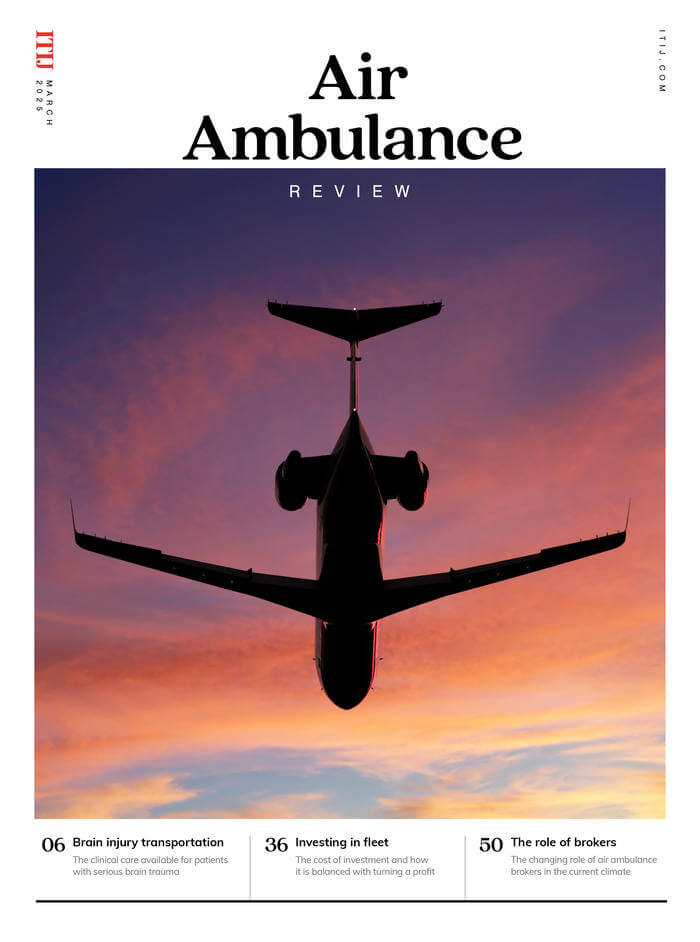
The Air Ambulance Review includes features on clinical care for ABIs; investing in fleet; the role of brokers in the air ambulance industry; and an accreditation update.
Chloe Fox
Chloe Fox is an Editorial Assistant for Voyageur Group, joining in 2024. She writes for ITIJ and AirMed&Rescue, covering a range of topics including international travel and health insurance, medical assistance provision, and air medical transportation. Chloe holds a BA (Hons) in English and an MA in English Literature from the University of Bristol.