
The cost of investment

Air ambulance operators are under pressure to keep costs as low as possible for clients, but investment in aircraft, clinical training and the latest medical equipment is still essential. What investments are being made, and how is it being balanced with the need to turn a profit? Robin Gauldie finds out
Faced with soaring costs and a shortfall in aircraft, spare parts and human resources, the air ambulance sector must work to explain to its clients how these challenges affect them. But not all customers fully understand the issues, say some air ambulance providers.
“Clearly not,” said Daniela Wilson, Director of Aviation at Airlec Ambulance, when asked if clients understand when increased costs are partly passed on to them. In some cases, cut-throat competition from less well-accredited operators plays a part, she implied.
“The current climate is significantly difficult as there are a big number of competitors on the market, some not EURAMI accredited, which are able to offer much cheaper rates,” she said.
The disparity of business models within the air ambulance sector – ranging from private ownership to shareholder companies – plus the wide array of different fleet models in operation influence pricing and can also make price comparison difficult for clients, she said.
Other voices in the air ambulance sector say the solution to the problem is to win over less-than-happy clients by providing a transparent, detailed explanation of why higher costs are being passed on to them.
Volker Lemke, Managing Director of FAI rent-a-jet, accepts that times are tough for the sector – but is a little less pessimistic than Wilson.
“The situation for many companies is still critical,” he said, noting that despite a post-pandemic rebound in global travel with resultant growth in the air ambulance industry, the sector faces significant challenges.
The cost explosion over the last two years and a scarcity of resources in
terms of aircraft, spare parts, pilots and other qualified personnel have adversely affected the industry
“The cost explosion over the last two years and a scarcity of resources in terms of aircraft, spare parts, pilots and other qualified personnel have adversely affected the industry. We are not yet back on track as we would have expected.”
Unlike Wilson, Lemke feels that clients are coming around to the inevitability of higher costs being passed on to them – thanks partly to FAI’s strategy of explaining the details.
“It took some time to gain acceptance, but today the issue seems to be largely understood,” he said. “At FAI, we felt that it was important to provide customers with detailed facts and figures, rather than just making a generalised statement such as ‘everything has become more expensive’.
“I personally discussed our cost analysis with a number of customers, explaining the percentage increases in various segments in detail. I believe this approach significantly helped foster understanding.”
Tom Hienckes, Business Development Manager at European Air Ambulance (EAA), seems, if not actually bullish, then cautiously optimistic, describing the air ambulance industry’s position as ‘challenging’ rather than ‘difficult’.
“The current air ambulance industry remains highly competitive, with ongoing consolidation, mergers, and new entrants,” he said.“Geopolitical shifts have led to fluctuating regional demands, increasing unpredictability and requiring rapid adaptation from our side. The industry faces rising operational costs, inflation, regulatory hurdles, and supply chain issues, not to mention the significant investments needed for aircraft, medical equipment, staff training, and more.”
Hienckes agreed with Lemke that clients can be won over – and retained – when operators clearly explain the reasons for higher prices.
“Our clients generally understand the need for cost adjustments, but clear and transparent communication is essential,” he emphasised. “Explaining the reasons behind these increases, such as rising costs or inflation, fosters understanding and acceptance. Operators should also explain to clients that costs will not necessarily continue to rise indefinitely. Transparency also involves showing clients that prices may decrease over time,” he added.
Our clients generally understand the need for cost adjustments, but clear and transparent communication is essential
“Highlighting the value of our services is crucial in reinforcing their willingness to accept increasing prices. Long-term relationships often influence how adjustments are perceived. We aim to build trust by demonstrating our efforts to absorb costs before passing them on.”
Expanding and upgrading
Unsurprisingly, operators looking to replace ageing aircraft or expand their fleet tend to look first at newer versions of aircraft types that they already fly.
“Investments are essential,” said Lemke. “In addition to the general maintenance costs required to keep the aircraft in a technically optimal condition, older aircraft in particular require various upgrades to meet the growing demands of air traffic – navigation equipment, for example.
“It is also important to keep pace with the rapid development of technology in other areas, most especially in the field of medical equipment. At the same time, adequate training for users must be planned to ensure that they can thoroughly master the complex technology,” he added.
FAI’s fleet has for a long time been dominated by the Learjet 60 and Challenger 604 (complemented by one Global Express aircraft that does not fly as a dedicated air ambulance).
In addition to the general maintenance costs required to keep the aircraft in a technically optimal condition, older aircraft in particular require various upgrades to meet the growing demands of air traffic
“It was logical therefore to purchase later models of the same type as part of the fleet renewal,” Lemke said. “The latest additions, a Learjet 60XR and a Challenger 605, are both significantly newer than our existing fleet and feature improved performance and optimised avionics.”
He noted that the air ambulance sector is predominantly for pre-owned aircraft.
“If a suitable offer arises, we are happy to consider a direct purchase. Currently, the selection of interesting aircraft that meet our fleet renewal programme is not that large, but with an intensive search, appropriate opportunities do arise.”
As part of the non-profit, humanitarian operator Luxembourg Air Rescue, EAA reinvests all of its earnings, Hienckes noted.
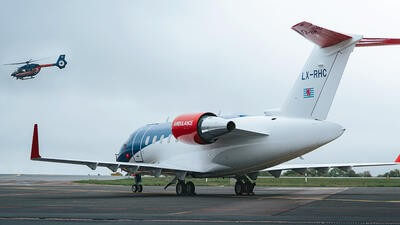
Its current fleet includes five aircraft: two Bombardier Challenger 605s and three Bombardier Learjet 45XRs, owned by EAA and its parent organisation.
“We maintain consistently high investment levels,” Hienckes said. “We added a second Bombardier Challenger 605 to our fleet in summer 2024, aligning with our strategy to enhance long-range air ambulance capabilities.
“Our first Challenger 605 exceeded expectations, and client feedback confirmed the need for a second aircraft. This model expanded our reach and services, allowing global patient repatriation with greater comfort and efficiency. The success over the past three years affirmed our choice, positioning EAA for continued growth in the long-range air ambulance market.”
In addition to the purchase of the two Challenger 605 aircraft, the Luxembourg-based operator is also investing in updated medical equipment, a new in-house training facility, and comprehensive digitalisation of its operations control centre.
Hienckes echoed Lemke’s take on the predominance of the pre-owned aircraft market in the air ambulance sector.
“Since EAA’s establishment, we have not procured any factory-new aircraft. Instead, we have consistently chosen pre-owned aircraft and managed all modifications in-house to achieve full air ambulance configurations.”

Investing in training
Investment in training for pilots and medical crew has become more important than ever, with pilots required to fly into a growing number of volatile regions and medical staff facing a widening range of complex cases challenges, said Wilson.
In 2021, Airlec added a Dassault Falcon 900 EX, with its 4,500 nautical mile (8,334 kilometre) range, to bring its fleet up to nine aircraft. The company also operates Hawker 1000 and Hawker 900, Merlin and Citation aircraft. In 2022, Airlec became the first operator to fly the Falcon 900 EX in air ambulance configuration.
“As an operator, you try to choose aircraft models which already exist in your fleet so you do not have to adapt to new training procedures,” Wilson said. “We have our own maintenance in-house and pilots undertake compulsory sim training twice a year. Operations will be trained in-house as well. Medics undergo compulsory training in our own facilities at our training centre, SimAirlec.”
“The introduction of a new aircraft presents significant challenges across all departments, far beyond just the training department,” Hienckes agreed.
Preparations involve hiring and training new pilots and medical crews and ensuring compliance with civil aviation authorities, alongside the extensive involvement of maintenance and engineering teams.
Investment in training for pilots and medical crew has become more important than ever


“Integration into the existing fleet extends well beyond the aircraft’s arrival or the commencement of commercial operations,” Hienckes emphasised. “Continuous feedback from pilots, dispatchers, and medical staff remains vital for refining operational processes, improving efficiency, and elevating the quality of service delivered to customers.”
Like Airlec, EAA prioritises in-house training, and is investing in a dedicated medical training academy, scheduled to open this year.
“We do as much as possible in-house,” said Hienckes. “Regular simulation drills, interactive e-learning platforms, and, most importantly, practical, hands-on sessions are at the core of our approach. We conduct periodic competency evaluations, encourage cross-training among departments, and provide ongoing education on industry trends. By meticulously tracking progress and gathering feedback, we continuously refine our programmes.”
Alongside the challenge of continually training personnel, air ambulance companies are also faced with a sector-wide staff shortfall. That means they must foster staff loyalty while luring new recruits with convincingly attractive pay, conditions and opportunities for in-company career advancement, operators agree.
“This is one of the most challenging questions at the moment, but fortunately we are in a better position than many of our competitors,” said Lemke. “Our worldwide operational profile offers a unique appeal to many staff members and the sheer size of the company guarantees excellent career opportunities, enabling us to attract candidates from a wide variety of backgrounds.
“Training in aviation in our region [Europe] is generally standardised and for the most part must also be completed as mandatory training,” Lemke pointed out. “FAI maintains a very consistent level of training.
“Additional training modules are commissioned by us and professionally created, completed in-house or externally at certified institutions. All employees must provide proof of their participation,” he said.
Empowering staff is key to retaining key personnel and recruiting new staffers, Hienckes added.
“At EAA, we believe that a strong corporate culture and values, a clear career and personal development plan, flexible working arrangements, training opportunities, mentorship initiatives, and knowledge management programmes, along with competitive compensation and working conditions, are essential for attracting and retaining our staff,” he concluded.
March 2025
Issue
The Air Ambulance Review includes features on clinical care for ABIs; investing in fleet; the role of brokers in the air ambulance industry; and an accreditation update.
Robin Gauldie
Robin Gauldie is a freelance journalist and a former editor of a number of travel trade and specialist publications including Travel Trade Gazette Europe, ABTA Magazine, Ireland 2000 and Climate Change - Addressing the Challenge. He contributes to several newspapers and magazines including The Scotsman and Telegraph Travel and is the author of more than 30 travel guidebooks to destinations around the world. He lives in Edinburgh.
Robin has been writing for ITIJ and its Review publications on a freelance basis since 2008, covering a wide range of topics that span the global insurance and assistance sectors.