
Can travellers find normality in a time of war?

Milan Korcok considers the global outlook, what risks this presents for travellers, and how insurers can help…
As international travel providers struggle to recapture pre-pandemic momentum, the collateral effects of wars and persisting economic uncertainties are challenging their ability to give customers what they want: to get back to normal – to take the sun in Morocco, roll the dice in Vegas, cruise the Mediterranean, or take the family to Florida.
Images of angry demonstrators massed on college campuses, boulevards, parks and sports fields in Europe, North America, Australia, Asia and beyond repudiate normality and test the individual traveller’s determination to “book it now”. According to a September 2023 report from the World Economic Forum (WEF), though recession concerns appear to have eased, the global economic outlook remains “anaemic”, with 61% of respondents to the Chief Economists Outlook believing it will likely weaken in the coming year. And though 86% are optimistic that the global inflation will ease, 74% warn that geopolitical tensions will add to that weakening. Their one-word summary going forward: “volatility”. And that report was issued two weeks before the outbreak in Gaza.
At a more granular level, the Conference Board of Canada reports that overseas travel for the first eight months of 2023 attained 71% of pre-pandemic 2019 levels, and travel to the UK and Europe increased a modest 1.2% over 2019 – not exactly big post-pandemic rebounds for Canadian travellers. But it was the somnolent consumer confidence index (which measures propensity to splurge on major items, like refrigerators, cars, or trips) that caught attention as it sank to its lowest point on record, dating back to 2002.
A dilemma for sellers of travel insurance products in this uncertain environment is how to warn clients of the inherent risks of travel while still espousing its rewards
The Conference Board of the US projected similar trends, showing the short-term outlook for business and labour market conditions softening, and consumer confidence falling steadily since summer levels. Dana Peterson, The Conference Board’s Chief Economist, commented in late 2023: “October’s retreat reflected pullbacks in both the Present Situation and Expectations Index. Write-in responses showed that consumers continued to be preoccupied with rising prices in general, and for grocery and gasoline prices in particular. Consumers also expressed concerns about the political situation and higher interest rates. Worries around war/conflicts also rose amid the recent turmoil in the Middle East. The decline in consumer confidence was evident across householders aged 35 and up, and not limited to any one income group.”
Travel alerts: a maze or a must?
A dilemma for sellers of travel insurance products in this uncertain environment is how to warn clients of the inherent risks of travel while still espousing its rewards. It’s not easy without getting entangled in the weeds, but official government alerts not only raise awareness of conditions on the ground, they can also impact one’s travel experience as well as insurance benefits. So mastering them is important. Among Five Eyes countries (referring to a postwar intelligence-sharing alliance), which includes Australia, Canada, New Zealand, the UK and the US, warning levels for outbound travel are largely standardised as they use common-source information and criteria. Level 1 means exercise normal precautions; level 2, exercise heightened caution; level 3, avoid non-essential travel (Americans and Australians rephrase this to ‘reconsider travel’); and level 4, avoid all travel. The UK’s Foreign, Commonwealth & Development Office (FCDO) minimises its use of level designations, favouring more editorial descriptions of risk, but generally the criteria are the same for all five countries. Ironically, perhaps, the UK is the only entity among the five to be rated level 2 (exercise heightened caution) by its peers.
Joining the UK in that level 2 category are quite a few allies: France, Germany, Belgium, Denmark, the Netherlands, Spain, Italy and Sweden are all at ‘elevated risk’.
Generally, crossing into, or remaining in, level 3 or 4 countries after being warned to get out exposes the traveller to potential restriction or loss of benefits such as emergency medical services, costs of itinerary changes or hotel cancellations, per diem disruption allowances, and bail or court costs for those who inadvertently (or otherwise) get involved in local altercations or demonstrations. But, as all five government advisory services clearly emphasise, the decision to restrict or deny insurance benefits lies only with the respective insurers. It is not government’s role or intention to mandate who pays what. And, as one veteran Canadian travel insurance broker told me during the Covid-19 experience: “I’ll be damned if government’s going to tell me who I can or cannot sell insurance to.”
Travel insurers have a role
Michael Camacho, President of Canada’s Travel Health Insurance Association, emphasises the role travel insurers have in keeping their customers safe. He told ITIJ: “Many of our members helped people in need as the news (from Gaza) was breaking, and once commercial operations ceased, they provided assistance to individuals in the region and those with scheduled trips there. These situations underscore the importance of both having travel insurance and understanding your coverage. THIA recommends that travellers know their policy, review the document and ask the insurance provider about travel advisory exclusions and benefits as well as other related exclusions.”
Each nation’s country-specific advisories are simple to access online and should be routine preparation for any foreign travel

Certainly, the perception of risk is highly subjective. One person’s interpretation of ‘high risk’ is another’s ‘wave off’. But ignoring official government-articulated risk levels has consequences. And they can be very costly. Each nation’s country-specific advisories are simple to access online and should be routine preparation for any foreign travel. Also, one source of advice is good, but two are better as they provide a more multidimensional focus on true risk on the ground. For example, Travel Canada designates nearly half of Mexico’s 31 states (Mexico City is an autonomous entity) as level 3 risk: ‘avoid all non-essential travel’. That ranking could negate some or all insurance benefits in case of misadventure in no-go areas. Ironically, despite these high risk levels, Mexico remains Canada’s most favoured vacation destination next to the US: 1.8 million visits in 2022. Understandably, that’s mostly during Canada’s legendary winter months.
On the other hand, the US, which shares a troubled 2,000-mile border with Mexico, designates six states as level 4 (no travel), seven as level 3 (reconsider travel), and 16 as level 2 (exercise increased caution). For the first time, Cozumel, Mexico’s highest volume tourism area – even though its beaches are routinely patrolled by armed military – has been elevated to level 2 risk.
The UK’s FCDO file on Mexico reads like a John le Carré novel: warning against highway travel in drug cartel areas throughout the interior; the border states adjoining the US states of Texas, New Mexico, Arizona and California; and such fabled Pacific coast beach resort areas as Acapulco, Zihuatanejo, and Puerto Vallarta. These are best reached by direct air travel, with recommendations to ‘stay on site’ the prevailing rule. Yet, despite the warnings, Mexico’s tourism continues to be robust – in 2023 welcoming approximately 39 million foreign visitors. That’s down from peak pre-Covid-19 years, but still strong: clear evidence that a margarita cocktail on a beach in January warrants some degree of risk, even though it may require the care and nurturing of gun-toting National Guard patrols.
Not to be neglected are governments’ free sign-on services such as the US Smart Traveler Enrollment Program (STEP), Registration of Canadians Abroad, or Australia’s Smartraveller programme. These keep registered travellers advised of unexpected conditions along their itinerary and help them to navigate around major weather events, border closures and civic disruptions, while also allowing families at home to contact them in case of domestic emergencies. Increasingly, travel insurers are building such adjunctive programmes into their own offerings.
The US: safe travels?
Though all other members of the Five Eyes rank the US as a level 1 nation, its pre-eminent role in the Israel-Hamas conflict has set off alarm bells within its borders. The Department of Homeland Security warned: “The US remains in a heightened threat environment… As the Israeli-Hamas conflict continues we have seen an increase in reports of threats against Jewish, Muslim, and Arab communities and institutions. Lone offenders, motivated by a range of violent ideologies, pose the most likely threat. We urge the public to stay vigilant and promptly report suspicious activity to local law enforcement.”
The war in the Middle East has raised the threat of an attack against Americans in the United States to a whole other level
And in testimony to the Senate Homeland Security Committee, FBI Director Christopher Wray further warned: “The war in the Middle East has raised the threat of an attack against Americans in the United States to a whole other level.” He emphasised that “Hamas and its allies will serve as an inspiration the likes of which we haven’t seen since ISIS launched its so-called caliphate years ago”. He added: “Here in the United States, our most immediate concern is that violent extremists – individuals or small groups – will draw inspiration from the events in the Middle East to carry out attacks on Americans going about their daily lives. That includes not just homegrown violent extremists inspired by a foreign terrorist organisation but also domestic violent extremists targeting Jewish or Muslim communities.”
Overall, data from US Customs and Border Protection indicate that 2.5 million undocumented migrants attempted to enter the US via the southwestern border in fiscal year 2023, ending in September, and this included arrivals from as far away as Ukraine, India and Turkey, as well as 169 individuals whose profiles matched those on FBI’s terror watch list. In 2022, there were 100. Add to that number 1.7 million ‘gotaways’ – border-crossers detected but not apprehended by authorities, and the plot thickens.
Caution? Certainly. There is still plenty of breathing room across the US for safe and pleasurable travel. But common sense and awareness of one’s surroundings are never out of place, which can also be said for France, Germany, Denmark, Sweden and Spain. Although sharing one’s unsolicited political view with a fellow customer at a supermarket checkout, especially during America’s election year, might be considered an unnecessary hazard.
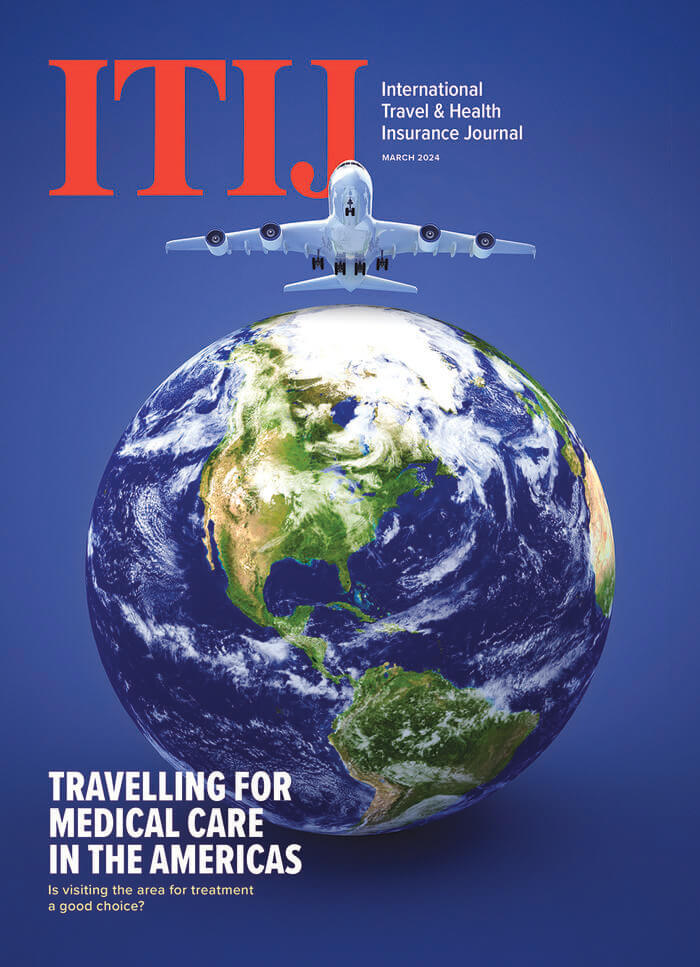
March 2024
Issue
We consider how businesses operating in the US endeavour to understand the complexities of the US billing system; speak to experts about the pros and cons of differing health systems in the US; examine the top features hospitals must have; and ask whether travellers can find normalcy in times of war.
Milan Korcok
Milan Korcok is a national award-wining medical writer who has been covering international healthcare activities and trends in Canada, the US and abroad for many years. He has long served as contributing editor to the Canadian Medical Association Journal and the Journal of the American Medical Association. He is a founder of – and has served as editor of – the US Journal of Drug and Alcohol Dependence; a founder of the Travel Health Insurance Association of Canada, and currently serves as contributor to ITIJ.