
Insurers must keep up with startups

Bigger legacy insurers must adapt their service offerings to keep up with the increasingly agile digital propositions offered by startups, warns data and analytics firm GlobalData

According to the company, global funding for insurtech broke the US$3 billion mark in 2018, representing a whopping 84.2-per-cent increase compared with 2017; insurtech, and the startups driving its evolution, are not going away, so adaptation is key.
One of the most game-changing trends of which insurers need to be aware – and one that is analysed in GlobalData’s recent Digital Challengers in Insurance – Thematic Research report – is the development of on-demand policies. These policies allow customers to purchase insurance coverage on a much smaller scale than previously, on an hourly, daily or weekly basis, usually via an app. This sort of flexibility is highly attractive to consumers and, if leveraged correctly, can be highly advantageous to providers.
“The digital challenge in insurance continues to grow and the scale of funding in 2018 is proof of that,” commented Ben Carey-Evans, an insurance analyst at GlobalData. “It has lagged behind other sectors, given what Uber and Netflix provide in transport and entertainment respectively. However, this type of flexible and instant service is [becoming] more commonplace, with a range of startups thriving in both personal and commercial lines. This has even prompted traditional insurers such as Aviva to respond with the release of its Aviva Plus, which allowed customers to pay monthly subscriptions and tweak cover levels during the contract.”
According to analytics from GlobalData, insurtechs in the UK received the second highest level of investment globally in 2018, with 101 completed deals reaching a value of $9.8 billion. The market is booming – but, warns Carey-Evans: “Established players have to adapt to progress made by startups or consumers will begin to go elsewhere. They can no longer rely on their trusted brand names, as they are not just competing against startups but can be left behind by their competitors partnering or investing in them.”
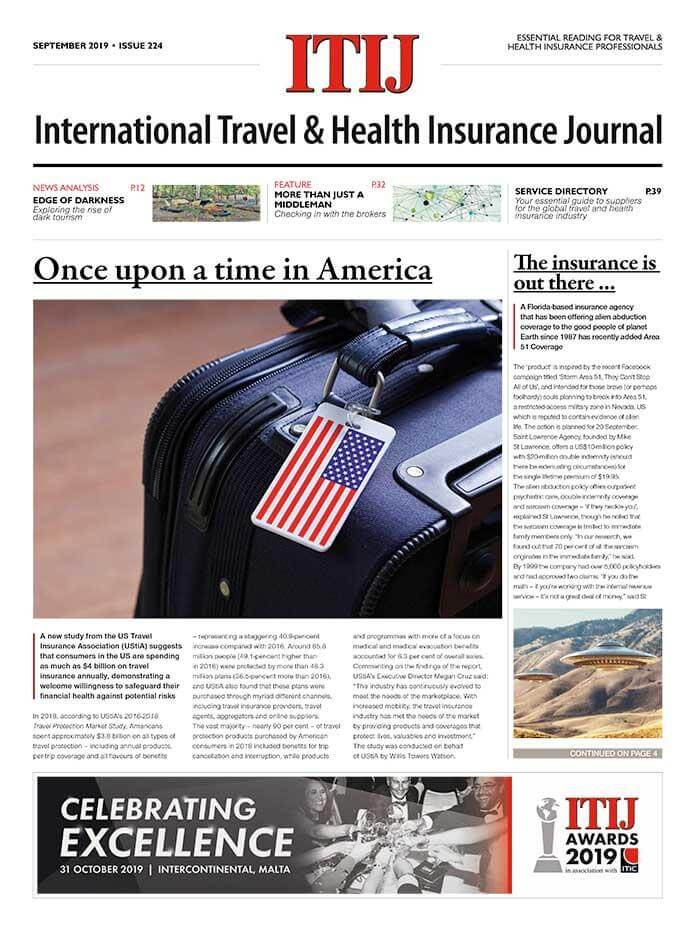
September 2019
Issue
In ITIJ’s September issue, we get to grips with some of the risks involved with the fast-growing trend of ‘dark tourism’; and we explore the enduring relevance of brokers in the global travel and health insurance landscape. We also hear personal insights from an insurtech specialist on how insurers can capitalise on the global tourism boom, a member of the UK’s Chartered Insurance Institute on how policies might evolve to meet the needs of tomorrow’s space travellers, and a global assistance provider CEO on how to better educate customers on hurricane risk.
Stefan Mohamed
Stefan Mohamed is the former Deputy Editor of ITIJ. He has over seven years’ experience writing about travel insurance and its ancillary industries. He also writes novels.