
Industry Voice: Navigating the AI revolution in US travel insurance

The US Travel Insurance Association tells ITIJ about the potential AI has for the industry, and the importance it brings to improving the customer journey
The integration of artificial intelligence (AI) is reshaping industries worldwide, and the US travel insurance sector is no exception. As discussions around AI’s potential continue to grow, the US Travel Insurance Association (USTIA) is focused on understanding how these advancements might refine operations and improve customer experiences while balancing the needs and concerns of customers, distributors and regulators alike. This evolving landscape marks a shift towards more responsive and efficient service delivery, signalling a period of significant change for the future of travel insurance.
AI is progressively being viewed not just as a tool for automation, but as a component in improving how travel insurance policies are crafted, managed and delivered. The promise of AI extends from boosting the speed and accuracy of claims processing to personalising customer interactions and managing risks more effectively. As AI continues to evolve, its adoption within travel insurance promises to offer profound benefits, setting new standards for the industry’s future.
However, integrating AI into the complex landscape of travel insurance requires careful attention to regulatory compliance and a commitment to ethical business practices, particularly regarding data usage and privacy. In this article, we explore both the opportunities and considerations involved, aiming to provide a balanced perspective that informs and prepares the industry for the future impacts of AI.
Current implementations and benefits of AI in travel insurance
Back-end efficiency enhancements
AI’s role in the US travel insurance industry is currently more pronounced in back-end operations rather than in direct customer interactions. By integrating AI with robotic process automation (RPA), the industry is streamlining the time-consuming tasks of assembling and sorting administrative documents that support claims, from trip cancellations to medical-related issues. This allows more time for claims examiners to focus on the actual evaluation of claims, leading to faster and more accurate resolutions. As a result, travel insurers can provide quicker responses, reducing waiting times and improving the overall experience for claimants.
Fraud detection and management
AI continues to play a crucial role in enhancing fraud detection capabilities within the travel insurance sector. Advanced AI systems are being developed to adapt and respond to new and evolving fraudulent schemes, enabling insurers to stay one step ahead. These systems analyse patterns and flag anomalies that may indicate fraudulent activity, allowing for pre-emptive actions that protect both the insurer and the insured from potential financial losses.
Challenges of integrating AI in travel insurance
Navigating regulatory compliance
The US travel insurance sector, like all insurance fields, operates within strict regulatory frameworks around consumer protection and fair business practices. As AI advances, insurance and other regulators worldwide are developing regulations and standards to govern its use. Although specific requirements may vary, these regulations generally stress the importance of companies demonstrating proactive management, strong governance, comprehensive risk management and effective internal audit functions to ensure the fair and non-discriminatory use of AI. This involves maintaining transparency and accountability, particularly when AI tools are used to support processes such as claims handling or pricing analysis. Insurers are tasked with demonstrating that any AI-supported processes can be audited and justified in compliance with regulatory standards, which requires implementing sophisticated oversight and control mechanisms.
AI is progressively being viewed not just as a tool for automation, but as a component in improving how travel insurance policies are crafted, managed and delivered

Ensuring privacy and data security
The use of AI in travel insurance requires the handling of sensitive personal data, making privacy and data security crucial. Insurers must implement robust security measures to protect this data against breaches and comply with global data protection regulations like the General Data Protection Regulation (GDPR) in Europe and various state-specific laws in the US. This involves encrypting data, securing data transfer and storage, and implementing rigorous access controls, therefore protecting customer information while harnessing AI capabilities.
AI continues to play a crucial role in enhancing fraud detection capabilities within the travel insurance sector
Addressing ethical implications
The ethical implications of AI in travel insurance are significant and multifaceted. Concerns arise particularly around the potential for bias in AI algorithms, which can influence decision-making processes in ways that might disadvantage certain groups of policyholders. To combat this, travel insurers are investing in developing AI solutions that are not only effective but also fair and impartial, so that all policyholders should receive equitable treatment. Additionally, there is the challenge of making sure that AI does not replace the human oversight necessary in sensitive cases, particularly in claim denials or adjustments, where a nuanced understanding of individual circumstances is crucial.
Balancing automation and personal touch
While AI can significantly enhance efficiency and decision-making speed, there is a critical need to balance these capabilities with the personal touch that is essential in insurance dealings, especially in claims processing and customer service. US travel insurers are tasked with integrating AI in a way that complements human expertise rather than replacing it, ensuring that technology augments service delivery without compromising the quality of human interaction and empathy that customers value.
Careful and cautious implementation
The adoption of AI in the US travel insurance industry is characterised by a careful and cautious approach. Given the high stakes involved – where real people face real potential issues – insurers are particularly meticulous about how AI is deployed. The focus is on making sure that the technology does not inadvertently disadvantage claimants or fail to detect fraudulent activities effectively. This careful implementation reflects a broader commitment to ethical practices and regulatory compliance, highlighting the industry’s dedication to responsible innovation.

Future trends and predictions
Personalised insurance products
Leveraging AI’s robust data analytics capabilities, US insurers are looking into highly personalised insurance offerings. By analysing vast amounts of data on individual behaviour, travel habits and risk factors, AI enables the creation of customised policies tailored to the specific needs and risk profiles of each traveller. This not only boosts customer satisfaction by providing coverage that better matches their requirements, but also increases the efficiency of underwriting processes.
Dynamic pricing models
AI’s ability to process and analyse real-time data from various sources allows for more dynamic and responsive pricing models. These models operate within the flexible pricing frameworks that have been approved in regulatory filings. This means insurers may be able to offer relevant product options in real time, based on evolving risk factors such as weather conditions, political instability, or public health issues. This flexibility helps insurers manage risk more effectively while offering customers more accurate pricing and better value for their insurance.
Faster customer interaction and support
While the current use of AI in direct customer interactions may be limited, there is significant potential for future applications. The industry is exploring how AI can further streamline customer service and claims handling, anticipating a shift where AI-driven tools like chatbots and automated response systems could become more prevalent. These advancements would aim to provide quicker, more accurate service and support, enhancing the overall customer experience without compromising the personal touch that is crucial in handling travel-related concerns.
Automated claims processing
AI’s integration into claims processing is anticipated to bring significant advancements, particularly for simpler claims like travel delays or trip cancellations. For these types of claims, AI can automatically assess eligibility based on a limited set of publicly available data, such as flight delay information or weather reports, dramatically reducing the time and labour traditionally required for handling. This streamlining allows for quicker resolutions
and timely reimbursements to customers while minimising human error and improving accuracy. However, even as AI accelerates claim evaluations, human intervention may still be required by regulators to ensure each claim is appropriately managed with thorough investigation, accurate decisions aligned with policy terms, and clear communication with customers.
The use of AI in travel insurance requires the handling of sensitive personal data, making privacy and data security crucial
AI-driven marketing in travel insurance
While in its early stages, AI is beginning to reshape US travel insurance marketing by enabling insurers to tailor products directly to consumer behaviours and preferences. Through advanced data analysis, AI can help identify potential customers and optimise insurance offerings to meet their specific travel needs. This targeted approach can improve engagement and increase the likelihood of purchases, enhancing overall customer acquisition strategies.
As AI continues to influence the US travel insurance sector, USTIA and our members are committed to navigating this landscape with caution and foresight. Embracing AI’s transformative potential requires a careful balance between innovation and responsibility, ensuring that advancements in efficiency and customer service are coupled with robust ethical standards and regulatory compliance. This strategic perspective underscores the industry’s dedication to leveraging AI to its fullest while protecting customer trust and maintaining the human touch that remains essential in insurance dealings.
February 2025
Issue
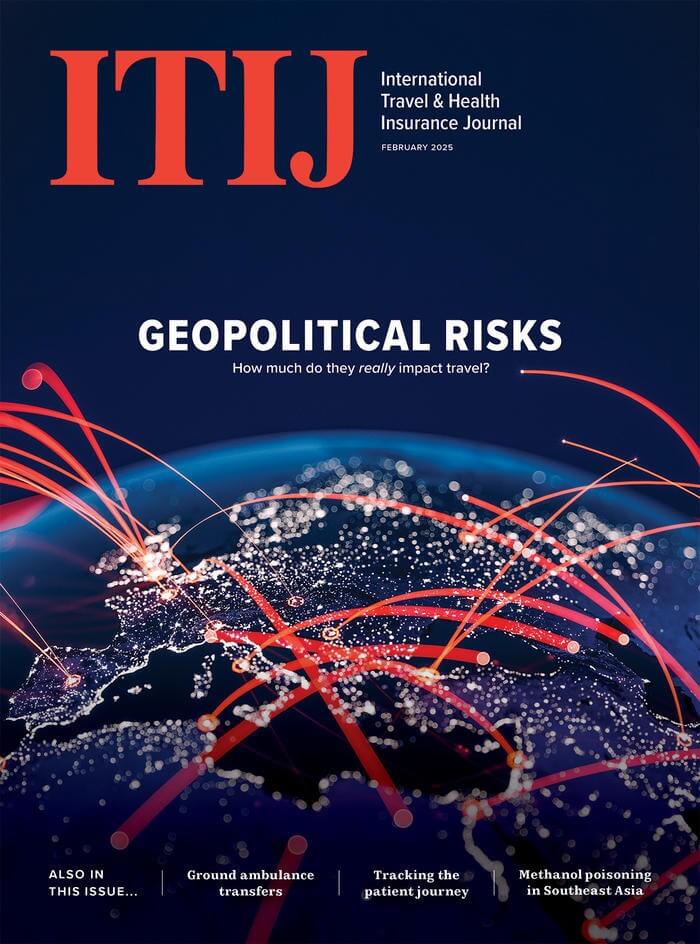
In the February issue of ITIJ we examine current geopolitical risks and their impact on travel; look at ground ambulance provision and how it is meeting customer needs; and explore the use of technology in the patient journey – looking at the efficiency of services.
US Travel Insurance Association USTIA
USTIA is a nonprofit association of insurance carriers and allied businesses involved in the development, administration, and marketing of travel insurance and assistance services. USTIA promotes fairness, integrity, and a commitment to excellence in the travel insurance industry, with a mission to educate the public on travel insurance while maintaining high industry standards. For more information visit ustia.org.