
Ground ambulances – making progress and meeting customer needs

Olivia Bowthorpe uncovers what’s driving the growing reliance on ground transfers for long distances, and how ambulances have adapted in the face of new challenges
Ground ambulances are making significant progress worldwide by embracing advances in technology, improving patient care, and adapting to changing demands. These advancements are enhancing efficiency and reliability, ensuring that patients receive the right care at the right time, no matter where they are.
Here, these innovations are examined in greater depth, highlighting their impact on patient outcomes and the wider global impact of these changes.
Ground ambulance provision around the world was significantly impacted by the Covid-19 pandemic. Demand increased alongside new challenges around infection control, border restrictions, staffing shortages and higher costs, requiring stricter protocols and operational adaptations to limit the spread of the virus.
One of the most significant shifts has been the growing reliance on ground ambulances for long-distance patient transfers.
Jesse Delien, the Department Chief of International Services at Ambuce Rescue Team, said: “In the past few years, especially post-Covid, it’s clear that ground ambulances have taken a bigger place in the international repatriation world than before.
“Higher standards were set for airport transfers, more local regulations from airports and countries were introduced, and an increase in long-distance ground ambulance transfers due to pathology and changes in airline policies occurred. Some airlines decided to no longer provide oxygen on board for example, which impacts passengers and creates the need for more and longer ground ambulance transfers than before.”
Delien, who is based in Belgium, added: “The rise in ground ambulance repatriations has been sustained, and we see a big increase in complex long-distance ambulance transfers. An important question we have to ask ourselves in this case is: what benefits the patient the most? This has to be looked at on a case-by-case basis by repatriation specialists.
“We are convinced that ground ambulances can provide more comfort than repatriations with, for example, medical escorts, where there is a lot of waiting, different local transfers, and layovers, whereas ground ambulances perform bed-to-bed transfers at the pace of the patient themselves. Does the patient need a rest? Then we can take a pit stop where necessary. I haven’t seen a plane do the same.”
In the past few years, especially post-Covid, it’s clear that ground ambulances have taken a bigger place in the international repatriation world than before
Taking advantage of technology
Technological advancements are also taking place, bridging the gap between pre-hospital care and hospital services. Ground ambulances are using telemedicine, advanced life support equipment, and electronic health records, improving decision-making and enabling smoother patient transitions to hospitals.
Several recent developments have been made in ground ambulance service provision at Falck, a leading international healthcare company. Freddy Lippert, Falck’s Chief Medical Officer, based in Denmark, told us: “We have integrated new technologies to improve communication and service delivery in our own ambulance services and ensure that our subcontractors meet the highest standards in the countries where our customers are.”
Falck, whose services include ground and air ambulance repatriations, telemedicine consultations, and on-the-ground medical assistance, operates in 26 countries in Europe, the US and Latin America.
“For our own ambulances, we use an advanced medical dispatch system (ESO-Logis Solutions) and advanced telemedicine systems that allow our medical staff to consult with medical specialists in real time, ensuring that patients receive the best possible care even before reaching the hospital,” said Lippert. “Additionally, we have implemented sophisticated dispatch systems that optimise route planning and resource allocation.
“We are also exploring the potential of using artificial intelligence to support our staff in making the best decisions and providing guidance and documentation.”
Delien added that his organisation is seeing many improvements within its emergency department. “Our Ambulance Rescue Team not only provides repatriations but also urgent and non-urgent transfers in Belgium, where we see an increase in use of technology, for example the test phase of an in-ambulance TV screen for stroke patients, to assess their symptoms while still in the ambulance.”

In addition, many ambulances are now using advanced GPS systems to find the fastest routes to and from hospitals, cutting down response times.
Oliver Müller, CEO of Gateway International EMS, based in Washington DC, told us: “GPS has been standing for a while now and is certainly helpful for the ground ambulance companies. However, the response times for us are not comparable to emergency calls; most of our transports are scheduled well in advance, although for the ambulance companies it can help shortly before our pick-ups, since they can allocate available resources.”
Lippert added: “Our use of real-time GPS equipment, which we consider the standard, has significantly improved our response times and our efficiency. Our dispatch centres can track the location of our ambulances in real time, allowing us to deploy the nearest available unit with the right competencies to an emergency.
“This technology also helps in navigating through traffic and finding the quickest routes to the destination.”
Ground ambulances are using telemedicine, advanced life support equipment, and electronic health records, improving decision-making and enabling smoother patient transitions to hospitals
Delien explained: “The use of real-time GPS equipment allows more resting time for our crews. Where a few years back all the drivers would choose their own, trusted routes, we now rely on the real-time GPS for roadworks and traffic jams, which makes for a shorter total driving time.
“This is a win for the team that has more spare time, and a win for the patient, who is faster to their destination. Our company has almost 200 ambulances throughout Belgium, which can be sent out immediately. For long-distance transfers (more than 1,000 kilometres) we depart the day after the request.”
Meeting customer needs
At Falck, ground ambulance services are continuously improved to meet customers’ evolving needs. Lippert said: “We have focused on enhancing the quality of care and ensuring patient comfort and safety. By investing in advanced training for medical staff, we ensure that they are well equipped to handle a wide range of medical emergencies.”
Ambulances are increasingly being redesigned with more comfortable interiors, better suspension systems for a smoother ride, and safety features like crash-resistant structures. These improvements aim to reduce stress and discomfort for patients.
“Falck has a fleet of specialised ambulances tailored to meet specific medical needs, often depending on specific contracts,” Lippert told us. “This includes neonatal ambulances equipped with incubators and other necessary equipment for transporting newborns, as well as ambulances designed to handle mental health crises with a focus on patient safety and comfort.”
Delien added: “Being the biggest ambulance company in Belgium makes us prepared for any type of transports, from neonatal and mental health to life support machines. All the ambulances are fully equipped with all the necessary equipment and can be changed depending on patient needs.”
Some countries, particularly in Europe and North America, are starting to use electric and hybrid ambulances to reduce their carbon footprint and help meet environmental goals.
Lippert said: “As part of our strategy, Falck is highly committed to sustainability and has started incorporating electric and hybrid ambulances into our fleet. Whenever possible, we offer electric or hybrid vehicles as part of our contracts. We also encourage our partners to make this a specific requirement for contracts, as we consider this important now and in the very near future.”
Airport challenges
Commenting on the increasing emphasis on standardising ambulance care protocols across countries, Lippert explained: “Standardised care protocols across our operations in different countries ensure consistency and high-quality care. This includes uniform training programmes, standardised equipment, and harmonised medical procedures.
“These efforts ensure that patients receive the same level of care regardless of where they are. In addition, we are constantly keeping up with new medical guidelines being published, and we, as a healthcare company, also contribute to the new guidelines by research and publications.”
Müller explained that Gateway International EMS’s list of providers is regularly improved via evaluation of its standards and performance. “We have reviewed our vetting protocols, like we do every two years. The standards obviously depend on the country and the availability of medical care in locations.”
Delien highlighted some changes to airport protocols seen in the last few years. “For example,” he said, “airports in Paris only allow tarmac access for local ambulance services, which have to follow a specific and costly training in French.
Ambulances are increasingly being redesigned with more comfortable interiors, better suspension systems for a smoother ride, and safety features like crash-resistant structures
“Also, Düsseldorf airport makes the fire department handle all the stretcher cases, providing the insurers with an extra invoice. These changes reduce the possibilities for medical commercial flights, and more ground ambulances are requested.
“This summer we performed a transport from Porto, Portugal, to Belgium, a transport which took six days in total. This brings new challenges: for example, where to sleep, with a patient who needs care.
“Working with different teams is a solution but comes at an increased price for the insurers because there are extra flights, rooms, waiting hours, and driving hours for our crews. There is still a very unstandardised protocol between different countries, even within the EU. All the healthcare systems are set up separately and communicate very little.
“We can also see big differences throughout different countries in financial aspects. Some countries like to perform surgeries themselves and keep patients as long as possible because the international clients ‘pay well’ for the hospitals, while other countries do the complete opposite.”
The rising popularity of ground transfers
Overall, ground ambulances have experienced sustained popularity following the pandemic. “We have seen a 30% increase in long-distance ground transportation,” said Müller. “Clients/insurance companies seem to be moving to ground transports for long distances when previously they were going to air ambulances for the same distance. We have surpassed the amount of cases we have done since before Covid-19, by 27% to date.”
Lippert added: “During the peak of the Covid-19 pandemic, we experienced less activity from our travelling customers for obvious reasons. However, we saw a significant increase in ground ambulance activities and the need for safer transport options.
“While the demand for ground activities has stabilised, it remains higher than pre-pandemic levels. We continue to adapt our services to meet the ongoing needs of our patients and our partners.”
Ground ambulances have adapted well in the face of evolving challenges, incorporating new technology and improving patient comfort, addressing sustainability and standardisation. The sustained rise in their demand post-pandemic shows the unique role they still play in the industry.
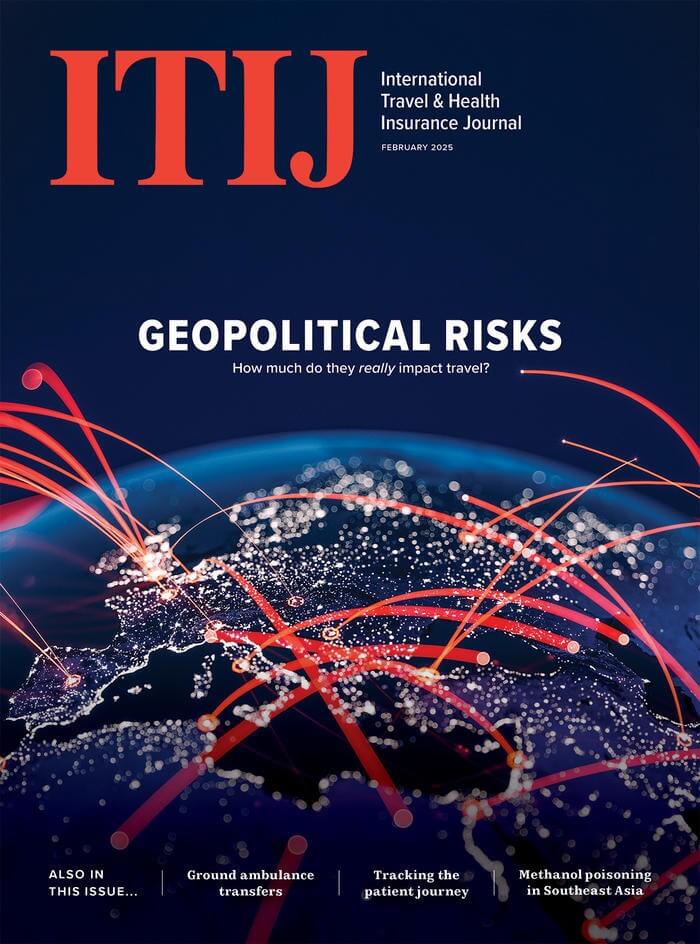
February 2025
Issue
In the February issue of ITIJ we examine current geopolitical risks and their impact on travel; look at ground ambulance provision and how it is meeting customer needs; and explore the use of technology in the patient journey – looking at the efficiency of services.