
Why international education is no longer an ‘anglosphere’

Milan Korcok examines the huge changes in international student numbers, and the implications this has globally
As colleges and universities in the ‘big four’ (the US, the UK, Canada, and Australia) lose international student applicants to new or expanded institutions in Asia, the Middle East, Latin America, and Africa (and don’t write off Europe), the prospect of an educational ‘anglosphere’ lasting much longer grows dim. No longer can the four expect to monopolise 40% of the world’s most ambitious students.
In the US – the strongest of the four in terms of school reputations, durability of their endowments, and overall variety of degree options – federal government data shows that just over 313,000 foreign student visa-holders entered the country in the month of August 2025. That’s down from nearly 387,000 in August 2024 and encompasses a 24% drop for Asian students overall, 17% for Middle Eastern, 11% for South American, and 32% for African students.
Market share changes
Studyportals, a Netherlands-based global platform and research resource dedicated to helping students navigate the complexities of international study options, also reports that since the beginning of the current year, the US has lost 36% of its market share for masters’ degrees.
Federal government data shows that just over 313,000 foreign student visa-holders entered the country in the month of August 2025. That’s down from nearly 387,000 in August 2024
Meanwhile, in Canada, government data shows that between January and July 2025, there has been a 69% decrease in the number of international students arriving in the country. And, according to ICEF Monitor, a similar decline in the enrolment of international students at UK universities was reported to be driven by significant reductions from key markets such as Nigeria (-36%), India (-15%), and China (-4%).
In Australia, over 15,300 student visa applications were withdrawn (suspended) last year, a rise from 5,700 in 2023 as student visa processing time reached 94 days for higher education, and international student numbers were capped at 270,000, which economic modelling by the University of Sydney suggested would have the unintended effect of reducing revenue by A$4.1 billion and costing 22,000 job losses.
A change of direction
The bright side of this phenomenon – and there is one – is that these student applicants are not giving up; they’re simply changing direction. One example of that global shift is a report from Studyportals noting that China has recently unveiled a new K visa initiative to attract young global science and tech talent to surpass the US in technological leadership.
And, according to the UK-based Times Higher Education 2026 World University Rankings (the Super Bowl of school quality and appeal – winners or losers), that leadership is wavering somewhat as the new ranking line-up shows that only 102 US universities made the top 500 – the lowest on record. As usual, Oxford (a perennial winner) tops out again, MIT (Massachusetts Institute of Technology) comes in second (no surprise there), and Princeton cops a third (a first-time surprise).
But the real surprise was the surfeit of ‘foreign’ schools (mostly Asian) breaking into the high ranks: China scoring five universities in the top 40, up from three last year; Hong Kong having six in the top 200; and India now showing the second highest number of ranked universities behind only the US.
Also noteworthy is that Japan’s University of Tokyo climbs to 26th, its highest-ever position, while South Korea now has recorded four institutions in the top 100. Also being ‘welcomed’ to the rankings are universities in Uzbekistan, Bahrain, Mongolia, and Syria.
only 102 US universities made the top 500 – the lowest on record- with China scoring five universities in the top 40, up from three last year
Student travel insurance
With all this global intermingling, the effects on travel insurance entities appear buoyant, but can’t be expected to affect all nations equally. Canadian retail travel insurers interviewed for this article were well aware of foreign student withdrawals but could only “wait and see” what effect they would have in time and within a climate generally showing that Gen Zs are nixing travel insurance as a cost they would rather apply to the purpose of their trip.
Brad Dance, Chief Customer Officer for TuGo, one of Canada’s leading travel insurance providers, said of the downturn in Canada-bound students: “I’ve heard numbers from 25% to 60% down. But that,” he added, “seems to be a function of the types of schools and the makeup of the students, namely the destination country.”
Similarly, data from Squaremouth, one of the leading online travel insurance marketplaces in the US, shows travel insurance purchases for solo travellers younger than 21 – for trips lasting longer than 60 days (a fair prototype for college-bound travellers) – down 26.5% for Europe, 44.6% for the US, 18.5% for Asia, and 11.6% for Canada.
Yet market research experts see a profitable future for the international student traffic when looking at it globally, over time. According to Verified Market Reports’ ‘Study Abroad Agency Market Insights’, the US$10.5 billion 2024 market value of this sector is forecast to achieve $18.7 billion by 2033, registering a 6.9% CAGR from 2026 to 2033. The report cites the Asia-Pacific region – led by China – boosting all cross-border activity, with India’s more than 1.3 million young people already studying abroad among the leaders.
It also emphasises that the “demand for global education is not only fuelled by pursuit of quality education” but also by “the desire to experience different cultures, which further enriches the student experience”. VMR also notes advances in technologies that have “streamlined the process of applying for study-abroad programs”, as well as “online platforms and social media [that] have made it easier for students to connect with agencies, access resources, and find relevant information about institutions and programs worldwide”.

However, it’s not going to be all roses and champagne. As the report emphasises, one significant challenge to maintaining healthy student exchange is the “fluctuating political climate in various countries”, along with instability of visa regulations, “and global pandemics like Covid-19 that can severely impact students’ ability to study abroad”.
For instance, the US saw a 43% decrease in international student enrolment in 2020, primarily due to travel restrictions and health concerns related to Covid-19. And besides the difficulty of controlling tuitions and fees, there are the implications securing accommodation and managing living expenses that can too often complicate guest students’ need to do what they travelled so many miles for: study.
December 2025
Issue
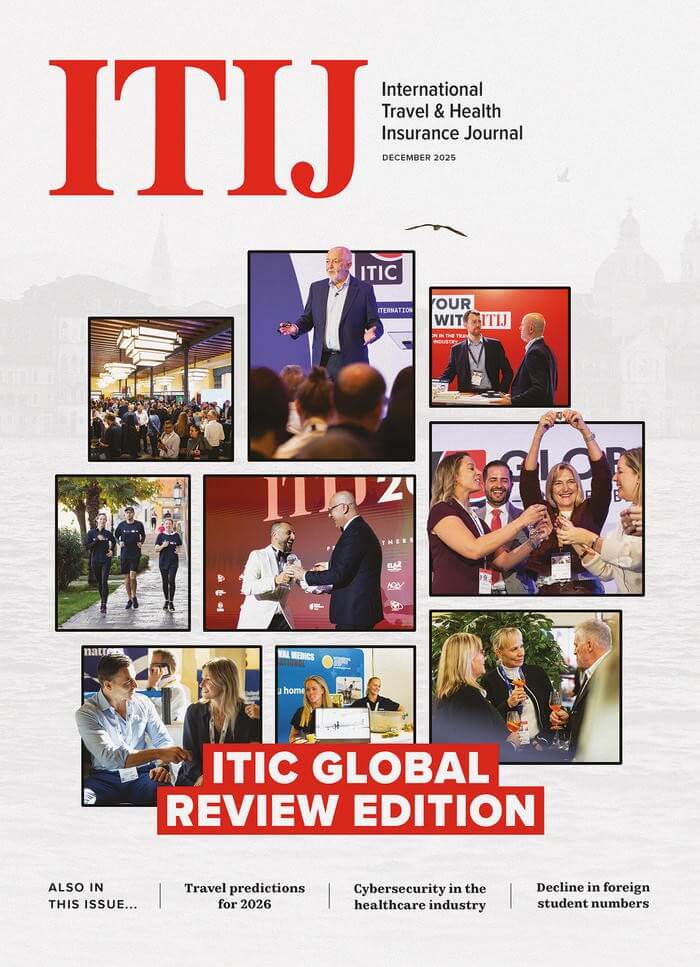
In this issue of ITIJ we examine breaches of cyber security in the healthcare sector and ask what can be done to prevent them, share travel predictions, including risks and hotspots, for 2026, and look at the global implications of changes in international student travel.
Milan Korcok
Milan Korcok is a national award-wining medical writer who has been covering international healthcare activities and trends in Canada, the US and abroad for many years. He has long served as contributing editor to the Canadian Medical Association Journal and the Journal of the American Medical Association. He is a founder of – and has served as editor of – the US Journal of Drug and Alcohol Dependence; a founder of the Travel Health Insurance Association of Canada, and currently serves as contributor to ITIJ.