When the location wasn’t what the records suggested

A traumatic brain injury in Cambodia became a complex cross-border medical evacuation as Kalaivarmen, Chief Operating Officer, and Sree Ganesh, Chief Business Development Director, at Aeromedical Global, tell ITIJ
When Aeromedical Global (AMG) was activated for the case, the clinical objective was clear: a patient who had sustained a traumatic brain injury in Cambodia required transfer to a specialised centre of excellence in Malaysia for further treatment. The operational picture, however, was less straightforward.
The challenges
AMG had established that the patient was physically in Cambodia. His immigration status and available travel records, however, indicated that he was in Thailand. The distinction became critical as the evacuation arrangements progressed. The patient could not simply be collected and moved according to the original documentation; the discrepancy had to be resolved before the planned cross-border movement could proceed. What initially appeared to be a medical transport therefore became a multi-layered operational exercise involving clinical coordination, ground logistics, immigration considerations and aviation planning.
AMG worked on these elements simultaneously. While the medical team assessed the patient’s condition and transport, the operations team coordinated with the relevant parties to establish the patient’s actual circumstances, clarify the documentation issue and determine a route that could be executed safely and lawfully. In parallel, AMG coordinated with the receiving centre in Malaysia to ensure that the destination and level of care were appropriate for the patient’s needs.
The repatriation
Once the roadblock was resolved, the evacuation moved into execution. Rather than treating the mission as a single flight, AMG structured it as a continuous, multimodal medical evacuation. The patient was first moved by ground ambulance in Cambodia, with medical support. The ground movement and cross-border arrangements were then coordinated to position the patient for the aviation sector. The journey continued by air to Malaysia, followed by a further ground ambulance transfer to the receiving medical facility.
The operation therefore brought together several distinct transport components within one coordinated plan: ground medical transport, cross-border road logistics, international air transport and onward ground ambulance transfer. Throughout, the medical requirements of the patient remained central to the operational decisions.
Importantly, this was not a repatriation simply because Malaysia was connected to the patient’s background. The purpose of the evacuation was to move him to a centre of excellence capable of providing the next stage of specialist care required.
Resolving problems
The case demonstrates a fundamental reality of international medical assistance: the most difficult part of an evacuation is not always the flight itself. Sometimes it is identifying the barrier that prevents the flight from happening, resolving it quickly and rebuilding the transport plan.
For AMG, the role extended beyond arranging an aircraft or an ambulance. It involved connecting medical assessment, cross-border coordination and multiple diplomatic clearances, ground transportation and aviation into one continuous patient journey.
From the patient’s location in Cambodia to definitive care in Malaysia, the mission required AMG to adapt the route, coordinate multiple stakeholders and keep the evacuation moving despite an unexpected operational roadblock. In complex medical assistance, the route on paper is only the starting point. The real test is making the journey work.
AMG’s role was ultimately to turn a complicated cross-border situation into a single, coordinated medical journey – combining ground transport, cross-border coordination and multiple diplomatic clearances and air evacuation to bring the patient safely back to Malaysia for continued care.
In complex assistance cases, the route on paper is not always the route that has to be taken. What matters is having the operational capability to adapt quickly while keeping the patient’s safety at the centre of every decision.
Kalaivarmen
Chief Operating Officer, AMG
Kalaivarmen is the Chief Operating Officer of Aeromedical Global, overseeing international medical assistance, aeromedical operations and complex patient movement. His work focuses on coordinating multidisciplinary teams and developing practical solutions for challenging cross-border medical transfers.
Sree Ganesh
Chief Business Development Director, AMG
Sree leads the organisation’s international business development and strategic partnerships. His focus includes building relationships with insurers, assistance companies, healthcare providers and aviation partners across international markets.
Together, Kalaivarmen and Sree combine operational expertise with commercial and industry insight, supporting AMG’s approach to complex medical evacuation, repatriation and patient transfer services across borders.
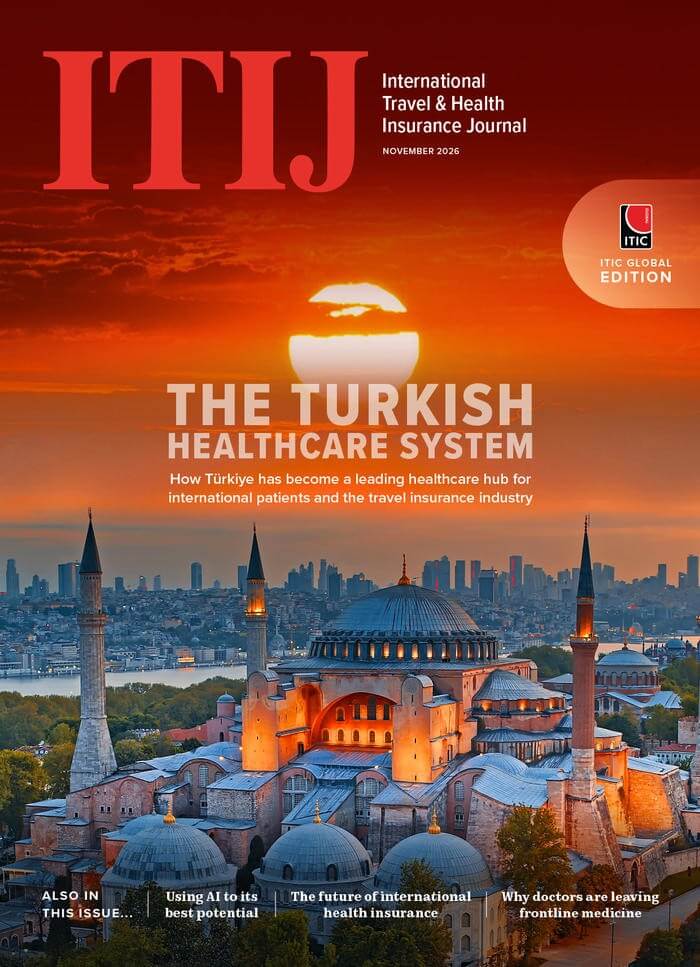
November 2026
Issue
In this, our biggest issue ever, our main focus is on artificial intelligence. After recent threats and warnings about the potential dangers of AI and calls for coordinated action to slow the technology's development, we speak to experts about the technology in a three-part special. We look at data-driven risk assessment, underwriting, and portfolio optimisation, which are all being transformed by AI, and ask what insurers and underwriters are doing to get the most out of the technology.
Editorial Team
The Editorial Team updates the ITIJ website daily, and works on features for the print edition. With expert industry knowledge and years of experience in writing about complex travel insurance issues, the Editorial Team is ready to investigate and report on the topics that matter most to ITIJ's readers.