When disruption strikes: building corporate security resilience before the crisis

As geopolitical disruption makes business travel harder to predict, organisations must know when to move, when to shelter, and how to turn intelligence into action. Chloe Fox explores
A political crisis can change the practical reality of business travel in a matter of hours. A road can become impassable, an airport can close, communications can fail, and a journey that looked straightforward can suddenly carry greater risk than staying where you are.
For companies with employees, expatriates, contractors, and operations spread across multiple locations, the challenge is not simply identifying that something is happening. It is knowing what it means for their people, when to act, and how to make decisions as options narrow.
The contributors to this feature describe a corporate security environment in which preparedness increasingly depends on intelligence, visibility, clearly defined responsibilities, and the ability to turn a plan into action.
A wider security landscape demands earlier preparation
“The lens has broadened significantly,” said Isaak Eliezer, Regional Security Manager, EMEA, at Healix International. Corporate security, he argued, has moved beyond physical protection into organisational decision-making, influencing “market entry and exit, strategic direction, workforce planning, and infrastructure requirements”.
For Jason Lowe, Director of Global Security Operations at Crisis24, that shift has created a corporate security landscape that is “more complex, faster moving, and less predictable”. Organisations now face interconnected risks affecting “people, assets, information, operations, supply chains, reputation, or the organisation’s ability to meet its objectives”.
Political polarisation, economic pressure, misinformation, cyber disruption, natural disasters, infrastructure failures, and social media can combine to amplify localised disruption.
Greg Pearson, Founder and CEO of FocusPoint International, sees the change in how people travel, too. “Business travel has become more decentralised,” he said, with employees working remotely, extending trips into personal travel, and operating where support infrastructure may have limitations. That makes preparation before departure increasingly important, particularly as disruption can occur in places not previously regarded as high-risk.
Lowe noted that civil disruption could develop in low-risk locations, triggered by “cost-of-living pressures, disputed political outcomes, labour action, shortages of essential goods or fuel, currency instability, or a single local incident that rapidly gains wider attention”.
Coverage alone does not guarantee a successful outcome


Pearson described this as “probably the most misunderstood aspect of business travel protection”. In an active crisis, he said, the immediate challenge was “determining where employees are, understanding what is happening on the ground, identifying safe movement options, coordinating transportation, securing accommodations if necessary, and maintaining communication until the situation stabilises”.
The need for that capability becomes more acute as conditions deteriorate. Roads may close, flights can be suspended, and communications can degrade. Security assistance cannot guarantee that movement will always be possible, but it can help determine whether it is feasible and identify lawful, safe options when a window opens.
For Eliezer, bringing insurance and specialist assistance together is ultimately about creating the capability to act when it matters. Organisations, he said, “need confidence that employees can be located, supported, communicated with, and, where necessary, evacuated safely and efficiently”.
Knowing when to move, and when not to
An evacuation decision is not simply about identifying a threat and ordering people out. Eliezer is clear that “evacuation should not automatically be treated as the default response”. As routes become unpredictable and airports or borders become overwhelmed, moving people can sometimes increase their exposure, making the quality of the information behind the decision critical.
Preparedness is no longer measured by whether an organisation has a travel policy. It is measured by how effectively that policy performs when everything goes wrong
Eliezer pointed to embassy alerts and travel advisories, kinetic activity, critical infrastructure resilience, and the condition of airports, ports, roads, and border crossings. His emphasis, however, is on what is happening operationally rather than relying solely on public statements. He calls for “operational intelligence rather than rhetoric or public statements”.
Lowe takes a similarly broad view of potential triggers: a credible threat to life, deteriorating security conditions, natural disasters, changes in government or diplomatic advice, transport disruption, civil unrest, armed conflict, targeted violence, or the breakdown of essential services. But the decision rarely rests on one factor alone. Instead, it considers “threat trajectory, exposure of personnel and operations, medical and welfare considerations, communications reliability, availability of safe movement windows, and the likelihood that options will narrow if action is delayed”.

The preparedness gap is often practical. Eliezer pointed to situational awareness as a particular challenge, especially as the volume of available information and automation creates its own noise. Organisations need to identify what is genuinely relevant to them.
“What organisations still require, for now, is skilled people who can cut through that noise, understand the organisation in depth and turn information into relevant intelligence.”
That capability can provide early warning and support mitigation before disruption becomes an operational problem. Lowe also identified unclear thresholds, untested travel policies, incomplete visibility of exposed personnel, and slow decision-making between teams as common weaknesses.
Eliezer described “lack of decisiveness” as a central vulnerability when sudden disruption occurs. A plan can appear mature on paper but fail in practice when “decision rights are unclear, contact data is outdated, employees do not know what to do, or senior leaders have not agreed in advance what level of risk is acceptable”.
For Pearson, situational awareness remains fundamental at the individual level. “An informed traveller is better equipped to recognise changing conditions, avoid unnecessary risk, and make better decisions long before a crisis develops.” Once an incident begins, he said, “timely, accurate intelligence is often the difference between a proactive response and a reactive one”.
The difference between being covered and being able to act
That distinction becomes particularly important when companies consider their travel protection arrangements. Insurance and security assistance can sit alongside one another, but they perform different functions.
Eliezer put it simply: “Insurance provides financial cover; dedicated security assistance provides operational capability.” Having cover in place does not necessarily mean an organisation has the resources or expertise to manage a crisis as it unfolds. “Coverage alone does not guarantee a successful outcome.”
Taylor El-Hage, Security Manager, Assistance, at International SOS, focused on what happens when normal infrastructure starts to fail: “Travel insurance and security assistance address related but fundamentally different problems. Insurance is principally a financial mechanism: it establishes what circumstances and costs are covered and what can subsequently be reimbursed. Security assistance is an operational capability concerned with what can be done to mitigate risk and provide support when a traveller is exposed to a deteriorating security situation.”
Lowe said companies should establish what their insurance, internal security function, and external assistance provider are each designed to do. Travel insurance can cover defined costs, subject to policy terms and triggers, while dedicated security assistance addresses the emerging risk: protecting personnel, assessing conditions, communicating with stakeholders, and coordinating action.
The difference is particularly clear when an evacuation is being considered. “That distinction becomes critical during an evacuation,” Lowe said. “Confirming that costs may be covered is different from having an executable plan.”
An executable plan requires knowing who is affected and where they are, whether they can be contacted, and whether roads or airports remain usable. It also means assessing whether remaining in place, relocating or evacuating is safest.

Evacuation is therefore not necessarily a binary choice. The appropriate response may be to stand fast and support people in place, relocate them to a safer area within the country, or conduct a full evacuation. The response can also depend on who is exposed: a short-term traveller may have different requirements from an expatriate family, a local employee, or a business-critical team.
For the contributors, much of the work needs to happen before a crisis. “Organisations should define decision thresholds before a crisis, not during one,” Eliezer said.
Lowe similarly stressed the need for “clear escalation thresholds, named decision-makers, delegated authority, and a predefined crisis management structure” before an incident develops. Without these arrangements, valuable time can be lost debating what to do when options may already be disappearing.
El-Hage argued that scenario planning can expose assumptions before they are tested in reality. “Asking in advance what would happen if the airport closed, telecommunications failed, a border became inaccessible or a trusted provider could no longer operate is far easier than discovering the answer during an evacuation.”
Pearson agreed that objective thresholds could help remove emotion from the decision-making process, while retaining enough flexibility to respond to changing circumstances. “Conditions can change hourly,” he said, meaning an evacuation that appears appropriate in the morning may become more dangerous later that day.
What happens once an extraction is underway
When an extraction is required, the operation starts with information rather than transportation. Eliezer said the first task was to establish “why evacuation is being considered, what is driving the decision, and what outcome is required”.
That means building a clear picture of who needs assistance, where they are, and what personal circumstances could affect the response, including documentation, medical or welfare needs, and family circumstances.
El-Hage similarly described the process as one of establishing the situation before deciding how to move. “An operation begins with establishing an accurate picture: who requires assistance, where they are, what threats they face, and whether movement is currently safer than remaining in place. From there, response teams can identify secure locations, viable routes, transport options, and contingency arrangements.”
Planning then works backwards from the desired destination, taking into account safe havens, borders, airports, onward travel, and conditions on the ground. As Eliezer put it, “a route that looks viable on a map may be unworkable if any of these are compromised”.
Only once those assessments are complete can ground teams, aviation partners, accommodation providers, and other resources be activated. Lowe described an extraction as “a structured operation, not simply the act of putting someone in a vehicle and moving them to an airport”. Sometimes, the first decision may be not to move at all. “In some cases, sheltering may be safer than attempting to move through areas affected by unrest, conflict, or active security operations,” Lowe said.
Where movement is required, people may first be taken to a secure hotel, company facility, partner site or other vetted location. Local capability can be critical, particularly where teams need to navigate roads, checkpoints, authorities, and changing local threat dynamics. If infrastructure has deteriorated, roads may be blocked, fuel scarce, airports intermittent, and telecommunications unreliable, requiring teams to reassess transport, border conditions, medical support, and available flight options.

Communication remains central throughout the operation. Pearson called it “perhaps the most overlooked component”, with responders maintaining contact with travellers, employers, and family members as circumstances change.
The operation therefore remains fluid until people reach their agreed destination. Eliezer said “24/7 intelligence and operational monitoring are critical”, while Lowe observed that “the safest route or airport in the morning may no longer be viable later in the day”. Post-extraction support can then include onward travel, medical checks, welfare support, family and HR communication, and lessons learned.
Making sure the policy works when it is tested
For HR teams and travel managers, the contributors agree that security planning needs to be embedded within the wider travel programme rather than treated as a separate function.
“Travel risk management works poorly when it is treated as the responsibility of a single department,” El-Hage said. “HR, travel teams, security functions, and external assistance providers each hold different pieces of information that become important during a crisis.”
Bringing those perspectives together before an incident ensures that roles, responsibilities, and decision-making processes are already understood when they are needed most.
That shared picture is particularly important when accounting for people. Travel teams may hold booking information, while HR, security, and local management have details on expatriates, local employees, contractors, and dependants. Without accurate, accessible information, organisations can lose valuable time establishing who is exposed and how they can be contacted.
An informed traveller is better equipped to recognise changing conditions, avoid unnecessary risk and make better decisions long before a crisis develops
Testing those arrangements can reveal weaknesses that are difficult to identify on paper. “Exercises can expose surprisingly basic problems: outdated contact details, unclear responsibilities, inaccessible traveller data, or senior decision-makers who have never previously considered the circumstances in which they would authorise an evacuation,” El-Hage said. Scenario exercises can also challenge the assumptions behind a plan by asking: “What happens when the organisation’s preferred airport, provider or communications system is precisely the thing that fails?”
For Lowe, travel risk policies should be treated as “living documents”, with incidents, exercises, and near misses feeding back into future planning. Pearson similarly argued that ownership needs to be shared: “The most successful organisations treat travel risk management as a shared responsibility rather than assigning ownership to a single department.”
Ultimately, El-Hage said, the measure of a policy is how it performs when circumstances change. “A genuinely fit-for-purpose travel policy should therefore be judged by how it performs under pressure, not by how comprehensive it appears on paper.” The aim is not to anticipate every crisis, but to ensure that when assumptions change, organisations can recognise it, make decisions, and act while viable options remain available.
October 2026
Issue
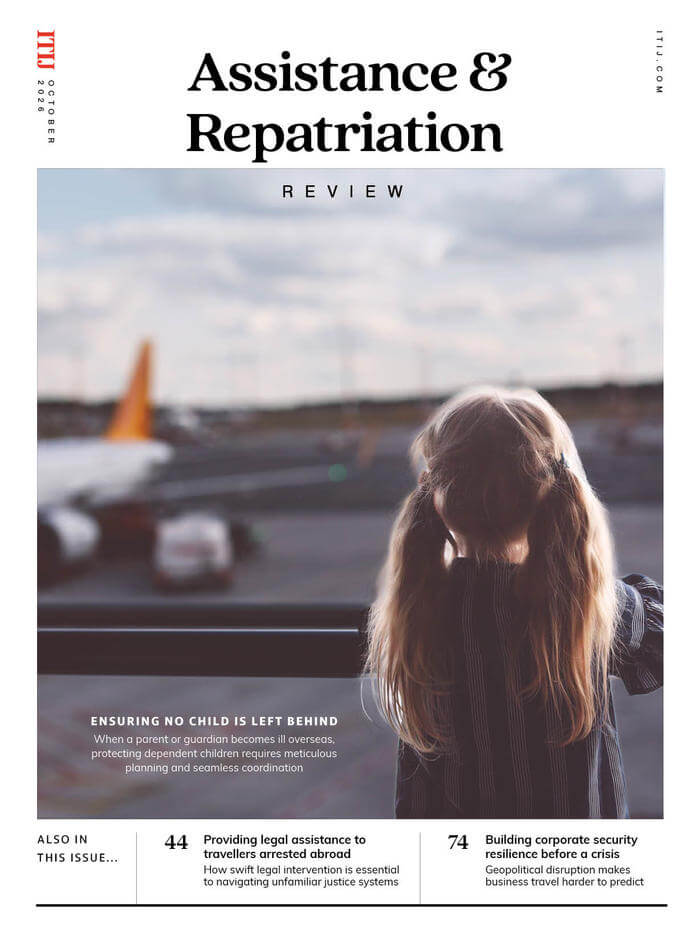
When a parent or guardian becomes seriously ill overseas, assistance providers face a complex challenge that extends well beyond clinical care. Although these cases are relatively rare, in this issue we look at how safeguarding dependent children requires careful planning, legal awareness, and close international coordination.
Chloe Fox
Chloe Fox is an Editorial Assistant for Voyageur Group, joining in 2024. She writes for ITIJ and AirMed&Rescue, covering a range of topics including international travel and health insurance, medical assistance provision, and air medical transportation. Chloe holds a BA (Hons) in English and an MA in English Literature from the University of Bristol.