Ten missions, nine days, four jets

Tyson Smith, Head of Business Development and Growth, Fixed Wing at LifeFlight, tells ITIJ how four jets delivered 10 air ambulance missions in nine days
Early on Sunday 16 August, one of our Challenger 604 jets landed in Sydney with two patients from Noumea, New Caledonia, while a second was crossing the Pacific towards Washington DC. By midmorning a third had left Brisbane for Bali to fly a young man home to Riyadh.
It was the busiest point of the nine days in which four jets from our Brisbane, Townsville and Singapore bases flew 10 missions, landed in 11 countries and territories and covered more than 100,000km. Every mission ran from one coordination centre and centralised roster, with crews inside duty limits and the next task in view.
Closer to home, the week started at 12.46am on Tuesday with a three-week-old baby in Cairns needing a paediatric intensive care bed in Brisbane. Our Brisbane jet was airborne inside two hours and flew to Cairns again the next morning with two more patients. It then flew a woman from Suva, Fiji, two patients from Noumea to separate Sydney hospitals and a ventilated patient from Tamworth, while our Townsville jet carried two cardiac patients from Darwin to Adelaide.
Going long
Our Singapore aircraft brought a man with a chest infection home from Ulaanbaatar, Mongolia, to Launceston. With rolling fuel restrictions in Ulaanbaatar, and drawing on our experience of northern China’s airports, we planned a technical stop in Hohhot both ways. The 604 was comfortably within range,and fuelling there on the way out gave ample reserves for the long legs south. A fresh crew and medical team, rostered in advance, took over at Townsville.
Every mission ran from one coordination centre and centralised roster, with crews inside duty limits and the next task in view
Washington was the longest mission: 15,500km and a 14-hour time difference for a young man recovering from spinal surgery.
Two complete flight crews and medical teams, the second pre-positioned in Honolulu, meant every sector was flown by a rested crew. Our operations team worked with US authorities on landing rights, shared military airfield approvals and a flight plan around the capital’s restricted airspace, as the president was in town. The patient was in a hospital bed 26 hours after leaving Brisbane.
The fourth jet flew a young man with a head injury and three family members from Bali to Riyadh. The team assessed Middle East airspace advisories for risks and confirmed crew and aircraft cover for the routing with our insurers inside the patient’s timeframe. Our nurse was briefed on local dress and customs, and the ambulance was waiting on the tarmac.
The 10th call
The last mission came to us. Homebound from Washington, the Townsville jet was retasked to Nadi, Fiji, for a woman with a pregnancy complication. Within hours we had a bed accepted in Townsville and a LifeFlight medical team at her side, ground coordination of a specialist team met the aircraft at our hangar for the airport-to-hospital leg then straight into surgery. Mother and baby are now both healthy and doing well.
None of this relied on one exceptional aircraft or day. It came from four of our 604 jets that are maintained in-house, a skilled staffing roster with depth built up from years of experience and an operations team that works seamlessly around the clock.
Tyson Smith
Head of Business Development and Growth, Fixed Wing, LifeFlight
Tyson leads one of the APAC region's most complex international jet retrieval operations. Overseeing more than 1,000 patient transports annually, he brings 14-plus years of aeromedical experience, driving global capability, operational excellence, and missioncritical outcomes under pressure.
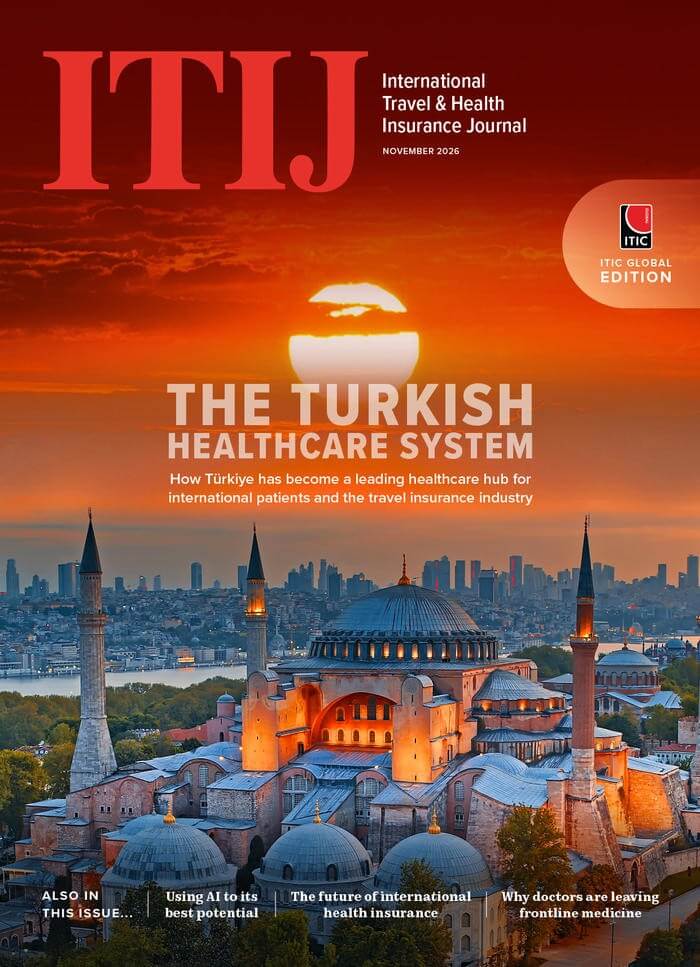
November 2026
Issue
In this, our biggest issue ever, our main focus is on artificial intelligence. After recent threats and warnings about the potential dangers of AI and calls for coordinated action to slow the technology's development, we speak to experts about the technology in a three-part special. We look at data-driven risk assessment, underwriting, and portfolio optimisation, which are all being transformed by AI, and ask what insurers and underwriters are doing to get the most out of the technology.
Editorial Team
The Editorial Team updates the ITIJ website daily, and works on features for the print edition. With expert industry knowledge and years of experience in writing about complex travel insurance issues, the Editorial Team is ready to investigate and report on the topics that matter most to ITIJ's readers.