Setting every mission up for success

Kristian Walter Høeg, COO of SmuuthCare, on the vital role of comprehensive patient information and medical reporting before assistance can begin
You have been with SmuuthCare for almost seven years. How has the industry changed in that time?
I’ve been working with air ambulance operations within our group for 10 years, and competition has intensified significantly in that time.
Contingency must be built into every mission plan from the outset, not improvised when circumstances shift
We’re now up against well-capitalised operators with larger fleets and multi-base networks, and price competition has grown, especially on shorter, intra-European routes that make up a large share of overall volume.
Where relationships and reputation used to carry a lot of weight in winning business, procurement today is far more structured, and price is very often the deciding factor.
That’s pushed us to think harder about efficiency – not just clinically, but commercially: what aircraft type, what cost base, what routes we’re genuinely competitive on. It’s a healthier, more demanding market than it was 10 years ago, and it rewards operators who stay sharp on both quality and cost.
Air ambulance missions often involve complex logistics and time-critical decisions. What are the biggest operational challenges SmuuthCare faces in coordinating these transports?
The core challenge is that critical variables – weather, airspace restrictions, permits, and an increasingly volatile geopolitical landscape – can change with little warning, often midmission.
Before any mission, we require accurate medical reports, patient details and hospital contact information
A route cleared in the morning can require full rerouting by afternoon, and with patients who cannot tolerate delay, there’s no margin to wait it out. Operating a focused fleet of two aircraft means we can’t absorb disruption the way a larger operator can.
Contingency must be built into every mission plan from the outset, not improvised when circumstances shift.
How is technology and real-time data helping to improve the safety, efficiency, and patient experience of air ambulance transfers?
Real-time data is what makes time-critical transport possible. Weather, air traffic restrictions and crew duty times can shift mid-mission, and live visibility lets us re-route immediately rather than reacting late – directly tied to patient safety.
For patient experience, it’s less about flashy technology and more about coordination quality: making sure the receiving hospital, medical crew and mission plan are all working from the same information, so there are no gaps when the patient lands.
Cross-border transfers can involve multiple healthcare providers, insurers, and authorities. How does SmuuthCare ensure seamless coordination between all parties involved?
It comes down to process discipline. Before any mission, we require accurate medical reports, patient details and hospital contact information – that’s the foundation everything else is built on. From there, our team stays in direct contact with the sending hospital, receiving hospital, insurer and relevant authorities throughout the mission, not just at handover. Owning that coordination end-toend is what keeps it seamless for everyone else, especially the patient.
Kristian Walter Høeg
COO, SmuuthCare
Kristian is the COO of SmuuthCare, part of the Sundberg Aviation Group. With over 15 years of aviation expertise, he oversees the company’s operational strategy and ensures the highest standards across all medical flight operations. SmuuthCare, based in Billund, Denmark, operates two Hawker 800XP aircraft designed to uphold the highest standards of in-flight medical care.
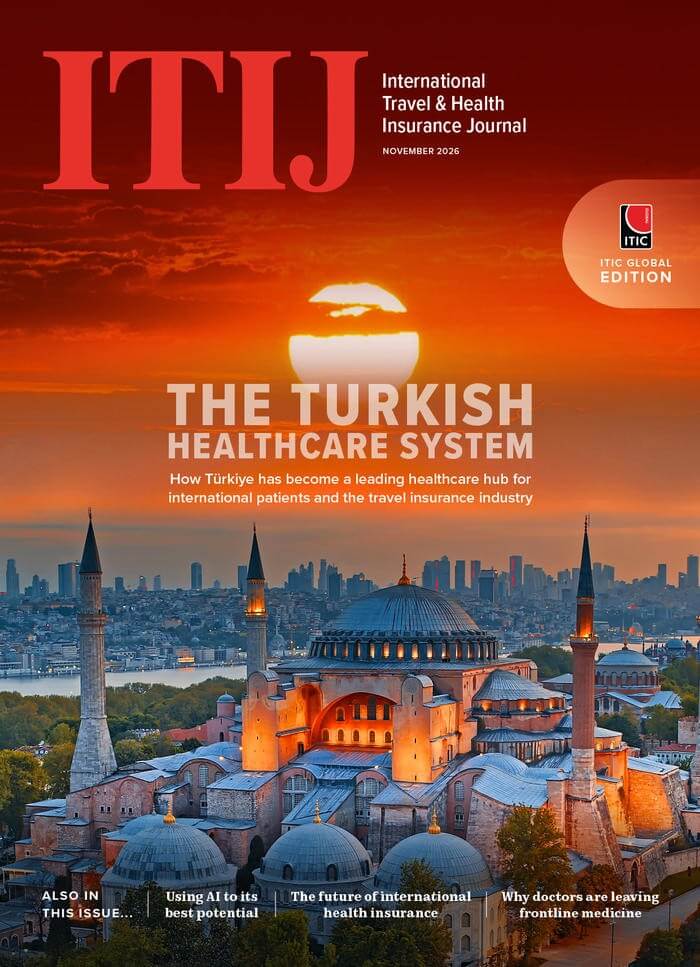
November 2026
Issue
In this, our biggest issue ever, our main focus is on artificial intelligence. After recent threats and warnings about the potential dangers of AI and calls for coordinated action to slow the technology's development, we speak to experts about the technology in a three-part special. We look at data-driven risk assessment, underwriting, and portfolio optimisation, which are all being transformed by AI, and ask what insurers and underwriters are doing to get the most out of the technology.
Editorial Team
The Editorial Team updates the ITIJ website daily, and works on features for the print edition. With expert industry knowledge and years of experience in writing about complex travel insurance issues, the Editorial Team is ready to investigate and report on the topics that matter most to ITIJ's readers.