
Reimagining claims payments in a global economy

Alfie Jake Thomson examines the future of claims payments: tradition, technology, and the rise of hybrid models
Claims have become increasingly global, and now, more than ever, businesses and organisations must find the payment system that is most efficient, secure, and cost-effective. Three approaches have stood out: international transfer protocols, cryptocurrency solutions, and parametric payment models.
In determining the best fit for an organisation, there is no universal solution, as Natalya Butakova, Chief Executive Officer of AP Companies, said: “From an operational perspective, there is no single payment solution that will work effectively across the global assistance and international healthcare ecosystem.” Many organisations now look towards hybrid payment ecosystems that combine traditional methods with emerging technologies to best optimise speed, costs, and the overall experience.

The old world: international transfer protocols
Traditional systems and local banking networks remain widely used, offering consistency in reliability, regulatory compliance, and familiarity. They remain critically important especially in the context of hospitals and regulatory healthcare providers which prioritise reliability and compliance above all else.
Speaking to ITIJ, Anna Trawick, Managing Director of SureGo Administrative Services, said that “electronic transfers, wire transfers, and paper cheques are still the primary method for claims payments”. Organisations that get to grips with the banking regulations, processing time frames, and transactional or intermediary costs associated with traditional systems can still process costs effectively. Mastering the nuances of international payments remains essential for any business that aspires to operate within the global marketplace.
Yet the traditional system is criticised by some who argue it is simply not up to the task. Carl Carter, CEO and Founder of CSC Global Partners, said that many see the international banking system as “overly complex and antiquated in today’s modern claims payment infrastructure”. While in terms of insurer-to-medical-provider payments, the traditional methods are less problematic, “as in this instance there is no expectation around expediency”, the insurer-to-consumer environment calls for higher expectations.
While in terms of insurer-to-medical-provider payments, the traditional methods are less problematic, as in this instance there is no expectation around expediency
“Consumers are used to making and receiving near instant payments and the traditional international banking systems lags far behind expectation in this scenario,” he said. “The old days of ‘your cheque is in the post’ or receiving your payment ‘in the next five working days’ simply cannot meet the expectations of the modern claimant. Especially if they feel insurers are quick to take their money, but slow to pay out.”
Such failings around efficiency have led to a growth in modern payment providers such as Vitesse and Flywire. Carter discussed how, when coupled with a digital-first third-party administrator (TPA) such as ClaimSorted, consumers can complete their claim and receive their payments direct to their bank accounts or virtual credit cards within minutes: “Not only does this deliver Net Promoter Score (NPS) boosting customer satisfaction, but the transaction costs are materially cheaper than the international and correspondent banking systems.”
The new world: cryptocurrency solutions
A relatively new arrival, cryptocurrency has been praised within emerging markets and developing countries where access to traditional banking infrastructure is either undeveloped or wholly inaccessible. Supporters of blockchain technologies and cryptocurrency speak of its ability to bridge the gaps where traditional methods have failed – creating greater possibilities for financial inclusion, investment, and new innovations.
They also point to the lower transactional costs compared with traditional payment systems. Through removal of intermediaries, cryptocurrency payments significantly reduce processing fees, with a report commissioned by the World Bank finding that the average cost of sending a US$200 cross-border payment through conventional methods was 6.3%, in stark contrast to the 1–2% fees incurred through cryptocurrency.
Through the elimination of intermediaries, payments can often become more affordable, ensuring more money reaches an intended recipient. The almost instant settlement of blockchain transactions is an attractive prospect and, combined with its detachment from the traditional systems, can be seen as a borderless solution for many.
Through the elimination of intermediaries, payments can often become more affordable, ensuring more money reaches an intended recipient
However, it is this exact detachment that has caused issues for cryptocurrency. Not being tied to the promises and variables of any bank, values can appreciate and depreciate rapidly, and without warning – payments worth thousands today can be worth hundreds tomorrow. This volatility, combined with the misinformation and complexity often associated with cryptocurrency, means that despite the hype and speculation, it has not resulted in, as Carter described, the “widespread adoption the revolution was supposed to bring”. Carter went on to say this was because of how, in many cases, “solutions are complex, volatile, and seeking to solve a problem that is already catered for using different modern payment solutions – ones that do not come with the added uncertainty of crypto payments”.
Such issues have kept the consumer adoption rate for cryptocurrency as a transactional currency relatively small; it is seen more as a “speculative investment currency format” with consumers remaining happier to receive payment in their native currency direct to their bank account or virtual credit cards.
Parametric payment models
A new form of insurance solution, parametric systems work to trigger automatic payments based on pre-defined events which are integrated with digital payment rails. By covering the probability of a loss-causing event, like a natural disaster, organisations can agree to make payment upon the occurrence of covered events meeting or exceeding a pre-defined intensity threshold, as measured by an objective value. These thresholds will be set in a way that aligns with both a client’s risk tolerance and the business continuity plan.
Sid Mouncey, Chief Commercial Officer of Blink Parametric, told ITIJ how, with a business sitting squarely within the parametric payment model, “the results speak for themselves”.
“By triggering automatic payments the moment a pre-defined event occurs, such as a flight delay exceeding a set threshold or a weather event breaching agreed parameters, we eliminate the friction that defines traditional claims processing,” he explained. “Customers don’t file a claim; they simply receive a payment in real time and, critically, at the time they need the money, not days or weeks later. That shift fundamentally changes the customer experience.”
Conducting a large customer study through its partner, MAWDY, Blink Parametric found that customers who had received an instant cash payment when a flight was delayed by over three hours had an NPS of 78, an incredibly high score for an insurance product.
The model is fast becoming a standard product feature in many travel insurance markets. Carter discussed Canada becoming one of the first to deliver widespread deployment of parametric solutions, within travel insurance policies for flight delays.

“Over half the Canadian travel insurance market now has real-time flight delay solutions that pay out an airport lounge pass, cash payment or newly emerging consumer gift card solutions,” he said. “Providers like Blink Parametric have been one of the driving forces behind such expansion, due to their flexibility of systems and payment resolutions.”
While parametric technology will never replace full travel insurance policies or apply to all sections, as the real-time data would not be available, where it is available it is “turbo-charging the customer experience”, shaping consumer behaviours, with brands that have rolled out parametric solutions seeing “increased sales, increased NPS, and reduced operational burden”, said Carter.
It is this challenge that excites us and we will continue to push the boundaries for what is possible in this area
Trawick told ITIJ that “parametric payment methods coupled with AI technology is where the industry is headed”, although this view came with a caveat: “When you consider variations in policies, custom carrier requirements, and state regulations for auditing and compliance, creating a system that checks all these boxes with a small financial gap will be challenging.” However: “It is this challenge that excites us and we will continue to push the boundaries for what is possible in this area.”
How do businesses choose the right approach?
Finding the optimal solution is difficult for businesses in an environment where clients increasingly expect instant access to guarantees of payment, digital authorisations, and rapid settlement capabilities, through mobile and digital ecosystems.
Organisations must take time to review what is happening at home, and internationally. Carter spoke of the “positive disruption” of a “tidal wave of new technology that is reshaping the industry for the better. The landscape is ever changing, and the pace of change is increasing… gone are the days where an organisation can sit back and watch what happens.” For those organisations built on legacy models, refusal to change means “a new entrant or a new technology quickly unseating a market leader”.
Discussing this question with ITIJ, Mouncey argued that the right payment architecture depends on what an organisation is optimising for, which varies significantly across the travel insurance ecosystem. For insurers, the priority is typically balancing regulatory compliance with the operational efficiency gains that automation delivers. For assistance companies, speed of global payout is often the decisive factor. “Brokers need flexibility; hospitals and healthcare providers [need] clarity and reliability above all.”
Brokers need flexibility; hospitals and healthcare providers need clarity and reliability above all
Mistakes come from treating this as a binary choice; businesses should map out operational priorities first, then ask which payment model best serves each case, utilising a layered approach: “Parametric triggers for high-frequency, low-complexity events where speed matters most, and traditional processes for complex claims that require human judgement.”
The organisations that will lead, going forward, are those that will treat payment infrastructure as a strategic capability, “not a back-office function,” he said.
Looking ahead: hybrid payment ecosystems
Consequently, to move forward in an ever-changing industry, many organisations are now actively embracing a combination of traditional rails with emerging technologies.
Butakova said many assistance companies were now “increasingly relying on the use of [a] hybrid payment ecosystem: local banking capabilities through regional infrastructure and offices, virtual card technologies where acquiring systems are available, digital transfer mechanisms, and, in certain urgent environments, alternative transfer channels that allow immediate operational continuity”.
Such flexibility is becoming an industry necessity when considering the growing demand for faster payments along with greater payment intelligence and operational visibility.
The future is not only about moving money faster, but also about understanding where costs originate, identifying provider pricing patterns earlier, and improving decision-making before costs can escalate
“The future is not only about moving money faster, but also about understanding where costs originate, identifying provider pricing patterns earlier, and improving decision-making before costs can escalate,” she said. “Within AP Companies, this increasingly involves the use of internal health intelligence, analytics systems supporting operational teams with provider benchmarking, medical cost visibility, and treatment pathway analysis, allowing assistance companies and insurers to make faster and more informed decisions, reduce unnecessary cost escalation, and improve overall claims outcomes.”
As global medical inflation continues to rise, with healthcare pricing becoming fragmented, Butakova praised hybrid systems for their ability to combine payment execution with real-time operational intelligence as the “critical differentiator within the international assistance ecosystem”.
Similarly optimistic, Carter discussed how CSC Global Partners is working with travel insurance companies and TPAs that are utilising hybrid payment ecosystems to deliver fast, accurate, and cost-effective payments, which are delivering increased customer satisfaction and consequently increasing retention.
“The combination of parametric technology to monitor eligible events against triggers, and then the delivery of a fast payment upon a trigger being hit, relies upon a fast payment mechanism to deliver prompt, near instant payment to the consumer,” he said. “Making a consumer aware of an eligible event and then offering them a hybrid choice of payment solutions puts the consumer in the driving seat as to what payment experience will fit their needs best.”
Mouncey raised how adoption of these hybrid approaches should not be seen as a pragmatic compromise but as “the right architecture for scale”.
Traditional rails give organisations global reach and regulatory certainty, while parametric systems promise speed and automation. The challenge comes in “ensuring those layers communicate seamlessly, and that the end customer experiences only the outcome: a payment that arrives before they’ve even had time to feel the disruption”.
Traditional rails give organisations global reach and regulatory certainty, while parametric systems promise speed and automation
Mouncey added that parametric models don’t exist in isolation, but rather on top of existing payment infrastructures, with the real opportunity coming from how intelligently organisations connect the two.
“At Blink Parametric, we integrate parametric triggers with modern digital payment rails to ensure that when an event happens, the disbursement follows within minutes, not days. That means combining the precision of event-driven logic with the reach and regulatory compliance of established banking networks.”
Looking ahead, Butakova believes the industry will continue moving towards “flexible hybrid models that combine the stability and compliance of traditional financial systems with the speed, automation, and operational flexibility of modern digital payment technologies”.
September 2026
Issue
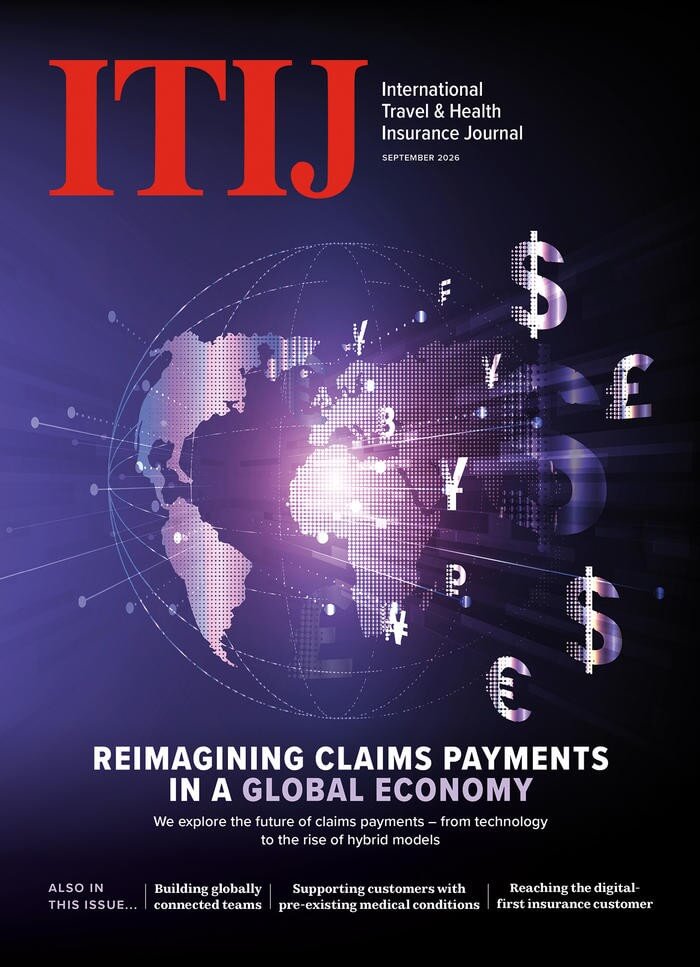
This month we take a close look at claims payments. As these payments become increasingly global, organisations are evaluating traditional international transfers, cryptocurrency, and parametric payment models to balance speed, cost, compliance, and customer experience.
While traditional banking systems remain trusted for reliability and regulatory certainty, they often fail to meet growing expectations for instant payments. Industry leaders increasingly favour hybrid payment ecosystems, combining established banking networks with modern digital technologies to deliver flexible, efficient, and customer-centric payment solutions. We hope the insights from our experts give you food for thought.