Raising the bar for global patient repatriation

Gaby Hosea, Director of Clinical Services at New Frontier Group, shares insights into quality, safety and excellence in medical escort services
As international patient transfers become increasingly complex, what are the most important industry standards and clinical guidelines that organisations should follow when transporting patients after hospitalisation?
An important, often overlooked, standard is matching escort level of care to licensed clinical scope, not title. ‘Nurse’ doesn't mean the same thing everywhere. In some countries, the designation reflects training as a bedside aide without authority to administer medications, whereas in the US, a licensed nurse operates under a robust scope of care and can administer medications and provide interventional therapies. That gap in scope, not the title, determines whether an escort is qualified for the mission.
Safety is the guiding principle that ultimately determines the appropriate level of care
We also see the reverse: clients requesting a physician-level escort for a stable patient who needs bedside monitoring. Physicians are typically trained to diagnose, not provide continuous bedside care that stable commercial transport requires. The standard that should drive these decisions is clinical need, not title.
How do you balance patient autonomy and choice with clinical risk management when determining whether a patient is fit to travel and what level of escort support is required?
Patient autonomy and clinical risk operate on different levels. Autonomy governs whether a patient can choose, while risk includes the full clinical picture including age, diagnosis, comorbidities, degree of deconditioning, and type of transition (hospital-to-hospital, hospitalto-home, hospital-to-rehab, or discharge to long-term care with limited ambulation).
Additionally, length of travel, pharmacological therapies, and required equipment determine the support the patient needs.
Safety is the guiding principle that ultimately determines the appropriate level of care. When a patient wants more independence than a clinical picture safely allows, the resolution is rarely to simply override them. Instead, we adjust escort intensity using a registered nurse (RN) versus physician escort, non-medical escort, or add clinical adjuncts versus more invasive monitoring to build enough support around patient choice to keep them safe.
What are the biggest challenges providers face in ensuring continuity of care during the transition from hospital to home country, and how can those risks be mitigated?
The biggest challenge sits at handoff. Transport needs to bridge gaps with preparation and communication well before wheels-up, not after.
Items to lock down include specialty medications dispensed with enough supply for the prescribed cycle, and confirmation that therapies and support structures needed are available before patients arrive.
Multi-stakeholder coordination is where this can break down: clinical, communication, coordination, IT, and finance functions all have to stay synced. Something as simple as an inbox accountability gap can undo careful clinical planning. We mitigate this through structured pre- and post-mission debriefs across every function, plus consistent training and competency logging for the escort team. Consistency and process mitigate risks.
Have you seen any emerging trends, technologies, or best practices that are improving quality outcomes in global medical escort and transitional care services?
Several trends stand out. Documentation is moving toward standardised, all-inclusive formats so nothing gets lost in translation between sending and receiving clinicians. Training is following suit with simulationbased competency verification and continuing education replacing years of experience as the sole proxy for readiness.
We're also seeing more robust fitness to fly standards and momentum toward a single, standardised MEDIF clearance form accepted across all airlines.
Perhaps the biggest shift is artificial intelligence (AI)-driven risk assessment on a global scale. Real-time location and safety data now feeding into pre-flight and en-route decisions weren't possible a few years ago. Even with that technology, communication and preparation remain the foundational cornerstones of good transitional care.
Gabrielle Hosea
MSN, RN, Director of Clinical Services, New Frontier Group
Gabrielle has 30 years of experience as a clinical leader and specialises in global medical escort. For the past two years, she has consulted for commercial air medical transport organisations and repatriated more than 10,000 patients across 100 countries. She has built clinical programmes from the ground up, developed SOPs and compliance frameworks, and founded a CAMTS-accredited medical transport company. She has served as a Clinical Site Evaluator for CAMTS and a Medical Community Advisor to IAG, where she shaped industrywide fitness-to-fly standards and international facility evaluation protocols.
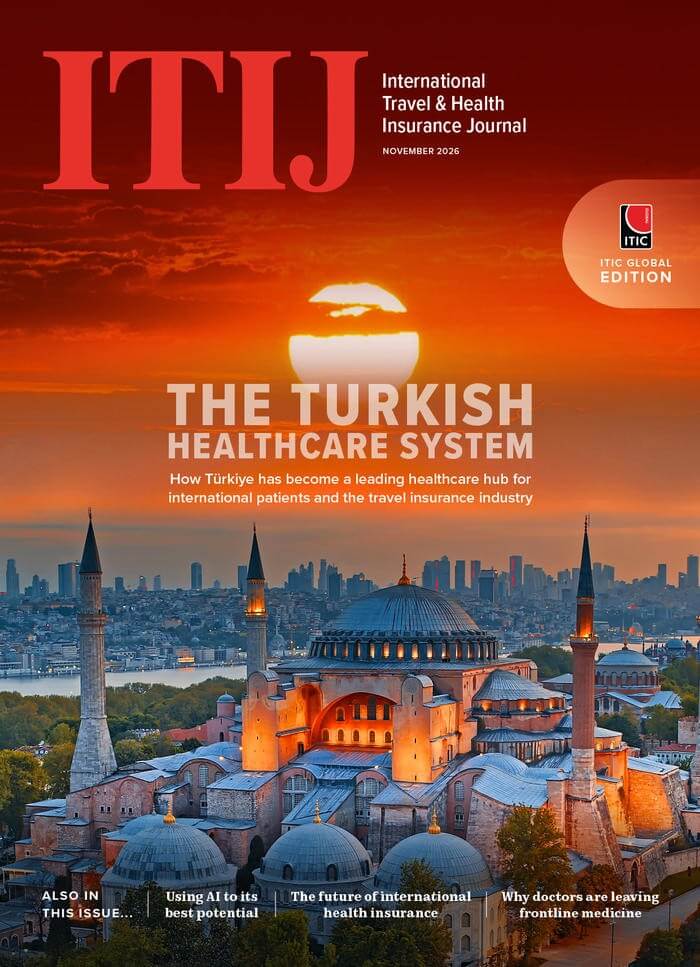
November 2026
Issue
In this, our biggest issue ever, our main focus is on artificial intelligence. After recent threats and warnings about the potential dangers of AI and calls for coordinated action to slow the technology's development, we speak to experts about the technology in a three-part special. We look at data-driven risk assessment, underwriting, and portfolio optimisation, which are all being transformed by AI, and ask what insurers and underwriters are doing to get the most out of the technology.
Editorial Team
The Editorial Team updates the ITIJ website daily, and works on features for the print edition. With expert industry knowledge and years of experience in writing about complex travel insurance issues, the Editorial Team is ready to investigate and report on the topics that matter most to ITIJ's readers.