
Providing legal assistance to travellers arrested abroad

Oliver Cuenca explores how swift legal intervention and consular coordination are essential to navigating unfamiliar justice systems
An unexpected arrest overseas is one of the most demanding crises a traveller can face, presenting immediate logistical and legal challenges for assistance providers, insurers, and corporate employers alike. When a client or employee is detained in an unfamiliar jurisdiction, the initial response frequently dictates the trajectory of the entire case.
Navigating complex foreign legal systems, managing the expectations of anxious families, and securing reliable local representation requires swift, decisive, and highly coordinated action. Here, we explore the critical first steps that must be taken following an international arrest, from establishing initial contact and leveraging consular support to assembling a robust, globally minded legal strategy.
The immediate aftermath
Michael Polak, Director of Justice Abroad, began by explaining that from a legal perspective, the first few hours following the arrest of a client abroad can be “absolutely critical”.
“The initial priority is to establish precisely where the individual is being held, the basis upon which they have been detained, whether they have been formally charged, and when they are due to be interviewed or appear before a court,” he said.
Polak added: “For a detainee in a foreign country there can often be pressure to sign a statement for the authorities … wrongly inculpating the individual. Often this is done without interpretation or legal representation and under the guise that the detainee will be released upon signing such a statement. Getting independent representation to see a detainee and to advise them of their rights before the detainee does anything against their own interests is therefore essential.”
For a detainee in a foreign country there can often be pressure to sign a statement for the authorities, wrongly inculpating the individual
Alongside this, he reported that the next step would be to ensure that the relevant embassy or consulate is notified as quickly as possible, adding that while embassies are limited in the support they can give, “consular officials can play an important role in confirming the individual’s location and welfare, as well as accessing the detainee and communicating with them”.

Polak noted that the right to access consular authorities is enshrined in international law under the Vienna Convention.
Alongside legal support, the role of the international legal counsel is also to assess concerns about medical treatment, detention conditions, and any other potential mistreatment, and raise them with the relevant embassy and the detainee’s own political representative in their home country.
The UK Foreign, Commonwealth & Development Office (FCDO) aligns with this approach, stating that in the event of a traveller being arrested while abroad, local authorities are expected to ask the detainee whether they want to contact an embassy, high commission or consulate.
Once informed, the role of the embassy or consulate is to contact the detainee as soon as possible to assess the situation, maintaining “regular contact with you, and do what we can to support your health and welfare while arrested or in prison abroad”.
However, the FCDO also noted that the speed at which it is able to do so may depend on the local authorities, and warned that local conditions may differ significantly from what the detainee would expect in their home country.
Detainees should not sign any documents if they do not understand them
The agency also warned that embassies and consulates cannot “get you out of prison; pay for lawyers, interpreters or any other costs, including fines; provide translation services; offer legal advice or represent you; start legal proceedings on your behalf; investigate a crime or respond to one; interfere with the local justice system; prevent you from being deported after release, even if you previously lived in the country; or get you special treatment”.
Operational best practices
Polak reported that when it comes to understanding the situation as clearly as possible, it is often best practice to discuss it with “the traveller’s family, colleagues or whoever has contacted us”.
“We would try to establish where the individual is being held, what is alleged to have happened, whether they have been charged, what contact they have had with the authorities, and whether there are any immediate concerns about their welfare,” he added.
Polak explained that once reliable information has been established about “the evidence, the local legal principles, and the legal procedure going forward”, managing the expectations of the traveller and their family becomes much easier, with the ability to define a likely timeline for proceedings.
“Families are understandably anxious and may expect immediate answers or release, but legal processes can differ significantly between jurisdictions and, often, rushing into a decision, such as how someone should plead to a charge, can result in mistakes and longer periods in custody,” he argued. “Therefore, it’s important to explain what is known about the situation, what remains uncertain, what the next procedural steps are, and what can be achieved by presenting the case in the strongest light.”
Many companies are unprepared for the possibility that one of their employees might be arrested while abroad

Once there is a clear view of the situation, Polak explained that the next step is typically to contact and instruct appropriate local lawyers who have the necessary experience to navigate the relevant legal system and provide direct access to the detained traveller.
“It is surprising, but we have come across cases involving international corporations who have instructed compromised local lawyers to represent an employee all through having inadequate knowledge of the local legal system,” he warned, noting that unfamiliarity with the local legal community could jeopardise the traveller’s situation further.
The FCDO reinforced this position, also strongly recommending that detainees find a local lawyer and a translator to assist with legal processes, and warning that detainees “should not sign any documents if they do not understand them”. The agency added that embassies should be able to provide a list of local, English-speaking lawyers – both digitally and on paper.
Polak noted that when it comes to ensuring any bail is paid promptly, such actions must be “balanced with proper compliance”.
“Where an assistance company, insurer, employer or family member is providing the funds, the transfer should go through an identifiable and auditable route rather than through informal intermediaries where possible,” he explained.
Preparation is vital before an arrest occurs
While there is no single formula for managing an arrest overseas, Polak argued that early intervention is “enormously important” – but warned that many companies are unprepared for the possibility that one of their employees might be arrested while abroad.

“There is little time to start looking around for representation or trying to understand the local law or politics once a situation has developed,” he explained. “Many companies … react slowly and without international understanding when it takes place.”
Polak argued that companies often do not have the capacity to provide adequate assistance to a detained employee, and that there is often considerable value and cost savings for companies in real terms in calling upon international counsel to coordinate the overall strategy, “rather than leaving this to an individual with no experience in that area”.
“Ultimately, the strongest cases tend to be those in which local legal expertise is coupled with effective international coordination, a set strategy, consular engagement, and disciplined media communication,” he concluded.
Coordination is key
When working with other parties – such as insurers or assistance firms – to assist a detained traveller, Polak argued that the most effective approach was a coordinated one.
“An assistance company or insurer will often be the first organisation contacted,” he said. “They may have a 24-hour emergency operation, obtain the initial information, and might be able to identify where the traveller is being detained.
They will also determine what assistance is covered under the relevant policy. Sometimes individuals and their families might be disappointed by what is being offered.”
An assistance company or insurer will often be the first organisation contacted
From there, insurance companies should ideally liaise with international legal firms that have experience in assisting individuals abroad and can ensure that the legal team assembled to assist actually has the expertise to do so.
Conclusion
Navigating a foreign justice system is undeniably fraught with potential pitfalls, but a well-coordinated response can significantly mitigate the worst outcomes for detained travellers. For the travel insurance and assistance sectors, the fundamental takeaway is the absolute necessity of preparation before a crisis actually occurs.
Relying on reactive, ad hoc solutions during the critical first hours of an arrest is a deeply risky strategy – one that can severely prejudice a client’s case. By establishing clear protocols and partnering with experienced international legal experts ahead of time, the industry can ensure that vulnerable policyholders receive robust, culturally aware, and strategically sound support.
Ultimately, safeguarding a traveller in detention relies not merely on financial assistance, but on a foundation of proactive, global coordination.

October 2026
Issue
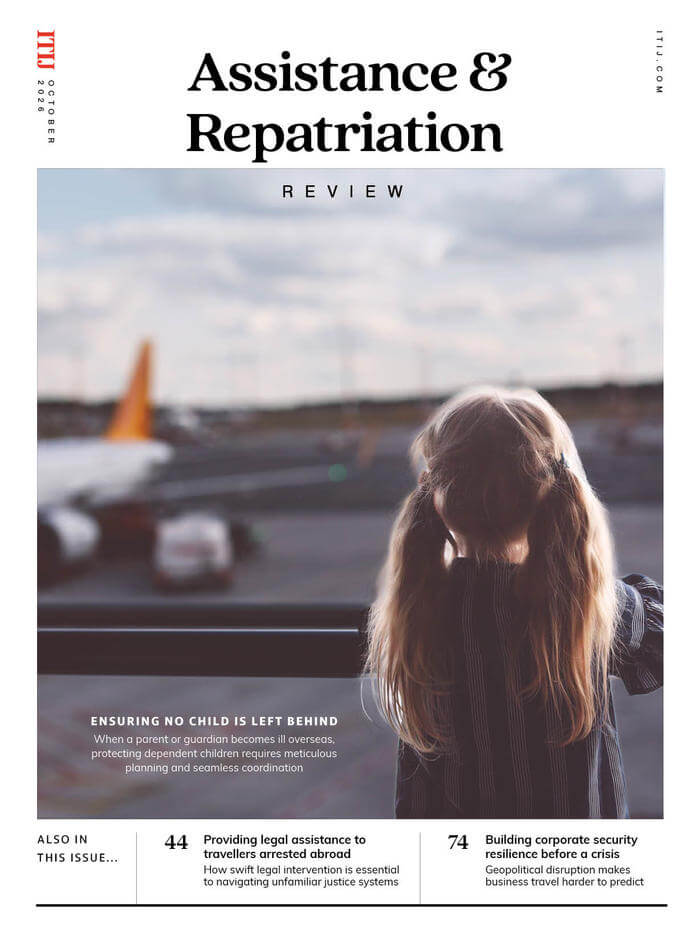
When a parent or guardian becomes seriously ill overseas, assistance providers face a complex challenge that extends well beyond clinical care. Although these cases are relatively rare, in this issue we look at how safeguarding dependent children requires careful planning, legal awareness, and close international coordination.
Editorial Team
The Editorial Team updates the ITIJ website daily, and works on features for the print edition. With expert industry knowledge and years of experience in writing about complex travel insurance issues, the Editorial Team is ready to investigate and report on the topics that matter most to ITIJ's readers.