
Legal assistance for travellers in need

Legal assistance for travellers abroad remains fragmented and inconsistent, even while global mobility grows. Chloe Fox examines how insurers, assistance providers, and legal networks are responding to the urgent need for better support
Travelling abroad is an enriching experience, but it can also expose individuals to unexpected legal challenges. Whether through unfortunate circumstances, misunderstandings, or becoming a victim of crime, travellers may find themselves navigating unfamiliar and often complex foreign legal systems. These situations can quickly become overwhelming due to language barriers, cultural differences, and the high costs of legal assistance.
While medical emergencies are widely recognised and insured against, legal troubles often receive less attention in travel insurance policies and assistance services. This gap leaves many travellers vulnerable at their most critical moments, struggling to find timely and reliable legal help in a foreign country.
This feature explores the scope and standards of legal assistance available to insured travellers, examining the challenges faced, the role of insurers and assistance providers, and how global legal support networks
operate to protect travellers abroad. Through expert insights and real-world examples, we assess whether current provisions adequately meet travellers’ needs and highlight opportunities for improvement in this vital area of travel protection.


Are travellers properly protected when they fall victim to crime abroad?
Even the most cautious traveller can unexpectedly find themselves entangled in legal troubles overseas. Whether through misfortune, a lack of awareness of local laws, or becoming a victim of crime, the experience can be bewildering and frightening. Navigating a foreign legal system with language barriers, different cultural norms, and often high legal fees can be overwhelming. For many, the ordeal turns from an unfortunate incident into a financially draining and emotionally exhausting crisis.
Alex Thompson, CEO of legal assistance platform Legaroo, said travellers are most often “woefully underprotected legally abroad”. He explained that while consular aid and travel insurance often provide some support, they rarely offer timely or effective legal assistance. “Unfamiliar legal systems mean even minor offences can escalate into serious problems. Consular support is limited in scope, and language and cultural barriers only make matters worse,” he said. “Moreover, legal fees and fines abroad are frequently steep, which can strain travellers financially. Finding reliable legal help, especially one who speaks your language, is both complex and urgent.”
Dick Atkins, Co-Founder of International Recoveries, agreed that legal protection for travellers was a largely overlooked issue. “Many assistance providers simply advise the victim to contact their home country embassy or local police,” he said. “But embassies have limited ability to intervene, and local police priorities may differ significantly from what a foreign victim expects. Most assistance companies don’t even consider involving local criminal lawyers as a useful strategy.”
Atkins emphasised the value of local criminal lawyers with connections to law enforcement: “They can push for quicker police action, help expedite investigations, and prevent victims from languishing in foreign detention centres. That kind of immediate, local legal intervention can make all the difference.”
Atkins stressed that insurers had a duty of care to ensure their assistance providers offered comprehensive legal responses. “Some providers even have security teams that can work alongside legal responders,” he added. “But access to criminal defence lawyers locally is crucial. Many insured travellers end up in terrible conditions abroad, often in prisons that lack basic standards. Insurance companies fall short of their duty if they do not provide effective legal referrals.”
Consular staff can provide lists of local lawyers and liaise with authorities ... but they cannot offer legal advice, pay legal fees, or interfere with judicial processes
Ian Brown, Partner at Trowers & Hamlins law firm, shed further light on the vulnerabilities faced by travellers abroad. “When travellers become victims of crime, they face complex local legal systems where prosecutions are controlled entirely by local police or prosecutors. Victims often have little influence over whether charges are filed or investigations pursued, which can be deeply frustrating,” he said. Brown also pointed out that if the traveller themselves faced accusations or criminal charges, “legal expenses insurance typically excludes criminal matters entirely, meaning individuals must fund their own defence”.
Brown touched on the role of the UK’s Foreign, Commonwealth & Development Office (FCDO), which provides some consular support. “Consular staff can provide lists of local lawyers and liaise with authorities,” he said, “but they cannot offer legal advice, pay legal fees, or interfere with judicial processes.” He warned of systemic differences abroad: “Many jurisdictions lack adequate translation services, the presumption of innocence, or fair bail systems travellers might expect at home. In some countries, suspects can be detained for prolonged periods without charge.”
Daniel Scognamiglio, Partner at Blake Morgan, reinforced the importance of local legal networks. “To navigate different legal systems, languages, and local resources, it’s crucial to maintain strong global networks of legal professionals,” he said. “Local experts understand their jurisdictions intimately, which enables travellers to receive consistent and effective assistance.” Scognamiglio added that the best contacts were those with strong connections within local courts and legal communities – relationships from which both law firms and clients benefit.

Global legal support networks: a lifeline abroad
Describing the practical challenges faced by travellers and their lawyers, Thompson said: “Cross-border legal representation is severely limited. A traveller’s home lawyer often struggles to find a reliable local adviser unless they’re part of an international network.” He pointed out that corporate travellers might have access to large international law firms, but noted that “these firms usually focus on corporate or commercial matters rather than criminal offences or administrative issues like visa violations”. For student travellers, the problem is even more acute. “Universities rarely provide direct legal help, and travellers often rely on consular lists of local lawyers, which can be outdated or overwhelming.
“Navigating diverse legal systems requires lawyers familiar with local judicial or administrative processes who can swiftly resolve issues such as assaults, fines, or detentions,” Thompson said. “Language barriers and cultural differences often escalate problems. While consulates offer some basic guidance, they cannot fund representation or guarantee quality, leaving travellers vulnerable.”
Universities rarely provide direct legal help, and travellers often rely on consular lists of local lawyers, which can be outdated or overwhelming
He summarised three crucial perspectives: “First, from a traveller wellbeing standpoint, prompt legal support alleviates stress and improves outcomes. Second, institutions like insurers or employers have a duty of care; by maintaining robust local legal networks, they reduce risks and potential liabilities. Third, there’s a clear business opportunity: insurers and assistance companies can stand out by expanding their legal services, rather than just medical or logistical assistance.”
Atkins concurred that insurers did not need to build their own legal networks from scratch. “Insurers only need to contract recognised global legal service providers who maintain local lawyer connections where their insured clients travel or live,” he said. “Attempting to compile internal lawyer lists for every jurisdiction is unrealistic given the vast scope and unpredictability of legal needs worldwide. Outsourcing to specialist providers with established local networks is the solution.”
Together, their insights make clear that in today’s interconnected world, global legal support networks are no longer a luxury but a necessity; a lifeline for travellers caught off guard by legal troubles abroad.


Civil versus criminal law: unexpected legal pitfalls
Atkins illustrated the wide variation in local laws with several examples. “In Thailand, ripping up local currency is a criminal offence punishable by up to 15 years’ imprisonment because it’s considered disrespectful to the King,” he said. “In the US, having open alcohol containers in vehicles is a criminal offence, making all passengers and drivers liable. In Turkey, accidentally carrying antiquities is a serious crime. And in Mexico, if you’re involved in a traffic accident causing injury, you’re likely to be arrested and charged criminally, regardless of intent.”
He stressed the importance of criminal defence lawyers in these situations: “Travellers often face unexpected criminal charges, and immediate legal support is vital. Assistance providers must be ready to support insureds, whether the issue is civil or criminal.”
Assistance providers must be ready to support insureds, whether the issue is civil or criminal
Scognamiglio went on to explain that the distinction between civil and criminal cases varies greatly from country to country and impacts the legal assistance available. “Many jurisdictions require a criminal conviction before victims can pursue civil claims for damages,” he said.
Brown added that civil claims bring further challenges: “They involve complex procedural rules, limitation periods, and evidence requirements. Legal cost regimes vary widely: some jurisdictions follow the English ‘loser pays’ principle, while others require each party to cover their own costs.” He noted that since Brexit, UK residents have faced increased difficulties pursuing claims in English courts against European Union (EU) defendants, leading to greater reliance on foreign legal systems.
The upshot is that travellers cannot assume that legal protections or procedures abroad will mirror those at home. Knowing these pitfalls ahead of time – and having access to the right legal expertise – can prevent a bad situation from becoming a legal quagmire.
International treaties and consular assistance: limited but vital
Thompson explained there was no global treaty ensuring free legal assistance for travellers. “Mutual legal assistance treaties (MLATs) facilitate cooperation between countries in criminal matters but do not provide funds for legal representation,” he said.
“Consular assistance from countries like the UK, Canada, or the US generally involves providing lists of local lawyers and ensuring travellers’ human rights are respected,” he added. “They do not pay for legal fees, which leaves travellers responsible for all costs. This reflects the absence of treaties designed to deliver direct legal help, as countries prioritise sovereignty over legal processes.”
Atkins noted that some international treaties could help in specific cases. “The Vienna Convention on Consular Relations requires consular access to nationals arrested abroad, which can be a lifesaver,” he said. “Many countries also have prisoner transfer treaties, allowing convicted prisoners to serve sentences in their home country. But these treaties rarely apply to the everyday legal issues travellers face.”
Scognamiglio pointed out that agreements such as the Treaty of Rome and conventions of Montreal and Athens offer some protections for travellers, but their practical impact is often limited and case specific.
Brown also mentioned the post-Brexit legal landscape: “The Brussels I regulation no longer applies, making enforcement of English court judgments in the EU more difficult. The UK’s accession to the Lugano Convention could improve this situation, but the outcome remains uncertain.”
Ultimately, while international treaties and consular assistance play valuable roles, they are not a substitute for immediate, practical legal support on the ground.

Strengthening legal protections for travellers
The legal vulnerabilities faced by travellers abroad are complex and significant. Language and cultural barriers, differing legal systems, limited consular support, and the high cost of legal representation combine to place travellers in precarious positions. Prompt access to reliable local legal experts is essential for protecting travellers’ rights and wellbeing.
Insurers and assistance providers must enhance their duty of care by ensuring insured travellers can quickly access local criminal and civil law experts worldwide. Partnering with established global legal networks provides the best chance of effective legal assistance.
As Atkins concluded, “without immediate access to experienced local legal counsel, travellers risk severe and lasting consequences. Legal assistance should be an integral part of travel protection, just like medical help.
That way, travellers facing unexpected legal challenges abroad can do so with confidence and support.”
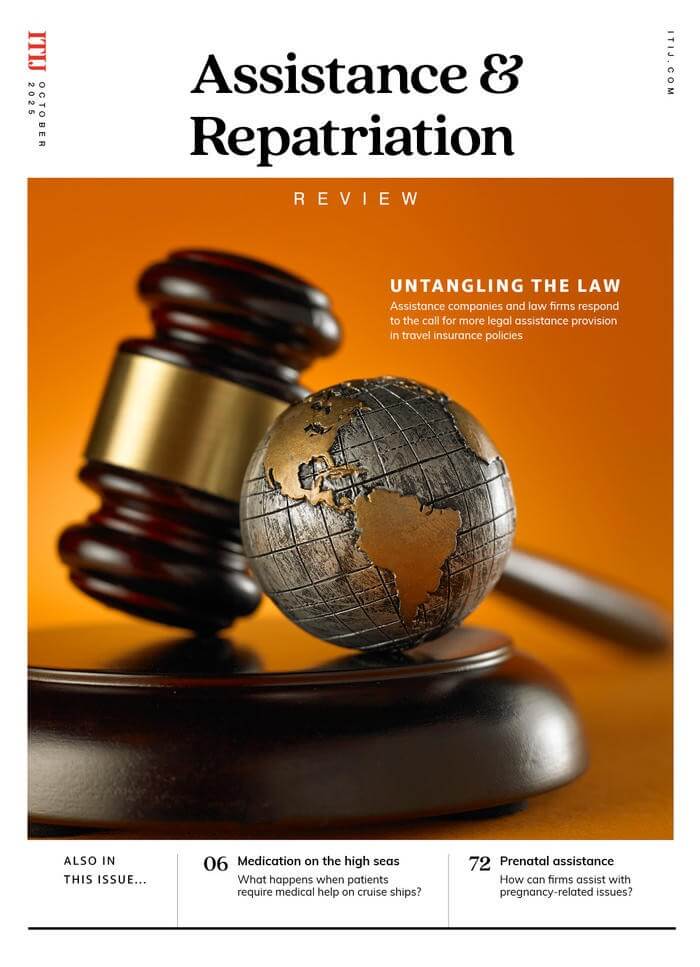
October 2025
Issue
In this latest Assistance & Repatriation Review we explore how legal networks and insurers can help travellers who fall foul of the law while abroad. We look into the intricacies surrounding how medical transfers can be provided to pre-natal and neonatal patients, and examine the provision of medical care to patients who become ill on cruise ships.
Chloe Fox
Chloe Fox is an Editorial Assistant for Voyageur Group, joining in 2024. She writes for ITIJ and AirMed&Rescue, covering a range of topics including international travel and health insurance, medical assistance provision, and air medical transportation. Chloe holds a BA (Hons) in English and an MA in English Literature from the University of Bristol.