
Pre-existing conditions: a hurdle, not a barrier, to international travel

Oliver Cuenca speaks to experts from around the world to discuss how travel insurers support customers with pre-existing medical conditions
Advancements in medical diagnostics and treatment are reshaping the risk landscape for pre-existing medical conditions. As modern medicine increasingly turns once acute or terminal illnesses into manageable chronic conditions, a clear tension has emerged: medicine is actively reducing uncertainty, whereas the insurance sector has historically been built to price and protect against it.
Defining and evaluating pre-existing conditions
Philip Hsia, CEO, and Clinton Bartlett, Vice President, Actuarial and Underwriting, at WorldTrips, noted that in the US travel insurance market, pre-existing conditions “aren’t evaluated on an individual basis”. Rather: “The product is built around a purchase requirement, rather than medical underwriting. Every plan carries a look-back period – 90 days on most of ours. Each plan’s waiver window differs. Buy outside that window and a claim tied to a pre-existing condition can be declined.”
The definition of a pre-existing medical condition is unique to each insurer
Hsia and Bartlett continued: “Severity doesn’t enter into it. A condition controlled solely through prescription medication, stable with no change to that prescription and no doctor visit related to it inside the 90-day window, isn’t treated as pre-existing at all. It would only count as pre-existing if the medication changed during that period – any change, up in dose, down in dose, or brand to generic. We want to cover the person who is genuinely stable, not penalise them for having a condition modern medicine has under control.”
A spokesperson from Staysure explained that the fundamental challenge with pre-existing medical conditions is that they present an increased risk that a customer may make a claim, particularly under the cancellation and emergency medical sections of cover.
The spokesperson noted, however, that “the definition of a pre-existing medical condition is unique to each insurer, so customers should check their policy wording, which should clearly define the terms”.
Jess Strange, Chief Customer Officer for Southern Cross Travel Insurance (SCTI), explained: “When someone calls us about cover even though they may have a heart condition, or diabetes, or a cancer they’re in remission from, they’re not just asking about a policy. They’re asking whether they still get to take the trip they’ve been dreaming about.”
From SCTI’s perspective, it has become clear that people in the New Zealand and Australian markets are travelling more later in life, meaning they often have health conditions that need to be acknowledged. The company’s oldest travel customer in the past three years was 103 years old, with coverage offered up to the age of 118.
Recognising this, Strange said that SCTI believes it has a growing responsibility to give customers with pre-existing conditions “real, accessible options, rather than a blanket ‘no’”.
Pierre Saddik, President and Founder of Saddik International, added that whether a medical questionnaire was issued for a travel insurance policy or not, “in all instances, once the policy was issued, it would typically contain a clause stating that eligibility will be validated at claims time, and exclusions would apply for pre-existing conditions which did not satisfy the stability clause”.
He argued that such an approach often leads to uncertainty, with travellers genuinely believing they are covered, even if they have answered the questionnaire inaccurately by mistake.
“My main criticism of the current system is that it always leaves the onus on the applicant,” he said, “which sometimes comes with a huge financial burden if things go medically wrong during a trip.”
Saddik suggested that the solution “may well lie with a push by regulators to balance the forces currently on the applicant’s shoulders”.
Such an approach, he argued, could involve obtaining consent to access patient medical records prior to policy issue, with accuracy being guaranteed by the entity that delivered it. Additionally, higher premiums could “offset the additional risks, if the records prove inaccurate, incomplete, or not up to date”.
Updating frameworks to reflect medical advancement
The Staysure spokesperson said that when adapting to a changing medical landscape – particularly cases where previously terminal or acute conditions have become manageable – third-party screening tools “not owned by insurers” can be a boon.
They added that from the customer’s perspective, most travel policies are limited in duration – either single-trip or annual – and so the purchase of a new policy provides a natural opportunity for updated screening, “whereby the assessment of a medical condition may reflect any changes in prognosis, for example from terminal to chronic”.
Hsia and Bartlett reiterated that because assessment frameworks do not operate on the level of individual prognosis, “trip protection isn’t rated off clinical outlook the way life or private medical insurance cover is”. They agreed that the time-sensitive nature of the purchase removes the need for that granularity.
However, they added: “That said, the product has to stay relevant to how people actually live and travel, and the medical landscape has shifted in a generation. Conditions that once kept people homebound are now managed with a pill. Our stable-medication carve-out is a direct reflection of that shift – when nothing has changed in the look-back window, we treat the condition accordingly.”
Strange, by contrast, said that her company invites customers with pre-existing conditions to complete a medical assessment so that they can more fairly evaluate risk based on the “individual’s actual circumstances, bearing in mind that not all pre-existing conditions can be covered”.
Additional premiums may be applied, but she noted that even when a condition could not be covered, her company would typically try to still offer a policy that covers all other aspects of the trip.
When it comes to medical advances and their relationship with how policies are constructed, this is where opportunity lies

“Even if we can’t insure the specific condition, we can often cover the rest of the journey where cause of the claim is not related to that disclosed condition,” she explained.
Saddik argued that when it comes to medical advances and their relationship with how policies are constructed, “this is where opportunity lies”, suggesting that the insurance industry could work to develop partnerships with medical technology to create a “predictive modelling map, over time, of these very risks”.
“Where previously someone’s file would be closed due to the risk being too great – no policy, no travel, no business – a new substandard market would emerge. If a medical condition previously untouchable from an insurer’s perspective now becomes manageable thanks to a treatment or a procedure, there would be a great opportunity to make use of all the medical connected tools that are now available.”
He explained: “With today’s wearables linking into medical apps, we know exactly your risk in real time. Given sufficient risk density in a given area, nothing prevents us from negotiating in advance with nearby hospitals discounts to the cost of a potential medical incident. Upstream of all this, preventive measures could also be easily pushed to travellers. Assistance companies and other third-party administrators could play a role in that.”
Appetite for risk
When asked about global variation in the availability of cover for pre-existing conditions in the travel sector, Saddik reported that “currently, insurers have a reputation of being risk-averse, and there seems to be no incentive to change”, including when it comes to how pre-existing conditions are covered.
However: “Like in many sectors, where there are risks there are rewards, [and] the future will reward insurers who will be ready to embrace the risk as opposed to hide behind some contract clause.”
By contrast, the Staysure spokesperson suggested that the picture was more diverse than the risk-averse stereotype suggested. They highlighted that insurers’ appetite for covering pre-existing conditions could vary dramatically from company to company. “Even within the UK, there are policies that do not accept any pre-existing medical conditions, while others provide cover for customers with more significant or severe conditions.”
They added: “When this variation is considered on a global scale, the range of approaches becomes even greater, making it difficult to draw a single conclusion about insurers’ appetite for risk.”

Balancing risk management and financial inclusion
Strange noted that when it comes to balancing the tension between risk and financial inclusion, it is critical that the customer discloses all conditions. “Full disclosure is what helps protect the traveller, as partial disclosure can void cover entirely,” she said. “Our approach is deliberately human. We’d rather have a conversation with a traveller about their health and their travel plans than see them either travel uninsured or abandon a trip they’ve been dreaming about for years.”
She added that when dealing with pre-existing conditions, reassurance is everything – both for the insurer and the insured.
When it comes to the tension between strict risk selection and the push for financial inclusion, the Staysure spokesperson explained that “this choice ultimately sits with customers”.
“The fundamental principle of insurance is risk pooling, whereby the losses of the few are met by the contributions of many,” they noted. “As a result, the price customers are willing to pay for insurance influences the level of risk insurers are able to accept.”
Full disclosure is what helps protect the traveller as partial disclosure can void cover entirely
Hsia and Bartlett argued that “travel insurance still has to be financially sustainable – if we can’t price risk appropriately, we can’t offer coverage at all, and that serves no-one”.
However, they added that when older travellers, or travellers with chronic conditions, face systematic exclusion, they are effectively told they can’t safely participate in international travel, and that carries real quality-of-life consequences – something that should be avoided as much as possible.
Conclusion
The international insurance industry finds itself at a critical crossroads: while medical science rapidly reduces the uncertainty surrounding pre-existing conditions, rigid legacy underwriting frameworks often lag behind. Despite this, efforts are being made by many insurers to ensure that as many people with pre-existing conditions as possible can travel with coverage.
To avoid competitive disadvantage and mounting regulatory scrutiny regarding fairness, insurers must adapt. Embracing dynamic, data-driven risk assessment offers a clear path forward – but the potential need for higher premiums to improve coverage of higher-risk individuals may be a tough sell for many customers.
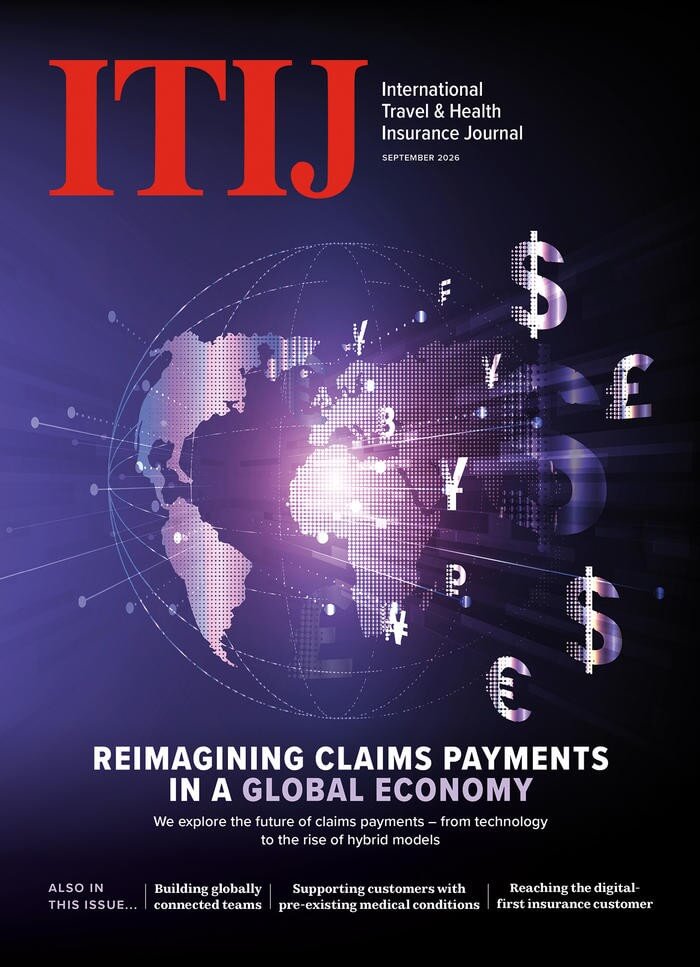
September 2026
Issue
This month we take a close look at claims payments. As these payments become increasingly global, organisations are evaluating traditional international transfers, cryptocurrency, and parametric payment models to balance speed, cost, compliance, and customer experience.
While traditional banking systems remain trusted for reliability and regulatory certainty, they often fail to meet growing expectations for instant payments. Industry leaders increasingly favour hybrid payment ecosystems, combining established banking networks with modern digital technologies to deliver flexible, efficient, and customer-centric payment solutions. We hope the insights from our experts give you food for thought.