
Medical non-disclosure and the risks for UK holidaymakers

Garry Nelson, Head of Corporate Affairs at AllClear Travel Insurance, tells ITIJ about the reasons some travellers do not buy the right insurance, and the potential severe consequences
This year is set to be a boom time for overseas travel. Our latest January 2025 data revealed that nine in 10 British adults (91%) started the new year with firm resolutions to book up overseas holidays for 2025. While 49% of those going on holiday abroad are planning to visit hotspots in the Mediterranean, many intend to go further afield: 32% would like to visit the Caribbean this year, with 20% opting for Australia or New Zealand, and 17% North America.
Set against the broad-based desire to travel, our research has also identified an emerging trend of people not declaring their full medical information when buying travel insurance. This is perhaps an understandable consequence of the cost of living crisis, but it is also an issue that can have catastrophic financial and emotional consequences for holidaymakers. Failure to declare relevant medical information when buying travel insurance can invalidate the policy. Falling ill in some countries without travel cover could cost a person their home. This is a seismic industry issue that needs to be tackled – and urgently.
Falling ill in some countries without travel cover could cost a person their home
Of great concern is that this trend is prevalent among those who have pre-existing medical conditions, and these people now account for a significant segment of the travel market. One in four British holidaymakers (25%) that have holidayed or will holiday abroad this year have a pre-existing medical condition.
Non-disclosure – the reasons why
Between October 2024 and January 2025, we commissioned research to help us understand the reasons why some people fail to declare important information when buying their travel cover. For people with ongoing pre-existing medical conditions, 63% admitted that they had not declared medical conditions when buying travel insurance in the past. The reasons for not declaring medical information are complex and wide-ranging: there are various factors at play, which suggests the problem may be challenging, and take time to solve.
Education is a key issue: 24% of respondents said they weren’t sure how much information needed to be declared when buying travel cover, and this made it easy for them to feel confused. In addition to this, 13% of people with medical conditions said they presumed their insurer would already have all the necessary information from a previous year’s policy. This assumption fails to acknowledge that medical histories can change year on year.
Conscious concealment: for a proportion of those surveyed, there was evidence of wilful concealment. Nationally, 22% of respondents were worried about being turned down for travel cover, so said they would control the amount of information they shared to get a policy before travelling. Furthermore, 16% of people had the express intention of securing a cheaper price for their policy – and believed they could achieve this if they limited the amount of medical information they provided at point of sale.
Assessing risks accurately: beyond a lack of general awareness of travel insurance, some people did not calculate personal risks accurately when making decisions on the cover they thought they needed. Around one in seven people (14%) believed they could cover the medical costs abroad if they were to be hospitalised when, in truth, medical bills in places like the USA can easy run into six or seven figures. Added to this, 14% of respondents felt the risk of falling ill abroad was low.
Proximity of foreign resort: nationally 11% of people implied travel cover was less important if they weren’t travelling far – and could easily get on a plane home if something went wrong. AllClear’s study over the summer revealed a growing number of older travellers cite proximity of destination as reason not to get travel cover at all.
Privacy: this was an issue for one in 10 respondents. At a time when online scams and identity theft is at a record high, it is understandable that people are concerned about the amount of information they declare – but, for those with medical conditions, it is essential to declare the information that is needed to get comprehensive cover.
Time: other respondents commented on being busy and getting confused by online forms.
The reasons people shop around on price
Since the cost of living crisis, UK holidaymakers have been hit by a financial double whammy: rising living costs have, for many, reduced disposable income, while holidays have also become more expensive – with prices rising by an average of 10% in 2024 for hotels, airfares and tour operator holidays. Set against this, our data revealed that 88% of Brits are considering cost-cutting moves to get the best value for money from their holiday spend in 2025. This includes looking to shift when they take holidays to avoid peak times (49%). In addition, some people (26%) are looking for all-inclusive deals and 25% said they would choose to go to a destination when the exchange rate was favourable to the pound. Within the mix for 2025, 28% are looking for cheaper travel cover.
The reasons for not declaring medical information are complex and wide-ranging: there are various factors at play
With this in mind, we asked people if and why they might be inclined to shop around for cheaper travel cover for 2025, even if it meant some important things weren’t covered:
- For around a third of people, it was simply a case of headline price – with many still living with the legacy of the cost of living crisis, budgets dictated a policy that fitted a given budget. On top of managing budgets at home was the added issue that holidays were getting more expensive so holiday costs had to be trimmed for 2025 (19%)
- Surprisingly, one in four people (26%) believed that all insurance policies were pretty much the same – and, alarmingly, this was most strongly felt by people with medical conditions (29%), the very people that need specialist cover
- As with the earlier issue of medical non-disclosure, when it came to falling ill or having an accident on holiday, people had the ‘it won’t happen to me’ mindset. Once again, people travelling short haul were under the false idea that a short distance travelled was somehow a mitigating factor in not disclosing medical conditions or looking for cheaper cover.

The consequences of not disclosing
Our research indicated that many people were not aware about the potential consequences of not disclosing medical conditions when buying travel insurance for their holidays abroad.
For people with medical conditions, 30% thought there may be limits on how much of the medical costs the insurer would cover, but they still believed their policy would be valid. A further 21% thought they may have to pay medical costs upfront and get reimbursed later when they got home. Others thought they would get away with a reprimand (15%) – while almost one in 10 believed if they had a policy document in their hands it would be valid simply because they had a policy document in their possession.
These findings present a stark wake-up call for people that have grown up buying cover on price – a mindset that, to some extent, has become socially acceptable through countless TV ads and price comparison sites. There is a consequence of buying cheap cover, and those that buy on price need to understand the big picture to help them make savvy and informed decisions.
Summary
From the data it is clear that there are a range of factors at play. Financial pressures are forcing many to cut costs on holiday spend but, in some ways, this isn’t helped by the industry marketing noise that too often associates cheap price with a good deal. For some this may well be the case, but for people with medical conditions it is time for a different conversation – putting safety first and focusing on how insurers can best protect and support people when they are abroad.
It’s also clear from our AllClear data that there is a sizeable knowledge gap that needs to be closed. At AllClear, we go to strenuous efforts to stress the importance of people disclosing medical information when buying travel cover – we firmly believe it’s the best way to help customers.
A lot of vulnerable customers are making decisions on cover that open them up to serious risks abroad. Together, we must change the agenda away from price and – for people with medical conditions – make the case for quality and safety first.
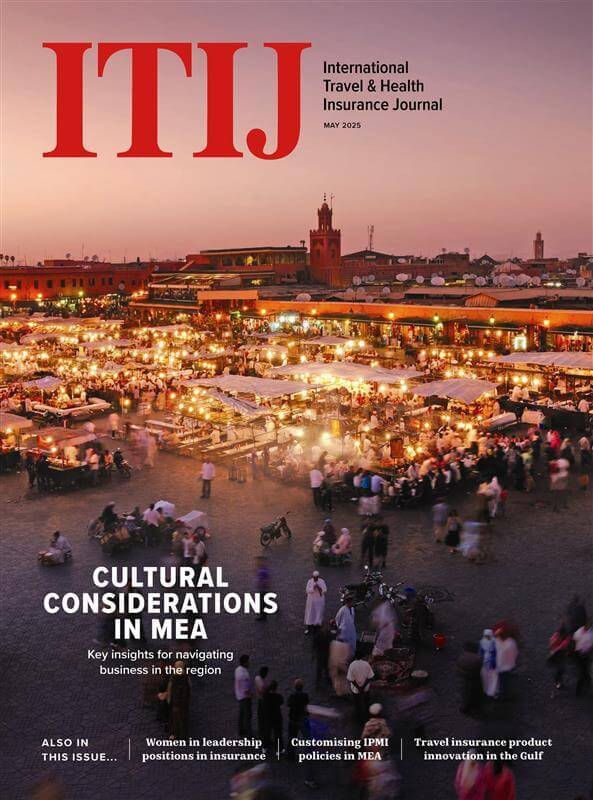
May 2025
Issue
In this issue of ITIJ we consider cultural considerations and understanding in the Middle East and Africa; look at IPMI in the MEA region and the customisation of policies; and gain insights from woman in leadership positions who share the obstacles and opportunities they have encountered.
Garry Nelson
After 18 years as a professional sportsman, during which he wrote two best-selling books, Garry headed up the London office of the Professional Footballers’ Association, followed by a full-time media role with ITV Sport.
Entering mainstream business in 2002, he was MD for a promotions company before switching roles to become Head of Marketing at AllClear in 2011. Promoted to Head of Corporate Affairs for AllClear Insurance Services and InsureandGo in November 2022, Garry is a regular industry commentator on a range of travel issues.
A full member of the Chartered Institute of Marketing (CIM) and a committee member of the British Insurance Brokers’ Association’s (BIBA) Access to Insurance group, Garry has also been invited by BIBA to advise the UK government All-Party Parliamentary Group on travel insurance and Covid-19.