The perils of social media posting

Emanuele Scansani, Operations Manager at travel risk experts Riskline, explains how some social media posts can prove controversial – and even punishable by law – in certain countries
Social media has revolutionised the way we communicate with each other and transmit information to the world. However, with this increased visibility, insurers should make sure clients are aware of the risks involved in using social media, especially in a world where Instagram, Facebook and Twitter spread information instantly and are, in some cases, even monitored by government authorities.

A social media slip-up can have serious repercussions. Consider this: a post on Facebook criticising the Sultan of Brunei, for example, can land someone in serious trouble with authorities there. Indeed, posts or tweets deemed to be anti-government in nature can potentially land a traveller in jail in dozens of countries, from Turkey to Thailand.
Even just sharing or liking posts of a particular political or religious nature could provoke unwanted attention from local authorities in specific countries. In Thailand, for example, there have been several cases of foreign nationals being jailed for posting or sharing comments critical of the King on social media – a strict offence under the country’s tough lèse-majesté laws. For another example, look back to November 2017, when a British national was arrested in India for sharing social media content deemed offensive to the Indian Government over its alleged role in the 1984 anti-Sikh riots.
Here’s the golden rule to communication: if in doubt, don’t create or share any content. Advise clients to avoid sharing, posting or liking any content that can be deemed political or religious in nature, especially when in a country where spreading such content is considered an offence.
Social media (in)security
In addition, the monitoring of social media activity by government authorities also raises concerns about privacy and personal data security. While it is an accepted fact that law enforcement in most countries around the world does monitor social media to a certain degree to scan for legitimate security threats, some countries, like Russia and China, have pervasive ICT surveillance measures in place, which could lead to data breaches.
In November 2018, it came to light that Russian-based IP addresses had been pulling vast amounts of personal data from Facebook and other social media platforms since 2014. In this instance, bringing in a blank device might make sense for the purposes of business-critical travel to such countries.
Keeping all this in mind, it is vital for travellers to be well-informed of potential technology and communication risks in the country they are visiting and to be mindful of their social media activity.
For travellers unaware of cultural customs and local laws, the path from cell phone to cell block is a short one. Insurers have a crucial role to play here – make sure clients are well-prepared and well-informed, so they can take the necessary precautions to mitigate risks, avoid the hassle of being questioned by local authorities and even ending up behind bars.
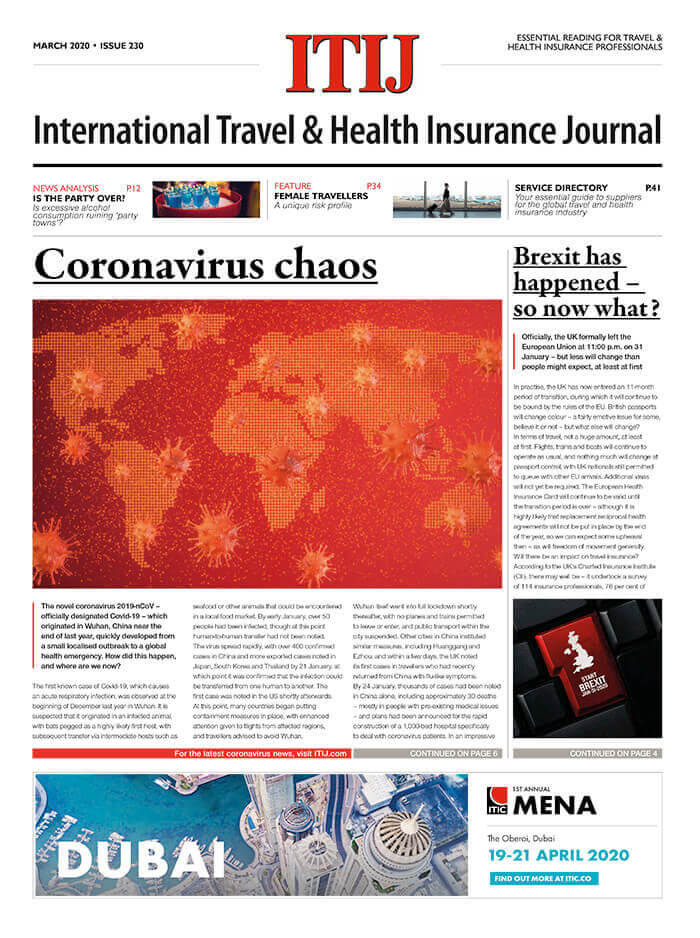
March 2020
Issue
In the March issue of ITIJ, we explore recent reports of sexual aggression and social misconduct in ‘party towns’, looking at the role of alcohol in such cases and recent initiatives aimed at curbing alcohol consumption in certain regions. We also look at the approaches insurers and travel security specialists are taking to educate and protect female travellers; we get insights into the personalisation of travel insurance in 2020; and we hear some fascinating facts about the importance of being social media savvy.
All this plus the latest on the effects of Brexit, the spread of Covid-19, and the UK’s new requirements on insurers to help those with pre-existing medical conditions to find cover.
Emanuele Scansani
Emanuele Scansani has been Operations Manager, Eurasia, for Riskline, a travel risk intelligence company in operation since 2007 and has been based in Denmark. An expert in global security and safety issues, particularly digital security. He is plurilingual and holds an MSc in Comparative Politics from the London School of Economics, as well as an MSc in International Relations and a Bachelor’s Degree in Political Science from the University of Bologna, Italy. He is currently based in Barcelona.
More from this issue
ITIJ's March issues out now!

Exposing the dangers of excess in party resorts

Female travellers: a unique risk profile