
No child left behind

When a parent or guardian becomes seriously ill overseas, assistance providers face a complex challenge that extends well beyond clinical care. Although these cases are relatively rare, safeguarding dependent children requires careful planning, legal awareness, and close international coordination, as Siân Yates reports
A patient’s medical care is only one part of the equation during an international medical emergency. Assistance providers may also find themselves responsible for safeguarding dependent children while coordinating treatment, repatriation, and onward travel.
Although these situations are relatively rare, they are among the most operationally demanding cases assistance providers can face. Success depends not only on clinical expertise, but also on early planning, close communication, and careful coordination between multiple organisations.
Dr Joseph Lelo, Medical Director at AMREF Flying Doctors, estimates that around one in every 20 missions undertaken by the organisation involves a dependent child requiring support, amounting to approximately 30–50 transports each year across its operations.
“The cases would range from road accident victims to childbirth complications where the mother is sick but gave birth to a healthy child,” he explained. “The real challenge isn’t clinical, it’s that our medical team’s duty of care is to the patient, while a dependent child needs something different – reassurance, continuity, and a plan for who looks after them.”
In these situations, the repatriation essentially involves two patients – the medical patient and the dependent individual
That said, Dr Alex Veldman, Medical Director at Unicair, noted that while the organisation carries out around 1,100–1,200 air ambulance missions annually, only a handful involve dependent children accompanying an adult patient.
“In such cases, the assistance or insurance company almost always arranges for a relative or family member to travel and care for the child,” he pointed out. “A dependent minor cannot be left alone during the days leading up to repatriation, so ensuring appropriate supervision is essential.”
More than one patient
Some described these cases as requiring two parallel workstreams: one focused on the patient’s clinical care, the other on safeguarding the dependent child.
“We don’t see it as a trade-off between the patient and the child,” said Dr Lelo. “Our medical crew’s focus stays entirely on the patient as their clinical mandate. The child’s safety and comfort are managed in parallel, usually by our operations and medical coordinators, who are working the guardianship, documentation, and logistics side of things from the moment a case comes in.”
Dr Veldman argued that this mindset should begin with recognising that the child effectively becomes a second case requiring active management. “In these situations, the repatriation essentially involves two patients – the medical patient and the dependent individual,” he noted. “Proper planning requires close collaboration between assistance companies, hospitals, airlines, embassies, and local authorities.”
Charles Taylor Assistance takes a similar approach through what it describes as its vulnerable customer framework. While dependent children form one part of that programme, the same principles apply to customers with mental health conditions, disabilities, and other additional needs.
A critically unstable patient may need the full cabin for equipment and crew, leaving no spare seat regardless of anyone’s preference

“For a child, a parent is their whole world, and it can be incredibly distressing and frightening if this parent is suddenly hospitalised overseas,” explained Dr Lynn Gordon, Chief Medical Officer at Charles Taylor Assistance. “We’ll treat each case in a highly personalised way, ensuring the child’s safety and acting in their very best interests at every stage.”
The organisation also considers developmental needs, communication requirements, and conditions such as autism or ADHD when determining the most appropriate avenue of support.
“We’ll identify every young person as vulnerable until proven otherwise,” Dr Gordon asserted. “A parent in hospital will likely be extremely worried about their child’s welfare. We’ll keep them fully informed and involved in any decisions, and any course of action involving a minor will always need to be taken in agreement with the child’s family.”
The operational challenge begins on the ground
“What makes a case genuinely difficult is rarely the flight itself,” Dr Lelo observed. “It’s whether a suitable guardian, the right documents, and a clear plan for the child are in place before the aircraft leaves the ground.
“This coordination is often what determines whether the child’s side of the mission goes smoothly. None of those parties has the full picture alone. Our control centre’s role is to hold all of those threads at once and keep them moving in parallel.”
Dr Gordon described a similarly collaborative strategy. “We’ll quickly identify and work hand-in-hand with any relevant parties, which may include hospitals, airlines, embassies, local authorities, insurers, family members, and even the police,” she explained. “We’ll ensure that all these stakeholders are aware of each other and we’ll communicate constantly with them.”
According to Dr Gordon, assistance providers have a duty to notify appropriate safeguarding authorities where necessary, while ensuring compliance with legal and regulatory requirements that vary significantly between countries.
Those differing frameworks have, in turn, helped shape Charles Taylor Assistance’s own safeguarding policies.
“The lesson we’ve taken is to start the documentation and guardianship conversation the moment a case involving a dependent child is flagged,” Dr Lelo added. “It’s rarely the flight that’s the hard part – it’s making sure the legal and family side keeps pace with it.”

Can the child travel?
While the instinct may be to keep families together wherever possible, doing so is not always in the child’s best interests. The decision depends on a combination of clinical, operational, and emotional factors, with no single solution fitting every case.
“The patient’s clinical needs come first,” explained Dr Lelo. “A critically unstable patient may need the full cabin for equipment and crew, leaving no spare seat regardless of anyone’s preference.
“Medevac aircraft are configured around medical equipment and monitors, not passenger comfort. We work through those factors as part of mission planning for every case.”
Dr Veldman believes the environment itself can be reason enough to consider alternative arrangements. “An air ambulance cabin – especially with a potentially critical patient on board – is not a comfortable environment for relatives, and even less so for a frightened child,” he told us. “There is no practical way to shield a dependent minor from witnessing medical interventions, hygiene care, or invasive procedures.”
On larger aircraft, crews may create a separate curtained area to provide greater privacy and reduce stress, but this is not always possible.
Dr Gordon said: “If a parent is significantly ill or injured and needs an air ambulance, we’ll recognise that an air ambulance isn’t the best environment for their child. The crew will need to devote their full attention to the patient.”
Instead, the organisation may arrange for a family member to accompany the child home on a scheduled airline, or where necessary send one of its own flight practitioners to travel with them, always with parental consent.
“Airlines are unable to accept unaccompanied minors without the written permission of a parent,” Dr Gordon noted. “We know that it’s much less distressing for a child to fly back with a responsible adult than as an unaccompanied passenger.”
Mark Chapman RN, Vice President of Business Development at Medway Air Ambulance, said that while his organisation had not encountered significant difficulties relating to airline policies, family involvement remained the preferred solution whenever possible.
“So far in my experience we have always been able to find or arrange for a family member to accompany the minor on a commercial flight,” he observed. “At 40,000 feet, it is a challenge to deal with a patient decompensating and the care of a minor at the same time.”
Planning for the child from day one
Early planning has emerged as one of the defining themes across the industry. Safeguarding arrangements should begin the moment a dependent child is identified, rather than once the patient’s transport has already been organised.
“The single most useful thing we’ve learned is not to let the child’s situation become an afterthought once the patient is stabilised,” said Dr Lelo. “Start planning for the child at the same moment you start planning for the parent.”
“We’ll ask who we can appoint as a responsible guardian and whether we can fly a family member or suitable alternative out quickly,” Dr Gordon added. “We’ll also establish whether there are friends or other parents already in the holiday group who can temporarily assume responsibility.”
What makes a case genuinely difficult is rarely the flight itself. It’s whether a suitable guardian, the right documents, and a clear plan for the child are in place before the aircraft leaves the ground
Where necessary, Charles Taylor Assistance may send one of its own practitioners or arrange temporary safeguarding until relatives arrive. “Every assistance provider should follow formal policies for minors,” Dr Gordon said. “Frontline staff need to know how and when to escalate concerns. It’s essential to make sure that red flags aren’t ignored when they’re picked up.”
Dr Veldman believes assistance companies should also ask one simple but critical question as early as possible: “Is this ill or injured person the primary caregiver of anyone else?”

Establishing the answer immediately, he argued, can prevent dependent children, or indeed vulnerable elderly relatives, from being overlooked as operational planning gathers pace.
Communication, compassion, and consistency
Communicating with children in a way they understand is key.
“We keep it simple, honest, and age-appropriate,” Dr Lelo explained. “No medical jargon, and no promises we can’t keep.”
Crews also aim to ensure one consistent individual communicates with the child throughout the journey, supported by familiar comforts such as blankets, toys, or simple explanations of what is happening.
“For a child, uncertainty is usually more frightening than the truth, gently explained,” Dr Lelo highlighted.
Unicair follows a similar philosophy. “If no family member is available, we add an additional team member – typically a paediatric nurse – to care for the child,” Dr Veldman said. “We also carry small toys, games, and teddy bears for comfort and distraction.”
Charles Taylor Assistance extends that emphasis on empathy beyond the mission itself. Dr Gordon said immersive staff training helps frontline teams provide empathetic support during highly emotional situations.
“Our customers often need help well beyond medical assistance itself,” she told us. “We enable our frontline staff to support families with real empathy and feeling during the most distressing experiences.”
Preparing for the unexpected
Dr Veldman suggested the rarity of such incidents demonstrates that current systems are largely effective, noting that he has “rarely, if ever” encountered major problems involving dependent children during more than 25 years of international aeromedical repatriation.
Meanwhile, Dr Lelo would like to see an internationally recognised safeguarding framework for dependent children comparable to the clinical and aviation safety standards already adopted across the industry. “Right now, a great deal of this work happens through individual operators’ good judgement and experience rather than a shared, auditable standard,” he said.
Chapman also sees value in developing broader industry guidance, suggesting the subject deserves greater discussion across the assistance community. “There are many more opportunities to look deeper into best practice,” he noted. “One option would be to dedicate a session to this subject at the next ITIC conference.”
“If this only comes up occasionally for your organisation, it’s tempting to treat it as a one-off problem to solve in the moment,” Dr Lelo concluded. “Have a basic decision framework ready, train your crews in how to communicate with frightened children, and treat the child as a person you have a duty of care towards in their own right, not as a logistical detail attached to the patient.”
Although dependent children rarely become part of an international medical evacuation, contributors agree that safeguarding them should never be left to improvisation. The organisations best equipped to respond are those that have already planned for what happens when the patient is not the only person needing protection.
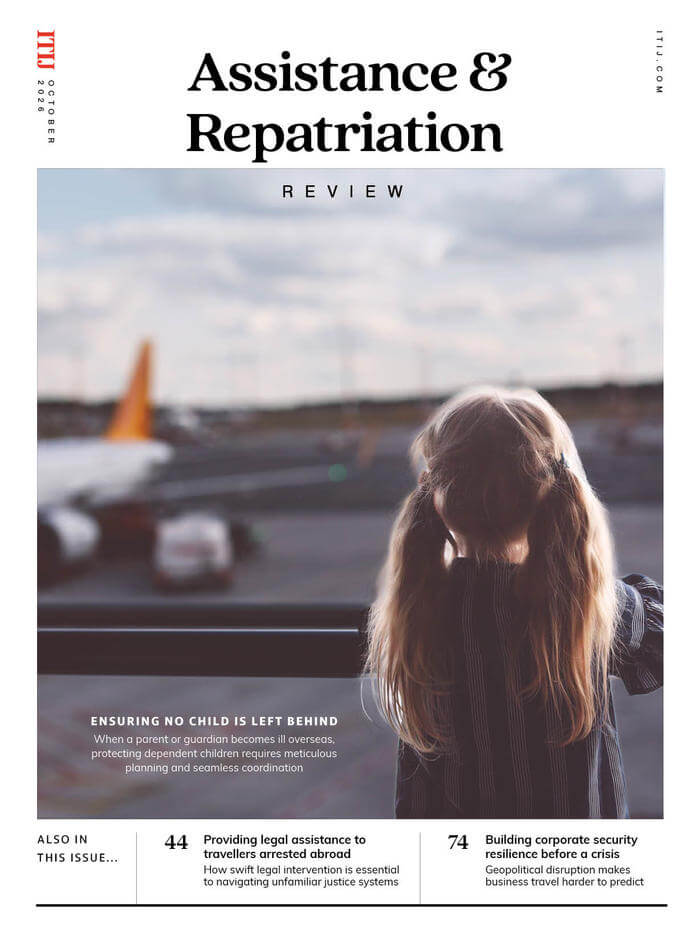
October 2026
Issue
When a parent or guardian becomes seriously ill overseas, assistance providers face a complex challenge that extends well beyond clinical care. Although these cases are relatively rare, in this issue we look at how safeguarding dependent children requires careful planning, legal awareness, and close international coordination.
Siân Yates
Siân Yates is News Editor at Voyageur Group and Editor of International Hospitals & Healthcare (IH&H). She holds a Master’s degree in Journalism, and has written across healthcare, travel, food and beverage, science and technology, and environmental topics. Her passion lies in magazine creation and editorial management.