
Navigating funeral repatriation challenges in the Middle East

Chloe Fox speaks to experts about legal hurdles, cultural customs, embalming, autopsies, and cost challenges in Middle East repatriations
Repatriating a deceased person often involves a complex set of legal and administrative steps. Language barriers, documentation requirements, and local regulations can all add extra layers of difficulty, making careful attention to detail essential.
Robert Hoey, President of Funeral Support Services in Japan, explained one of the biggest hurdles regarding repatriations from the Middle East: “One of the main legal and administrative challenges is the language difference. In many Middle Eastern countries, official documents are issued in Arabic, which means they must be translated into English for repatriation as Japan accepts repatriation documents in English.”
He highlighted the importance of accuracy in translations, noting that even a small mistake could cause significant delays. “Translations need to be done very carefully because a small error could create a big problem once the deceased reaches Japan. If there is a mistake translating the cause of death, the death certificate will need to be reissued.” He highlighted the complexity of medical terminology and recommended that, in such circumstances, translations be carried out by a specialist in medical translation.
Despite the potential language barriers, some administrative processes in the Middle East can be relatively straightforward. Sam Tester, Operations Director at Homeland International, said: “Many countries in the Middle East have simple and effective administrative processes which are fit for purpose, particularly compared to countries in different continents.” He noted that the structure of local funeral and repatriation services helped to streamline cases: “Most countries in the Middle East are Muslim countries, which means that funeral and repatriation processes need to be swift to support their cultural and religious rites.”
In many of these instances, paperwork can be completed within a single day. However, challenging circumstances extend timelines, particularly in cases of suspicious or unexplained deaths. Tester recounted a particular instance of this: “One example was a case we managed out of Basra, Iraq, which meant we had to attend a courthouse in Baghdad to apply for permission to repatriate out of the country after a suspicious death, which added delay to the case.”
Many countries in the Middle East have simple and effective administrative processes which are fit for purpose
Family involvement also plays a crucial role in repatriation timelines. Fiona Greenwood, Operations Director at Rowland Brothers International, explained: “In general, we rarely encounter difficulties when arranging repatriations from Middle Eastern countries, as authorities typically complete the necessary documentation promptly. In most instances, if family members are present and have signed the required authorisations, the process is quick.”
However, minor complications can arise when the next of kin’s surname differs from that of the deceased. As Greenwood added: “Additional checks may take place to ensure the next of kin is verified by local authorities.”
She also pointed out that when someone dies alone in a country, documents often need to be completed electronically and forwarded to authorities before permissions can be granted. “This may involve assistance from the embassy or consulate in-country,” she explained, highlighting the extra coordination required in such cases.
In addition, investigations into the cause of death naturally extend timelines. Greenwood emphasised: “If the cause of death is suspicious or under investigation, the timeline will be longer while authorities complete their investigation into the cause or circumstances of death.” However, she noted that this process was no different from what would happen in any other region under similar circumstances.

Balancing religious practices and repatriation requirements
Religious and cultural practices heavily influence the handling of the deceased, particularly in relation to embalming and timing. Hoey explained the contrast in expectations between the Middle East and Japan: “Islamic practices are widely observed in the Middle East, and local customs differ significantly from those in Japan. While embalming is uncommon in the region, it is required for repatriation to Japan. Only experienced repatriation companies typically have access to embalmers, and the techniques they use differ from those practised in Japan.
“In the Middle East, embalming is primarily focused on preservation for transportation purposes. However, in Japan, embalming places importance not only on preservation but also on appearance. Great care is taken with how the body looks, as this is considered very important in Japanese culture.”
Timing adds another layer of pressure for religious repatriations. Tester observed: “There can be an added pressure on our team in these cases as the timeline is usually the biggest factor when it comes to religious expectations.” However, he noted that countries such as the United Arab Emirates (UAE), Saudi Arabia, and Qatar “are all set up effectively to allow cases to move quickly”.
Often, the deceased may be of a different faith from that of the local population, but administrative efficiency can still enable rapid repatriation. Tester explained: “We are able to provide a fast repatriation home thanks to the country’s administrative processes, which helps us to exceed our client’s expectations.”
He contrasted this with repatriations to the Middle East from other regions, which can take far longer. “A case from Brazil to Egypt or from the UK to Iran, for example, can take far longer than the family expects, purely because the government document processes can take so long. What we must do with these cases is to manage expectations through honest conversations with clients; this way there are never false promises which can lead to unnecessary stress and upset.”
Greenwood agreed that communication with families was essential to avoid misunderstandings: “The rules and regulations of each Middle Eastern country need to be adhered to as well as specific religious customs and rituals for preparation and transport. These may differ from the specific faith requirements of the person that passed away and therefore clear expectations need to be set by the repatriation specialists at the early stages with the next of kin.”

Resolving conflicts between religious customs and legal procedures
Conflicts can sometimes arise when religious practices intersect with legal requirements, such as autopsies or official investigations. Hoey explained: “Autopsies in the Middle East are uncommon unless the death is suspicious or accidental. In these instances, investigations can cause delays, which is also common in many other countries.”
He added that Islamic customs, which call for burial to take place as soon as possible, could in some cases help speed up the repatriation process because documentation is often prepared quickly. “In our experience, the body can be on a flight to Japan within a few days of death.”
Tester reflected on the sensitivities involved: “Autopsies and delays are usually the biggest conflict for religious repatriations as they impact the belief of the family and the deceased person. Time is one factor: the burial ideally often needs to take place on the same day or as soon as is possible, and any delay can impact the opportunity for this. Some religions do not allow any interfering with the body, such as Judaism and Islam. Autopsies and embalming can make this problematic for families, and the fact that these will need to take place before a repatriation can take place. While we are seeing technology progress in the digital autopsy space [using CT or MRI scans to examine the body], the use of this non-invasive method is very limited. Even in countries where it is being used, it is only used in limited circumstances and jurisdictions.”
Greenwood highlighted the impact on family expectations: “In some Middle Eastern countries, authorities may unintentionally give families inaccurate information. We have experienced unrealistic expectations set by local police indicating repatriation could be completed in one day. This can cause immediate upset among family members when correct expectations are set that do not meet what has been communicated.”
Embalming performed in the Middle East typically focuses solely on preservation for travel, while in Japan there is also a strong emphasis on the physical appearance
She continued: “In some cases, cultural or religious practices may conflict with legal requirements related to investigations, suspicious deaths, or autopsies, which are prohibited in certain faiths. These situations can be very distressing for families, and the time required for repatriation may be extended as a result.”
Viewing arrangements can also be limited, Greenwood explained: “Preparation of the deceased for repatriation may take place in the local hospital, [and] viewing prior to repatriation may not be possible or, if possible, may be within the mortuary area, which does not meet family expectations of viewing in the same manner as in their home country.” She concluded: “Communication between repatriation specialist, client, and family members is key.”


Comparing repatriation across regions
Repatriation timelines, processes, and complexity vary significantly by region. Hoey explained that, for Japan, “documentation for repatriations leaving the Middle East can be very complex. However, local repatriation companies are experienced with the process. Since my business is in Japan, I rely on strong partnerships in the Middle East to ensure everything goes smoothly. In turn, these same companies will rely on our expertise when sending loved ones home to the Middle East from Japan.”
Tester described structural differences in local services: “While the overall complexity is comparable to other regions, repatriations from the Middle East are often faster. Coordination, however, can differ and requires a thorough understanding of local culture and procedures, as traditional Western-style funeral homes are generally absent.
“In the Middle East, embalming centres and mortuaries are usually located within government-managed buildings or hospitals, unlike in Western countries, where such services are often part of funeral homes. It is therefore essential to work with an experienced repatriation company that understands these nuances, as specific considerations vary by country. Companies expecting a Western-style funeral setup, including a funeral home, funeral director, and mortuary, can face challenges when operating in regions without such infrastructure.”
Managing costs while respecting cultural needs
Repatriation involves balancing practical cost considerations with the cultural and religious needs that are deeply important to families. While managing expenses is part of the process, care must always be taken to ensure the deceased is treated with dignity and traditions are respected.
Hoey pointed out: “Surprisingly, costs for repatriations in the Middle East are quite reasonable compared to Asia. We rely on our partners there to keep us updated frequently on the process. Communication is very important, so families always know what is going on with their loved ones. We can manage expectations and costs when dealing with our trusted partners in the region.”
Tester added: “Cost is no different depending on cultural or religious needs; the repatriation process is always the same: the same process, the same documents, and the same flight routes.”
However, Greenwood reflected on the impact of wider circumstances on cost: “When reviewing repatriation arrangements worldwide, several factors can affect costs.
These include conflict or political unrest in the destination country, as well as diverse cultural or religious requirements. Costs may increase where specialised services are needed to prepare the deceased for transportation, where additional documentation is required, or when travel arrangements are complex.”
She stressed the importance of working closely with local global partners to streamline processes, audit cases, review costs, and collaborate to keep services accessible, while delivering effective and well-controlled repatriation support for both clients and private individuals.
In conclusion, the challenges of repatriating a deceased person from the Middle East underscore how deeply culture, religion, and tradition shape end-of-life practices. Islamic and Jewish customs in the Middle East generally favour swift burial and minimal intervention, so embalming is not usually practised unless required for international transportation.
When repatriation is necessary, preservation becomes a practical and legal requirement, and experienced professionals must carefully balance religious considerations with logistical needs.
Embalming performed in the Middle East typically focuses solely on preservation for travel, while in Japan there is also a strong emphasis on the physical appearance of the deceased, reflecting cultural values around respect and final goodbyes. Successfully managing this process requires not only technical expertise but also cultural sensitivity and empathy.
Ultimately, repatriation is about more than transportation; it is about honouring the deceased and supporting grieving families by respecting traditions across borders.

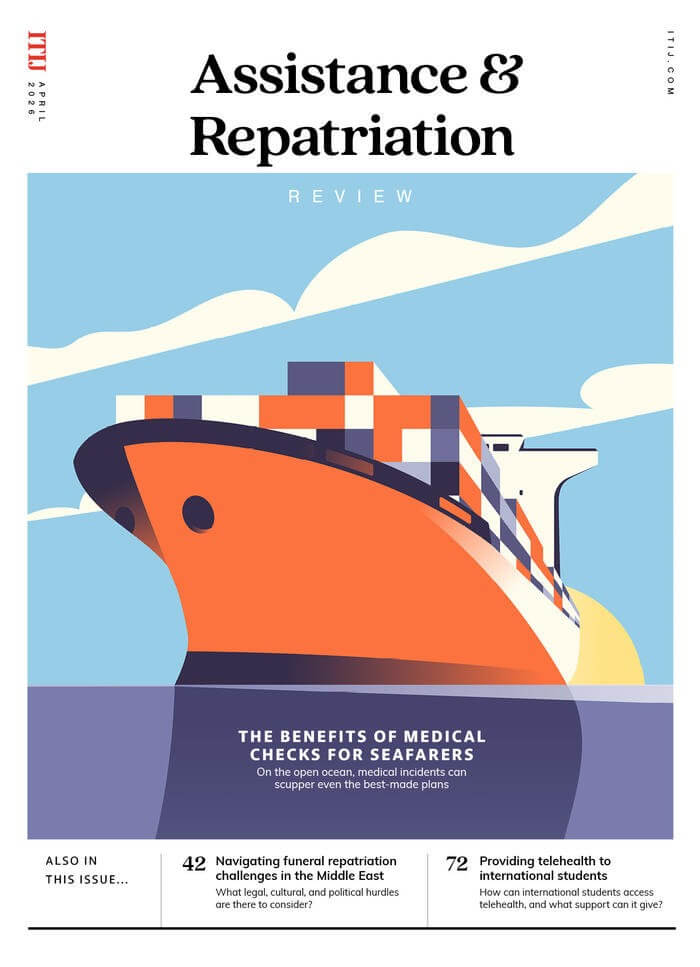
April 2026
Issue
In the first Assistance & Repatriation Review of 2026, we explore the cultural, legal, and logistical intricacies of funeral repatriation in, around, and out of the Middle East. We also consider how pre-deployment medical assessments can save lives and sea voyages. The burgeoning demand for telehealth among students is covered in our third feature, plus we look at how companies are delivering services that meet that need.
Chloe Fox
Chloe Fox is an Editorial Assistant for Voyageur Group, joining in 2024. She writes for ITIJ and AirMed&Rescue, covering a range of topics including international travel and health insurance, medical assistance provision, and air medical transportation. Chloe holds a BA (Hons) in English and an MA in English Literature from the University of Bristol.