
News Analysis: Everest risk and rescue limits in the ‘death zone’: implications for travel insurers

Chloe Fox investigates the hidden risks behind Mount Everest’s booming expedition industry, where safety at extreme altitude depends on regulation, operator standards, staffing discipline, and rescue readiness
The latest Mount Everest season has exposed a growing tension at the heart of high-altitude climbing: the rapid expansion of commercial expeditions versus the unforgiving realities of extreme environments. Insights from experts in medicine, journalism, and mountain operations reveal that while the industry has made significant advances in safety and preparation, expectations around rescue, evacuation, and survival above 6,000–8,000 metres often remain dangerously disconnected from what is physically and logistically possible.
This reality is most stark in the ‘death zone’, the region above 8,000 metres (26,247ft) where oxygen levels fall to roughly one-third of those at sea level. At this altitude, the human body cannot acclimatise. Vital functions begin to deteriorate, and survival is measured in hours rather than days, with most people able to endure only around 16–20 hours before retreat becomes critical.
For insurers and travel risk managers, Everest represents a broader challenge: expectations of protection can often exceed what rescue systems are realistically able to deliver. The key concerns centre on three interconnected issues: the limits of rescue in remote environments, the variability of expedition standards, and the challenge of managing expectations when incidents occur in conditions where time, access, and resources are severely constrained.
The limits of rescue above the death zone
At the centre of the discussion is a rare survival case involving climber Dawa, who reportedly spent six days above extreme altitude without supplemental oxygen before descending to approximately 6,000 metres. Dr Ken Zafren, Associate Medical Director at the Himalayan Rescue Association and a leading figure in Himalayan emergency medicine, emphasised both the extraordinariness and the context-dependent nature of the outcome. He explained: “Dawa’s survival for six days was unique and amazing. He did have oxygen – from the atmosphere – but had run out of supplemental oxygen. That wasn’t a major issue for descending. After a couple days he found some chocolates in his pocket and was able to melt some ice, so he did have a little food and water. The down climbing suits on Everest are very warm. Still, it was a remarkable feat.”
The significance of the case for insurers is not that it demonstrates what is possible, but that it demonstrates how exceptional survival outcomes can distort expectations of what is normally achievable. Dr Zafren’s framing challenges the idea that survival at extreme altitude is simply a matter of physical endurance. Instead, it highlights how outcomes depend on practical factors including equipment, weather, residual supplies, decision-making, and the timing of rescue.
I suspect that many climbers think that there is a good chance of rescue if they would need one. That is not true
That same emphasis on operational reality extends to widespread misconceptions about rescue and evacuation on Everest. Dr Zafren was direct about the gap between perception and capability, explaining that many climbers overestimate the likelihood of rescue when they are in difficulty: “I suspect that many climbers think that there is a good chance of rescue if they would need one. That is not true… I have no idea what insurers think, but they should familiarise themselves with the situation at Everest Base Camp (EBC). Many climbers and trekkers don’t want to walk down to the airport at Lukla, so they invent a medical problem to get a helicopter ride paid by insurance. Many ‘emergency’ evacuations from EBC are not emergencies.”
This creates a dual risk exposure for insurers operating in the Himalayan region. Genuine high-altitude medical emergencies can occur in environments where response times are structurally limited, while lower-altitude evacuation systems may also face inappropriate use or inflated claims. Distinguishing between the two is essential when assessing both operational risk and claims patterns.
Even where aviation infrastructure exists, Dr Zafren noted that logistics remain the decisive factor. “Helicopter rescue carries very high risk above 6,000 metres, but now pilots on Mount Everest routinely land at Camp II (6,500 metres) and have accomplished long-line rescues as high as 7,800 metres. To land that high, the weather must be very calm. If there is limited visibility because of clouds or at night, helicopter rescue is impossible.” Importantly, he also refuted a common misconception in insurance thinking: “There is no such thing as an evacuation being medically impossible, but many patients have died because of their illnesses or injuries while being evacuated.”
For underwriting teams and assistance providers, the distinction is critical. The issue is not whether evacuation can theoretically be initiated, but whether it can be completed within a survivable physiological window under rapidly changing environmental conditions.
In Khumbu and most of Nepal there are plenty of helicopters. However, it typically takes many hours for one to arrive
Dr Zafren also highlighted an often under-communicated operational constraint in remote trekking and climbing regions: delay. “In Khumbu and most of Nepal there are plenty of helicopters. However, it typically takes many hours for one to arrive. It may be possible to ride a horse or be carried by porters, but it is not a rapid means of rescue.” For insurers, this reinforces the importance of managing expectations around response times rather than focusing only on whether rescue resources exist.
Commercialisation, regulation, and uneven safety standards
While medical experts focus on physiological limits, expedition observers point to structural and commercial factors that shape risk exposure on the mountain. The limits of rescue explain why Everest is inherently hazardous; however, experts differ on how much current risk is driven by the mountain itself versus the way commercial expeditions are organised.
Alan Arnette, Everest summiteer and long-time chronicler of expedition fatalities and industry trends, argued that safety outcomes were unevenly distributed across operators and may be obscured by weaknesses in reporting systems. He stated: “There is a general lack of professionalism and discipline with regards to safety throughout the Nepali mountains, not just on Everest, especially with the budget operators.”
He further suggests that incentives within parts of the industry may contribute to under-reporting of adverse outcomes.
From a risk management perspective, Arnette’s assessment highlights a potential asymmetry between perceived safety data and actual field conditions. If incident reporting is incomplete or selectively disclosed, insurers and risk managers may be assessing exposure using only partial visibility of losses.
The core issue is that the budget operator accepts anyone, regardless of experience, and they hire inexperienced ‘guides’, thus you see a deadly combination of inexperienced clients with unqualified guides
He identifies a core structural driver of risk concentration: “The core issue is that the budget operator accepts anyone, regardless of experience, and they hire inexperienced ‘guides’, thus you see a deadly combination of inexperienced clients with unqualified guides.”
However, not all observers view Everest’s commercialisation as a direct cause of rising risk. Ben Ayers, Everest correspondent for Outside Magazine, provided a different assessment, arguing that overall safety performance had improved even as access to the mountain had expanded. He stated: “The vast majority of expedition companies operating in Nepal maintain very high safety standards. This is evidenced by the decreasing number of deaths and fatalities as a percentage of people on the mountain.”
Ayers nevertheless agreed that variation between operators remained a significant factor in risk exposure. “There are several companies that run very low-budget expeditions, and they are unable or unwilling to maintain these same safety standards. I don’t think it’s cost pressure that erodes safety – it’s the lack of regulations and enforcement on the mountain that would hold companies to a minimum standard of safety.” In summary: “Right now, it’s only market pressure that maintains safety standards.”
Ayers regards planning and operational execution as the primary drivers of preventable safety failures: “The fundamental reason for safety failures is a lack of adequate planning and resourcing of teams on the mountain. This planning and resourcing begins long before people set foot on Everest.” He also emphasised the importance of expectation management in reducing avoidable incidents: “It’s about managing client expectations, so that clients know their safety comes first – that coming back down alive is more important than reaching the summit.”
It’s about managing client expectations, so that clients know their safety comes first – that coming back down alive is more important than reaching the summit
He noted a distinction between incidents on the mountain this year that were caused by unavoidable medical deterioration and those linked to failures in expedition judgement: “Some were caused by medical events that could not have been prevented. But the others were all due to an inability to follow basic safety guidelines like turning around before the clients and the team run out of oxygen or before they become too exhausted to descend.”
On the question of systemic over-commercialisation, Ayers rejected the idea that Everest was physically overloaded. “Mount Everest had approximately 500 paying clients on the mountain this spring, maybe around 1,500 climbers in total including local workers.” He compared this with other major peaks: “Denali in the US sees around 1,000 climbers each year and had more deaths this year than Everest did. Aconcagua sees up to 4,000 climbers each year. Mont Blanc routinely sees 30,000 climbers each year. Yet there are few conversations about the over-commercialisation of these peaks, and others.”
His conclusion reframes the debate: “Everest has not exceeded its carrying capacity – it has exceeded its regulatory capacity.”
For insurers and travel risk managers, this distinction changes the way exposure should be assessed. The issue is not simply the number of people exposed to danger, but whether systems exist to manage that exposure effectively. Governance, enforcement, operator competence, and decision-making standards may be more significant risk indicators than overall climber numbers.
What Everest reveals about insurance risk
Across all perspectives, a consistent theme emerges: Everest risk is often driven by well-known constraints that are underestimated in commercial communication, rather than unknown dangers. Whether the issue is delayed helicopter access above 6,000 metres, differences in expedition professionalism, or the limits of judgement under extreme physiological stress, the mountain continues to reveal gaps between perceived and actual rescue capability.
For the travel risk and insurance sector, Everest serves as a stress test of assumptions surrounding rescue timelines, operator standards, and the true meaning of an ‘emergency’ at extreme altitude. The challenge is determining how realistic rescue expectations are when considering the delays, environmental constraints, and medical risks that define extreme-altitude environments.
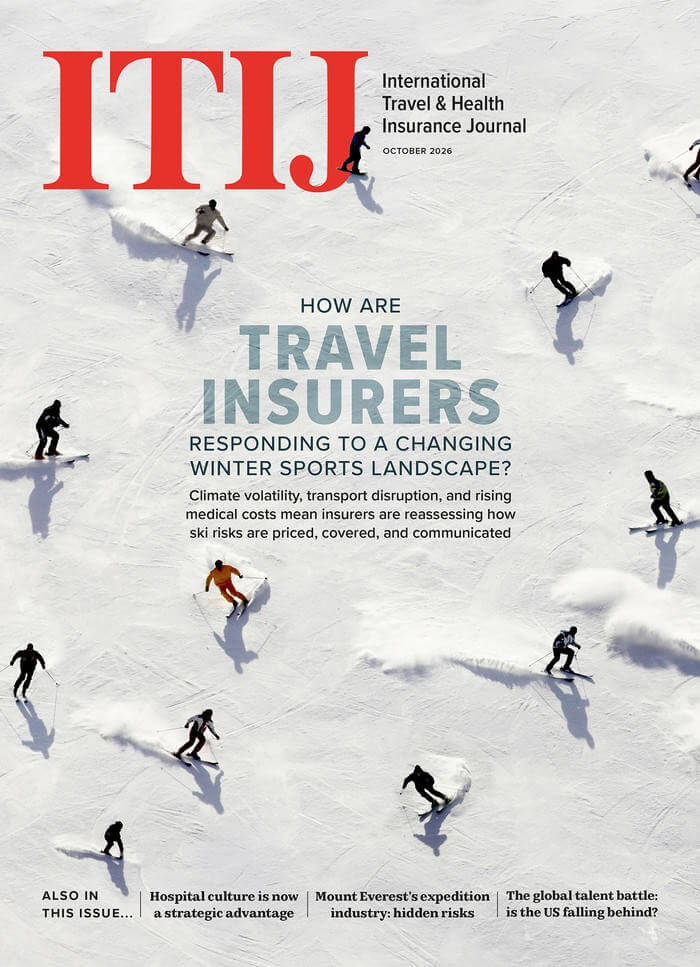
October 2026
Issue
This month in ITIJ we take a close look at how travel insurers are responding to the changes in winter sports risk, and we ask how risk is priced, covered and communicated to policy holders.
How do international hospitals stand out from the crowd, and become the number one choice for insurers and assistance companies? Clinical excellence alone is no longer enough. We look at why hospital culture has become a strategic advantage, and how dedicated international departments are strengthening relationships between hospitals, insurers, and assistance companies.
Chloe Fox
Chloe Fox is an Editorial Assistant for Voyageur Group, joining in 2024. She writes for ITIJ and AirMed&Rescue, covering a range of topics including international travel and health insurance, medical assistance provision, and air medical transportation. Chloe holds a BA (Hons) in English and an MA in English Literature from the University of Bristol.