
News Analysis: Have Greece’s emergency services adapted quickly enough to the rapid growth of adventure tourists?

Diving and climbing have become popular activities for visitors to Greece, widening the destination’s portfolio of attractions. Is there a risk that Greece’s emergency responders are being over-extended? Robin Gauldie reports
Scuba diving has boomed in Greece since restrictions were lifted 20 years ago. The dive organisation PADI (the Professional Association of Diving Instructors) now lists more than 60 scuba companies that are paid-up members of the Association scattered around mainland and island resorts.
Once wary of divers looting its ancient shipwrecks, Greece now takes pride in its ‘underwater museum’ in the Sporades islands, and retired naval vessels have been scuttled and artificial reefs created to attract divers to the new Apokoronas Diving Park, off Crete. Over the last two decades, Greece has also increasingly attracted climbers, lured by challenging rock faces on the mainland and islands.
It’s easy to see why some islands are keen to tap these niche markets. Keen divers and climbers are an undemanding clientele: accommodating them does not require major investment in frills like fine-dining restaurants, upscale spas or sophisticated nightlife.
Up to 15,000 climbers visit the island of Kalymnos every year. They stay, on average, for 15 days and many arrive in shoulder seasons, helping guesthouses and hotels to stay open almost all year – on neighbouring Kos, Greece’s fourth most popular isle, as on most Greek resort islands, most tourism establishments close from October until Easter. Now, though, a few are asking whether Greece’s emergency rescue services and emergency medical infrastructure have adapted quickly enough to the rapid growth of these more edgy holiday activities.
“Greece’s mountain rescue system remains inadequate due to the lack of a proper helicopter rescue system,” Christos Belogiannis, Secretary-General of the Greek Mountain Guides Association, told To Vima, the Greek newspaper, following the widely publicised fatal fall of a Czech climber. Poor visibility, strong winds, and rain prevented a safe approach by helicopter. The incident represented a worst-case scenario and highlighted essential issues that Greece’s mountain rescue strategy planners need to address, he said, adding that firefighters and volunteer rescuers with climbing skills cannot replace a coordinated state-run helicopter emergency medical services (HEMS) system with crews trained for rapid deployment and interagency cooperation.
First response to accidents involving walkers and climbers is normally by firefighters, and Greece’s firefighting service is pressured by worsening wildfire seasons.
The Hellenic Coast Guard – the default first responder for incidents at sea – is tested by an ongoing migrant crisis, with thousands of illegal migrants heading for Greek shores annually. So is the Hellenic Air Force, which is responsible for the country’s helicopter search and rescue (SAR) operations.
Diving accidents are far outnumbered by less headline-grabbing fatalities: a total of 357 drownings occurred in summer 2025, most of them close to shore. In June 2026, two fatalities were reported on the same day: the body of a 17-year-old tourist was recovered by first responders from the sea off a beach on Crete, and a 57-year-old German visitor died while swimming at Tingaki, on Kos. Diving has become a mainstream holiday activity, but it’s still often seen by news media as an edgy, risky sport, so fatal accidents involving divers – especially foreign visitors to Greece – tend to receive more media attention.

Unique challenges
Marta Marrocco, Director of Assistance and Claims Services at Divers Alert Network (DAN) Europe, a worldwide nonprofit assistance and insurance provider, said DAN had no evidence that Greece was experiencing a systemic safety crisis in recreational diving.
From an assistance and insurance perspective, though, Greece presents a unique combination of factors, including strong growth in diving tourism, a highly seasonal market, a large number of islands, and significant numbers of holidaymakers participating in discover-diving experiences or entry-level courses, she stated.
“The principal challenge may be less about accident frequency and more about the complexity of emergency response when incidents occur, particularly in remote island locations,” Marrocco said.
Greece’s mainly public emergency medical system generally functions effectively, Marrocco pointed out, but faces the challenge of covering hundreds of inhabited islands spread across a large maritime area as well as a mountainous mainland.
“As a result, emergency response often involves coordination between local healthcare facilities, ambulance services, the Hellenic Coast Guard, air or sea transport providers, and hyperbaric treatment facilities,” Marrocco added.
“This can create logistical challenges that are less common in destinations where diving activity is concentrated near major urban centres,” she said. “The challenge is often not the availability of professional responders but the geographical realities involved in reaching specialised care from remote islands or isolated locations.”
PADI, which has led the way in making scuba a popular holiday pastime, lists more than 150 member dive operations in Greece, with around 70 on the mainland, more than 30 on the large island of Crete, and others scattered across smaller isles.
Greece’s mountain rescue system remains inadequate due to the lack of a proper helicopter rescue system
Around a dozen hyperbaric and decompression facilities are located in hospitals and clinics around Greece.
“While chambers exist in Athens, Thessaloniki, and Crete, access is not equally convenient from all diving destinations, particularly smaller islands, so patient transfers over significant distances may sometimes be required for serious decompression illness cases,” noted Marrocco.
“From an assistance and insurance perspective, one recurring concern is that many tourists assume their standard travel insurance automatically covers scuba diving. This is not always the case,” she added. “This issue is particularly relevant for first-time divers who decide to try diving during a holiday and may not have considered specialist diving insurance before booking the activity.
“Greece should not be viewed as either an unsafe or an unregulated diving destination,” Marrocco confirmed. DAN Europe had recorded around 120 diving-related incidents in Greece since 2020, against around 11,000 diving and non-diving, she stated.
“The more relevant issue is that diving in Greece often takes place within a geographically complex environment where emergency logistics can be challenging. Combined with the growing popularity of holiday try-dives and entry-level diving experiences, this highlights the continuing importance of appropriate medical screening, diver education, emergency planning, and adequate insurance coverage,” she concluded.
Difficult terrain
With its sheer cliffs and treeless slopes, Kalymnos is the stereotype of the tiny, barren Greek island. It looks like an unpromising place to make a living. Appearances, though, are deceptive.
With one of the largest fishing fleets in the Mediterranean, Kalymnos is prosperous, and home to around 17,000 people. Local services include a large modern hospital, with facilities (visiting scuba divers might note) that include a hyperbaric chamber. Lacking long, sandy beaches with room to build big hotels, its tourism sector is small – especially when compared with next-door Kos – and the island’s mayor, Giannis Mastrokoukos, says he wants to establish Kalymnos as a “model hub for global climbing development”.
“Kalymnos is reinforcing its position as a global reference point for safety, innovation, and development in climbing,” Mastrokoukos said at the annual meeting of the International Climbing and Mountaineering Federation (UIAA) Safety Commission, which the island hosted in May, only a few weeks after Petr Hruban’s death.
Kalymnos does not have a full-time mountain rescue service, and helicopter SAR is not continuously available. Rescue operations on Kalymnos are the responsibility of the local fire brigade, sometimes aided by a volunteer group, the Kalymnos Rescue Team. Some in the international climbing community have said that climbers visiting Greece should be entitled to expect more from local emergency services.
Hruban’s fall resulted from the failure of a rock anchor, one of thousands bolted into Kalymnos’s rock faces on more than 5,000 climbing routes. Around 1,000 were emplaced by climbers more than 20 years ago and require replacement, according to Aris Theodoropoulos of Climb Kalymnos.
While hyperbaric chambers exist in Athens, Thessaloniki and Crete, access is not equally convenient from all diving destinations, particularly smaller islands
A climbing coach and Director of Greece’s Mountaineering Club of Acharnes, Theodoropoulos is credited with putting Kalymnos and its cliffs on the map for climbers and pioneering many of its routes. He is also a Founder of Rebolt Kalymnos, a volunteer group that has so far replaced ageing steel anchors with new titanium bolts on 300 of the island’s climbing routes. The Kalymnos municipality has reportedly pledged €600,000 for further maintenance. It may not be enough.
“Although at least 20 incidents a year require stretcher evacuations in extremely difficult terrain, there is currently only one volunteer fire station with three professional firefighters,” Theodoropoulos told eKathimerini, a leading Greek newspaper.
Kestutis Skrupskelis, a Lithuanian climber who was on the spot at the fatal accident, was also critical. “On an island that relies solely on people coming there to climb, there are no rescue teams on standby,” he said. In fact, while Kalymnos welcomes climbers (and their money), the local economy does not depend on climbing, or even (unlike many Greek isles) on mainstream package tourism.
Hardcore climbers might point out that accidents – sometimes fatal – more frequently befall walkers on relatively unchallenging terrain than climbers on giddy cliff faces.
While this article was being written, a Spanish visitor was found dead by search and rescue responders on Mount Olympus, Greece’s highest mountain. The visitor was ill-equipped for unseasonably snowy conditions on the 2,917m mountain and reportedly attempted to reach its summit alone, against the advice of other walkers. A few days later, fire service and volunteer responders rescued a lone British hiker who required help after being injured on the mountain.
In April, a 60-year-old French walker was the victim of a fatal accident in what media reports called as a ‘remote’ area of the island of Ikaria – in fact, close to a main road and only 8km from a popular beach resort and helipad. The body was recovered by fire service crews and a helicopter.
On Zakynthos, firefighters were called on to rescue a 21-year-old tourist who fell from cliffs above the iconic Navagio beach, a popular Instagram spot, and a 62-year-old Belgian tourist fell from the top of another scenic cliff viewpoint on neighbouring Lefkada.
Greece’s seas and mountains are not uniquely high-risk when compared with other destinations. European Avalanche Warning Services, an international safety organisation, reported 151 avalanche fatalities Europe-wide in winter 2025–26 – most of them in Italy, France, and Austria, three mature mountain tourism destinations with highly sophisticated emergency rescue infrastructure. For divers and climbers, though, Greece is still an emerging destination where diving and climbing are niche activities. Emergency response services reflect that status.
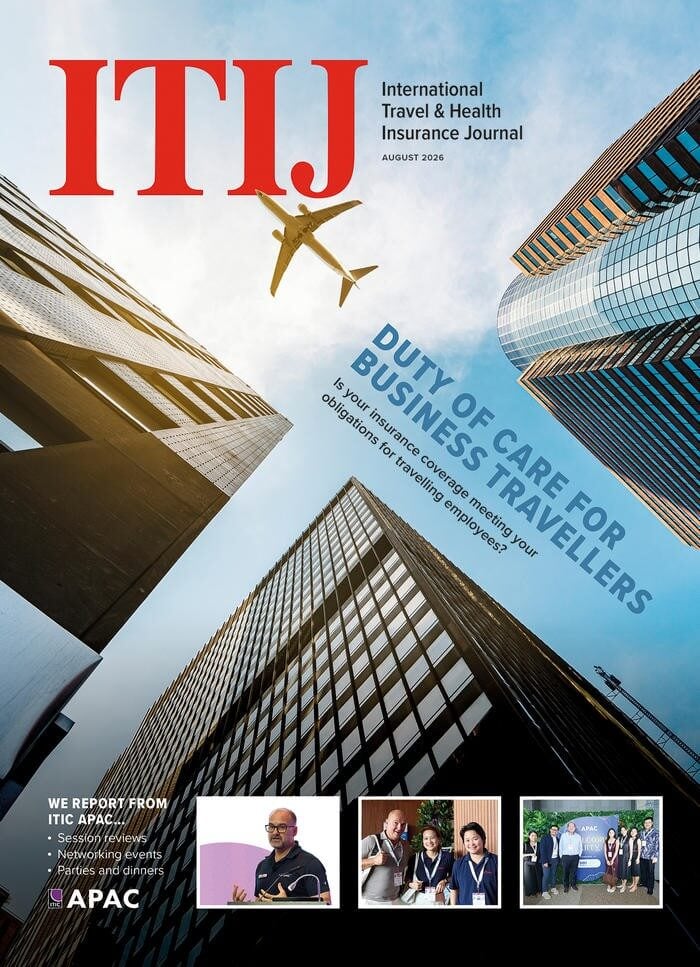
August 2026
Issue
This month we examine an issue important to many of us – the complexities of insuring business travellers. Employee travel exposes organisations to risks including medical emergencies, travel disruption, geopolitical instability and cyber threats. Adequate insurance coverage is more than a financial safeguard; it is a vital part of meeting an organisation’s duty of care obligations and responsibilities.
Robin Gauldie
Robin Gauldie is a freelance journalist and a former editor of a number of travel trade and specialist publications including Travel Trade Gazette Europe, ABTA Magazine, Ireland 2000 and Climate Change - Addressing the Challenge. He contributes to several newspapers and magazines including The Scotsman and Telegraph Travel and is the author of more than 30 travel guidebooks to destinations around the world. He lives in Edinburgh.
Robin has been writing for ITIJ and its Review publications on a freelance basis since 2008, covering a wide range of topics that span the global insurance and assistance sectors.