
Navigating critical care across continents

Mustapha Hmoud, Sales and Development Manager at Air Ocean Maroc, talks to Michelle Royle about his role, complex cases, and their expanding fleet
You have been with Air Ocean Maroc for almost five years, but you have been in the industry for much longer. Can you tell us about your current role and what your day-to-day responsibilities involve?
I currently serve as the Sales and Development Manager for Air Ocean Maroc. My role combines business development with operational support, ensuring we continue to strengthen relationships with assistance companies, insurers, governments, hospitals, and healthcare providers across the globe.
On a daily basis, I work closely with our operations, medical, and flight crews to coordinate patient transfers, develop new partnerships, and support clients throughout every stage of a mission. Medical aviation is a 24/7 business where every case is different, so flexibility, responsiveness, and teamwork are essential.
What drew you to the medical assistance and transport sector, and how has your career evolved within it?
Aviation has always been my passion, but medical aviation offers something unique – it allows me to make a real difference in people’s lives. Every mission has a human story behind it, and knowing that our work helps patients receive the care they need is extremely rewarding.
Over the years, I have been fortunate to work with leading international assistance companies and insurers, managing complex medical repatriation and critical care transfers across multiple continents. This experience has strengthened both my commercial and operational understanding of the industry and continues to motivate me every day.
Air Ocean Maroc operates in a highly time-sensitive environment – what are the biggest operational challenges you face in coordinating complex cases?
The greatest challenge is coordinating numerous stakeholders within very short time frames. A single mission may involve hospitals, treating physicians, ground ambulance providers, airport authorities, civil aviation authorities, immigration services, medical escorts, and assistance companies across several countries.
In many cases, medical conditions can change rapidly, requiring immediate adjustments to the flight plan or medical arrangements. Success depends on excellent communication, careful planning, experienced personnel, and the ability to remain calm under pressure.
Can you tell us about your fleet?
Air Ocean Maroc operates one of the largest and most diverse aviation fleets in Africa, enabling us to respond rapidly to both regional and intercontinental medical transport missions. Our current fleet includes three Bombardier Learjet 45 aircraft, a Bombardier Challenger 604, an Embraer Legacy 600, a Hawker 800XPi, a Beechcraft King Air 200, and our recently added Bombardier Global 5000.
The greatest challenge is coordinating numerous stakeholders within very short time frames
With the addition of the Global 5000, we are currently evaluating the implementation of a dual-configuration (VIP/air ambulance) layout. This would significantly enhance our long-range medical capabilities by allowing us to perform non-stop intercontinental medical evacuations and transport critical patients over extended distances with greater speed, comfort, and efficiency.
Our dedicated air ambulance aircraft are equipped with advanced intensive care systems, including transport ventilators, multi-parameter patient monitors, infusion pumps, defibrillators, suction units, oxygen systems, and other life support equipment. This enables our specialised medical teams to safely transport patients ranging from stable medical cases to critically ill ICU patients requiring continuous advanced care.

Air Ocean Maroc operates one of the largest and most diverse aviation fleets in Africa, enabling us to respond rapidly to both regional and intercontinental medical transport missions
While having a modern and versatile fleet is essential, it is equally important that every mission is carried out in accordance with the highest international quality standards. That is why we are particularly proud to be one of the only EURAMI-accredited air ambulance providers serving North, West, and Central Africa, as well as Spain, Portugal, Italy, and the wider Southern European region. This accreditation reflects our unwavering commitment to patient safety, clinical excellence, and operational quality, giving our partners the confidence that every mission is conducted in accordance with internationally recognised best practices.
How do you ensure effective collaboration between airlines, medical teams, insurers, and assistance companies during critical transfers?
Successful missions depend entirely on communication and trust.
We maintain continuous communication with all stakeholders from the initial medical assessment until the patient reaches their final destination. Every stakeholder receives timely updates, allowing everyone involved to make informed decisions throughout the mission.
Our coordination team works around the clock to monitor every aspect of the operation, ensuring seamless cooperation between medical teams, flight crews, hospitals, assistance companies, insurers, and ground transportation providers. Building long-term relationships based on transparency and reliability has been one of the key reasons behind our continued growth.

What key trends are you currently seeing in the medical transport and assistance industry, particularly in North Africa and internationally?
The industry has become increasingly global, with growing demand for international medical repatriations and specialised critical care transportation.
We are also seeing greater emphasis on accreditation, patient safety, and quality assurance. Clients increasingly seek providers with internationally recognised certifications that demonstrate operational excellence.
In North Africa, healthcare mobility continues to expand as patients increasingly travel abroad for specialised treatment, while international tourism generates additional demand for emergency medical transportation services.
Technology is also transforming the industry through improved patient monitoring, digital case management, and more efficient communication between all parties involved.
How have customer expectations changed in recent years when it comes to medical repatriation or patient transfers?
Expectations have risen significantly. Today, clients expect not only rapid response times but also complete transparency throughout the mission. Families, insurers, and assistance companies want continuous updates, accurate information, and reassurance that patients are receiving the highest possible standard of care.
Customers are also paying greater attention to provider experience, medical capabilities, aircraft quality, international accreditation, and operational reliability. They want confidence that the provider they choose can successfully manage even the most complex missions.

What role do communication and cultural understanding play in successfully managing international medical assistance cases?
Communication is one of the most important aspects of our business.
Every mission involves people from different countries, cultures, languages, and healthcare systems. Clear communication helps avoid misunderstandings, builds trust, and ensures smooth coordination between all parties.
Cultural awareness is equally important. Understanding local customs, respecting cultural differences, and communicating with empathy can make a significant difference, particularly when supporting patients and families during stressful situations.
We are also seeing greater emphasis on accreditation, patient safety, and quality assurance
At Air Ocean Maroc, our multilingual team and extensive international experience allow us to work effectively with partners across Europe, Africa, the Middle East, Asia, and the Americas. We believe that combining operational excellence with genuine human understanding is what ultimately defines outstanding medical assistance.
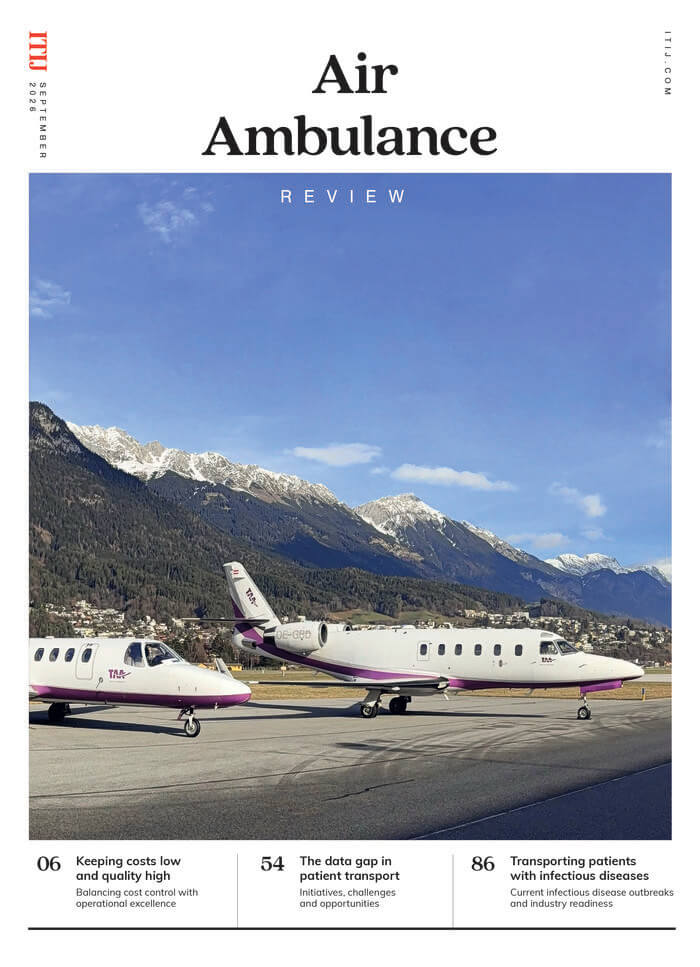
September 2026
Issue
This issue we focus on the problems that rising costs are having on the industry. Air ambulance providers are facing costs across fuel, aircraft maintenance, staffing, insurance, regulatory compliance, and specialist medical equipment. As if that wasn’t enough, delayed payments from insurers are adding further financial pressure. Despite these challenges, providers agree that patient safety and clinical quality must not be compromised.
Michelle Royle
Michelle is Editor of ITIJ.