
Interview: Paul Tiba, Managing Director of Airlec Air Espace

Paul Tiba, Managing Director of Airlec Air Espace, speaks to Chloe Fox about fleet innovation, clinical excellence, and the operational strategy driving the company’s global medevac success
You’ve overseen the introduction of the Falcon 900EX in medevac
configuration, a first in the industry. What strategic and operational lessons did Airlec Air Espace learn from that mission, and how has it influenced your growth trajectory?
With the Falcon 900EX, our ambition was clear: to become the go-to solution provider for missions that others cannot perform. That mindset has shaped Airlec’s identity.
Aviation safety should be treated with the same precision as clinical care
Many missions come with constraints (distance, runway, weather, patient
condition) and still, the patient must be moved safely. The Falcon gives us the ability to go the extra mile: triple engine redundancy, great range, large cabin space, and the flexibility to fully adapt configuration for complex scenarios.
The Falcon is sincerely an amazing tool for all our partners.
Airlec secured its first European Aero-Medical Institute (EURAMI) fixed wing accreditations in adult, paediatric, neonatal, and advanced critical care. How have these milestones shaped your clinical standards and differentiated your service offering?
Securing EURAMI accreditations across the full spectrum of care forced us to refine every detail of our clinical processes. It validated years of experience, through protocols, training, coordination, and documentation.
It also strengthened our position with partners who need to rely on consistent standards worldwide. EURAMI recognises in us the ability to deal with all types of patients.
However, I must say that I remain slightly disappointed that the aviation side of our industry has become secondary in accreditation frameworks. As a pilot and operator, I advocate for true aviation standards – not just “everyone fits in”. In my humble opinion, aviation safety should be treated with the same precision as clinical care.
The simultaneous repatriation of two Covid-19 patients underscored your team’s capability for complex missions. What were the key operational and safety adaptations made in response to Covid-19?
We actually went further: we flew up to four intensive care unit (ICU) Covid-19 patients simultaneously on longhaul flights.
There were no radical adaptations. We simply applied our existing expertise in managing highly infectious diseases, followed scientific evidence, and consulted with top scientists. That’s why we were able, from day one, back in March 2020, to perform open-cabin operations.
We didn’t improvise; we trusted the science. That approach proved effective and safe throughout the pandemic.

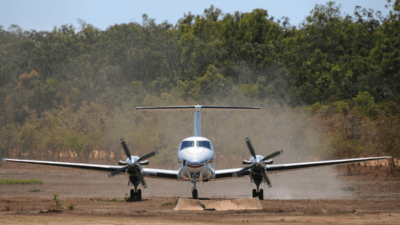
You recently introduced a second Hawker 900XP for medevac operations. What drove this investment, and how are you managing integration of new assets without compromising mission readiness?
It’s a recent aircraft, configured for intensive care transport, and, in my
view, the most versatile jet ambulance currently available.
I’ve flown it even on a full world tour. It delivers exceptional long-range capability yet remains highly efficient on short-haul missions thanks to its low fuel consumption. Moreover, it shares the same CS-25 certification as larger aircraft, which gives peace of mind to patients and partners.
Again, it’s about finding the right solution. The 900XP is also one of the very few medevac jets capable of operating from unpaved runways, which represents again a unique tool for our partners.
Operating from Bordeaux, France, with missions across continents, how do you maintain seamless operations – especially concerning flight permits, cross-border coordination, and medical protocols?
Seamless operations are the result of meticulous anticipation and strong communication. Our 24/7 coordination centre handles overflight permits, clearances, ground coordination, and contingency plans with a strong culture of proactive problem-solving.
Our 24/7 coordination centre handles overflight permits, clearances, ground coordination, and contingency plans with a strong culture of proactive problem-solving
But our footprint goes far beyond Bordeaux. As part of the DexFly group, we now operate with teams and departments based in Paris, Bordeaux, Tunis, and Monastir, with secondary bases, with aircraft and crew, in Lille, Lyon, and Marseille. We are also actively working toward expansion through foreign air operator certificates (AOCs). More soon…

Given the critical nature of your missions, how do you effectively recruit, train, and retain both flight and medical crew to maintain high readiness and patient care standards?
Since our merger with Valljet, we’ve restructured and modernised our organisation significantly. We adopted newer, more efficient tools and expanded our sales team from just two people to a dedicated group of six. This team now manages each mission from start to finish and acts as the single point of contact for our clients, 24/7.
Our operations control centre (OCC) and dispatch functions are now shared between all AOCs, which has greatly improved communication and coordination. Most importantly, this streamlined structure allows our clients to experience simpler, more efficient service.
Also, we strongly encourage internal promotion, even if it means costly training investments. Career growth within the group is a priority: many of our current leaders and captains started in first officer or junior ground positions and grew into their roles.
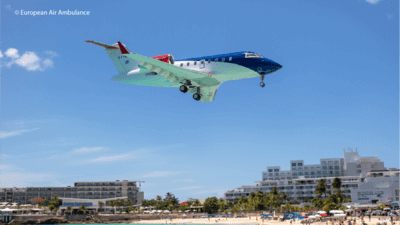

With medevac evolving rapidly, what technologies or innovations (e.g. extracorporeal membrane oxygenation (ECMO) capable aircraft, telemedicine, dedicated critical care modules) are you exploring to stay ahead?
We follow every evolution in medical care – ECMO, dialysis, and complex ICU setups are part of our daily capabilities now. Our equipment, aircraft, and team readiness reflect these standards.
Personally, I am a strong believer in innovation. I am convinced we are at a turning point in the integration of healthcare and aerospace technologies. We have even co-founded a medical telemonitoring startup to help shape the future of remote monitoring.
Following high-stakes missions, Airlec conducts thorough debriefs. Can you describe your quality assurance processes and how mission feedback drives continuous service improvements?
At DexFly group level, we have a fully integrated management system encompassing both medical and aviation activities. No fewer than seven full-time employees are dedicated to safety, compliance, and quality.
We treat that at high level, as a driver of performance, not just a requirement anymore. Open information sharing is encouraged, and we see briefing and debriefing as critical success factors.
This culture of transparency and reflection is the backbone of our continuous improvement goal.
Paul Tiba, Managing Director, DexFly and Airlec Air Espace
Paul is the Managing Director of DexFly, an aeronautical group that includes French air ambulance operator Airlec Air Espace. A pilot, instructor, and examiner with over 6,700 flight hours, he has extensive experience in international medical repatriation, including in conflict zones. He has spent the past 16 years leading operations and driving the strategic growth of Airlec in the aeromedical sector.
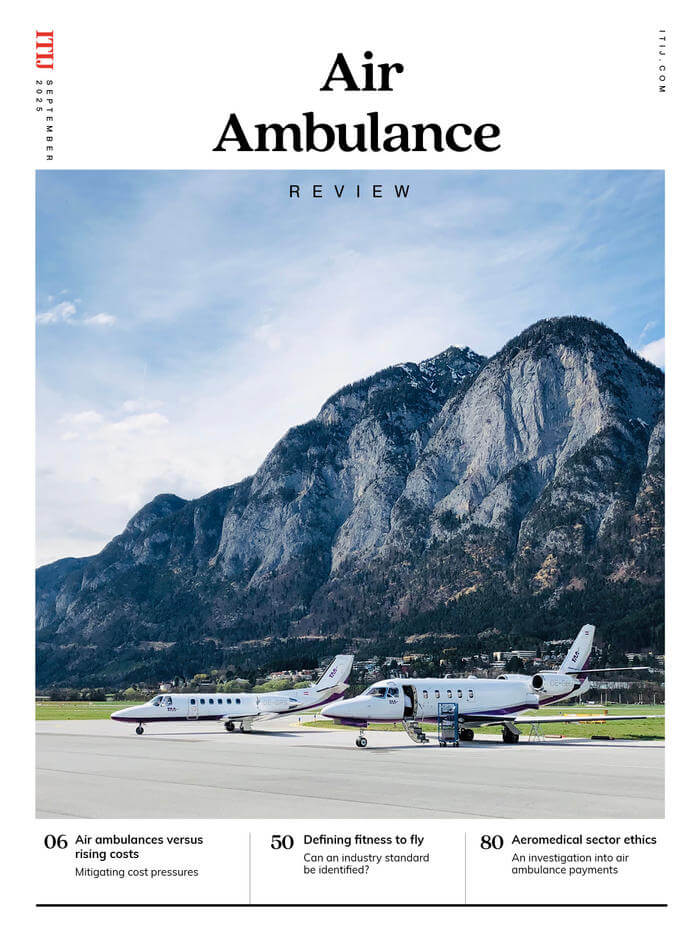
September 2025
Issue
We include an examination on defining ‘fitness to fly’, and ask if an industry standard can be identified, and what that would involve. We also look at capacity in the aeromedical market and experts share their insights. Ethics and transparency in the aeromedical sector is a big issue, and we include an investigation into air ambulance payments.
Chloe Fox
Chloe Fox is an Editorial Assistant for Voyageur Group, joining in 2024. She writes for ITIJ and AirMed&Rescue, covering a range of topics including international travel and health insurance, medical assistance provision, and air medical transportation. Chloe holds a BA (Hons) in English and an MA in English Literature from the University of Bristol.