
Interview: John Foster, Panorama Jets

Chloe Fox speaks to John Foster, Executive Vice President of Panorama Jets, about scaling an air ambulance operation while maintaining safety, clinical excellence, and a responsive service
Could you share a bit about your professional path and the experiences that led you to your role as Executive Vice President at Panorama Jets?
I started my career in government accounting, which gave me a strong foundation in finance and operations. In December 2011, I joined Aero Ambulancia to help expand its Dominican Republic-based air ambulance and charter business.
Since then, the company evolved into Helidosa Aviation Group, and in 2024 we rebranded as Panorama Jets.
Over six years, we grew revenue from US$4 million to $30 million, strengthening both charter and air ambulance divisions. I then served as Chief Operating Officer (COO) for three years, overseeing operations and guiding strategic initiatives. I currently serve as Executive Vice President (EVP), reporting to the board and helping shape the company’s long-term growth and vision.

Which aspects of your previous aviation or leadership roles have proved most valuable in managing both charter and medical evacuation operations today?
My experience in aviation and leadership has been key in managing both charter and medevac operations. Oversight of operations and finance helps me build efficient systems, while leading fast-growing teams taught me the value of clear communication, structured decision-making, and calm leadership.
Rising costs for fuel, maintenance, and medical equipment make balancing efficiency with high-quality care more complex
Safety has always been central, whether we’re transporting VIPs or critically ill patients, and it guides training, risk management, and resource allocation. Serving as the public face of an air ambulance also reinforced the importance of building trust with clients and partners in complex missions.
Panorama Jets has built a reputation for responsive, high-quality service – what operational practices or values do you believe most differentiate the company in the air ambulance space?
Panorama Jets stands out for readiness, clinical excellence, safety, and service. Our 24/7 dispatch team, streamlined communication, and strategically located aircraft allow rapid response.
Our critical care medical teams, supported by advanced onboard equipment, provide ICU-level care on every mission. Safety is central, with rigorous pilot training, proactive risk management, and a ‘just culture’ approach.
A customer-focused mindset, clear communication, reliable follow-through, and competitive pricing help us build lasting trust with hospitals, insurers, and families.

With a diverse fleet and both rotary- and fixed-wing capabilities, how does Panorama Jets ensure consistent safety, medical quality, and logistical performance across all missions?
We ensure safety, medical quality, and operational performance through standards, training, and structured processes. Pilots train regularly, aircraft are meticulously maintained, and a proactive safety system helps us identify and mitigate risks.
Our medical teams follow standardised protocols and continuous skills development, ensuring ICU-level care on every mission. Advanced equipment helps maintain consistent care across all aircraft.
Our operations centre coordinates every mission, tracking aircraft, crew, and patient needs in real time. Standardised dispatch and communication procedures help keep operations efficient and reliable.
From your perspective, what are the most significant challenges currently facing the global air ambulance and medical repatriation sector?
From my perspective, the air ambulance and medical repatriation sector faces several challenges. Rising costs for fuel, maintenance, and medical equipment make balancing efficiency with high-quality care more complex. Staffing shortages among pilots and critical care clinicians also affect 24/7 readiness.
Patients and families expect not just safe transport, but compassionate, personalised care
We navigate complex international regulations, while insurance and pricing considerations add another layer. At the same time, demand for long-range repatriation continues to grow, requiring careful planning.
Through it all, maintaining a strong safety culture and consistent clinical standards remains our top priority.
How have evolving expectations from insurers, assistance companies, and patients reshaped how providers must deliver air medical services?
Evolving expectations from insurers, assistance companies, and patients have shaped how we deliver air medical services. There’s a growing focus on transparency, efficiency, and clear communication, which means timely updates, accurate documentation, and predictable pricing.
Patients and families expect not just safe transport, but compassionate, personalised care. Insurers and assistance companies require adherence to protocols and clear justification for medical necessity.
Meeting these expectations requires a disciplined, coordinated approach, balancing clinical excellence, operational efficiency, and thoughtful communication. Ultimately, it’s about building trust and confidence while delivering the highest-quality service possible.

Looking ahead, how do you see technology – whether in aircraft, communications, or medical equipment – transforming air ambulance operations over the next decade?
Looking ahead, I see technology playing an increasingly important role in air ambulance operations. Advances in aircraft systems will improve efficiency, range, and safety, while better communications tools will allow real-time coordination with crews, hospitals, and families.
On the medical side, sophisticated onboard equipment and monitoring will enable ICU-level care in challenging environments, and telemedicine and data integration can enhance decision-making and patient outcomes. Technology also helps streamline operational planning and logistics, enabling faster, more accurate missions. Over the next decade, I expect these innovations will let us provide care that’s safer, faster, and more personalised, while keeping the human touch patients and families rely on.

What strategic initiatives or investments is Panorama Jets prioritising to stay competitive and meet future demands in the air medical transport sector?
At Panorama Jets, we’re focusing on strategic initiatives that keep us competitive and ready for the future. One priority is upgrading our fleet with newer aircraft while keeping aircraft types to a minimum. This helps us maximise pilot expertise and simplify maintenance, ensuring consistent safety and operational performance.
We’re also investing in advanced medical equipment, training, and communications systems to maintain the highest level of patient care and mission readiness. By focusing on smart fleet growth, operational efficiency, and clinical excellence, we’re positioning Panorama Jets to continue delivering safe, responsive, and high-quality air medical services.
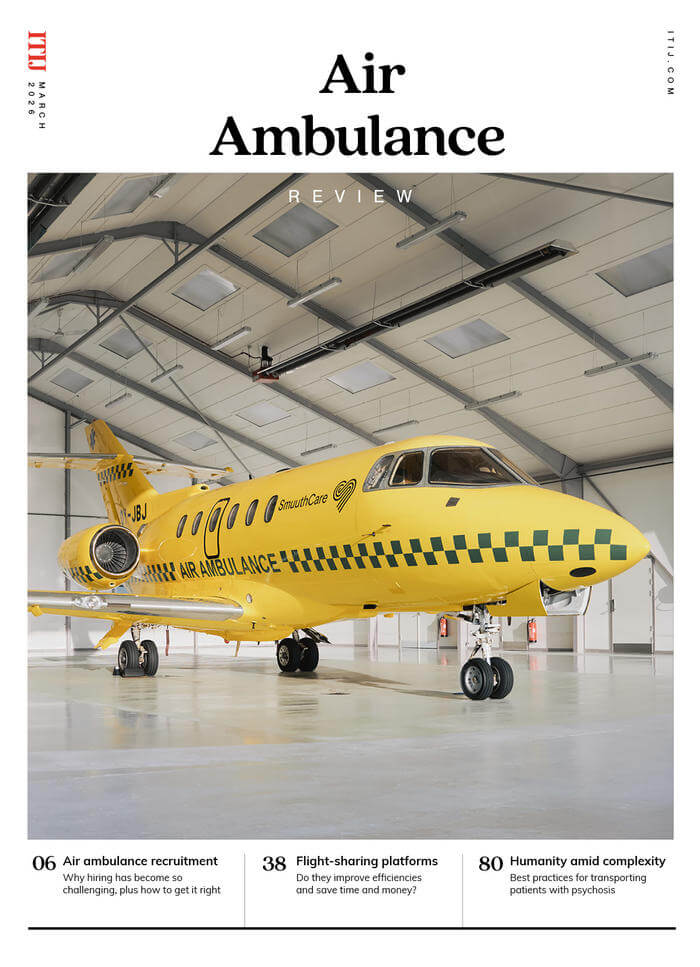
March 2026
Issue
In this issue of Air Ambulance Review we examine the challenges facing air ambulance providers when it comes to recruitment; look at flight-sharing platforms and ask if they can improve efficiencies; and we delve into the latest medications, protocols and best practices for transferring vulnerable patients with psychosis.
Chloe Fox
Chloe Fox is an Editorial Assistant for Voyageur Group, joining in 2024. She writes for ITIJ and AirMed&Rescue, covering a range of topics including international travel and health insurance, medical assistance provision, and air medical transportation. Chloe holds a BA (Hons) in English and an MA in English Literature from the University of Bristol.