
Interview: Blessy George, Head of North America at AXA Partners

Blessy George from AXA Partners speaks to ITIJ about evolving customer expectations, emerging global risks, and the growing role of technology in delivering more personalised solutions
Can you share a little about your professional journey and what led you to join AXA Partners?
I started working for an insurance company part-time during university. As a young person, it‘s rare to choose insurance as a career early on. Nevertheless, my first full-time job after graduating was with CNA when they had a life and disability business. After working there for some years, I went to law school and continued my career as an in-house attorney.
AXA Partners US recruited me in late 2011 to help build their travel insurance business. After a few years, I was promoted to General Counsel for the Americas region. While I enjoyed legal roles, I began thinking about the next step in my career, wanting something more focused on the business.
For the past decade we’ve experienced various global shifts in risks, such as climate change, political movements, and health risks
After sharing my interests with our Regional CEO, I was encouraged to pursue the US CEO and Country Manager role, which I was appointed to in June 2020, during the early months of Covid-19. In July 2023, my responsibilities expanded to include our Canadian entity as well.
What are your key responsibilities in your current role, and what aspects of your work do you find most rewarding?
As CEO, my key responsibilities span across our companies in the US and Canada – from delivering exceptional service to our clients and customers, to evolving our market capabilities and focusing on our amazing employees to help ensure we have a work environment where they can thrive. These are all components of my ultimate responsibility to grow a strong, profitable business that is valued in the market.
What fascinates me about AXA Partners is how this is truly a people business at its core. The individuals who thrive here share natural empathy and understand what it means to care for others during vulnerable moments. This creates a culture where creativity and entrepreneurial drive combine with genuine pride in our human impact.
What I find most rewarding is collaborating with this exceptional team as they innovate while maintaining the trust customers place in us. There‘s something uniquely fulfilling about leading an organisation where business success and making a meaningful difference are so intrinsically connected.

What are some of the biggest trends currently shaping the insurance and assistance industry, and what changes have you observed over the last 10 years?
For the past decade we’ve experienced various global shifts in risks, such as climate change, political movements, and health risks, of which the Covid-19 pandemic was life-altering.
Additionally, we’ve seen significant acceleration in the adoption of certain technologies, particularly with automation and artificial intelligence.
These shifts in risks and faster adoption of technologies have dramatically impacted how we all look at the world, decide how we want to live and how we protect ourselves from the related risks.
The insurance and assistance industry have had to adapt to these changes to ensure we bring value to our clients and customers. This has resulted in new digital players that challenge conventions while established players strategically reposition themselves. This has fostered innovation that benefits travellers through expanded capabilities.
It’s interesting, even in our highly connected world, that access to medical care and crisis support internationally remains more fragmented than you might expect
Consumer expectations have changed considerably, with travellers now expecting digital-first experiences and personalised service. The rise of insurtechs has both responded to and accelerated this trend toward more intuitive, streamlined solutions.
A noteworthy development has been the rising demand for mental health support during travel. This reflects broader societal awareness and has prompted our industry to develop more comprehensive services addressing both physical and psychological wellbeing.
These industry shifts coincide with a broader movement toward experience-focused travel. People are increasingly unwilling to postpone their travel adventures, creating both opportunities and responsibilities for our industry to enable and protect these meaningful experiences.
It’s interesting, even in our highly connected world, that access to medical care and crisis support internationally remains more fragmented than you might expect
How are shifting customer expectations influencing the industry, and what strategies is AXA Partners using to stay ahead?
Customer expectations are evolving rapidly in today‘s digital landscape. What we‘re seeing is that in a world where people are bombarded with choices for virtually everything, travellers are increasingly seeking personalised experiences that align with their specific needs and preferences. They want services and benefits tailored to their destination choices, planned activities, and individual travel styles – all accessible instantly and with minimal friction.
At AXA Partners, we’re responding to this shift by staying closely connected to certain market segments. This allows us to truly understand the nuanced preferences and behaviours of various traveller types. We don’t just collect this information – we actively use these insights to drive our business forward in three key areas: developing more relevant products, expanding strategic partnerships that enhance our offerings, and creating intuitive digital tools that significantly improve both our value proposition and the overall customer experience.
The goal isn’t just to meet current expectations but to anticipate future needs in this rapidly changing global travel environment. By maintaining this customer-centric approach, we’re able to deliver assistance and insurance solutions that feel personally relevant to each traveller while still scaling efficiently across our global operations.
What factors or practices do you believe are essential for fostering customer loyalty?
In our industry, customer loyalty is built on a foundation of trust, and that’s especially true given that our touch points with customers often occur during their most vulnerable moments. When someone‘s facing a medical emergency or crisis while travelling, they need to feel confident that we understand what they’re going through, can help them navigate unfamiliar systems, and will be there with support exactly when and how they need it.
We support travellers throughout their journey, but what sets us apart is how we show up during those critical moments. Our network of medical professionals and crisis teams around the world brings not just expertise but genuine empathy to every situation. They provide reassurance during what can be really frightening experiences far from home. This human connection is what creates meaningful relationships with our customers.
Great partnerships come down to bringing complementary strengths to the table

Everything we do operationally is built around honouring this trust. It influences how we design our benefits, how we deliver assistance through both digital channels and human specialists, and how we handle claims. When travellers experience this level of care during difficult situations, it creates something more valuable than ordinary brand loyalty. It establishes a relationship that truly matters to both sides.
How do internal mentoring programmes at AXA Partners contribute to employee development and drive innovation within the company?
Our mentoring programmes are an important component of how we develop talent and nurture innovation at our company. Our business is rooted in empathy, agility, and problem-solving qualities that we actively cultivate through mentoring.
I‘ve seen firsthand how these connections between experienced team members and emerging talent create a rich environment for fresh thinking and collaboration across different functions. It‘s especially rewarding to watch how mentoring relationships help break down traditional barriers and inspire new approaches to evolving customer needs.
With technology rapidly evolving, how is AXA Partners leveraging innovation to enhance its services, and are there any exciting advancements on the horizon?
We‘re focusing on using technology to create tools that help travellers stay ahead of potential risks while they’re away from home. It’s interesting that, even in our highly connected world, access to medical care and crisis support internationally remains more fragmented than you might expect. Our customers naturally want digital solutions, but delivering these consistently can be challenging, depending on where travellers find themselves and what infrastructure is available in that particular location.
We’re continuing to build our digital capabilities to offer everything from real-time safety guidance to accessible medical information and on-demand assistance, all through whatever devices travellers prefer to use. I’m particularly excited about where we’re headed – creating more seamless, personalised support that meets travellers exactly where they are, with the kind of intuitive experience they’ve come to expect from the best digital services in their daily lives.
When forming partnerships, what key qualities or criteria are most important to ensure a successful collaboration?
For us, great partnerships come down to bringing complementary strengths to the table. When we each contribute what we do best, we create something more valuable for travellers than either of us could deliver on our own. What’s equally important is maintaining honest conversation. Not just celebrating the wins together, but being open about what isn’t working so we can fix it. That’s how our organisations truly come together in ways that make a difference, rather than just partnering on paper.
Artificial intelligence is transforming our landscape in meaningful ways
Looking ahead, what do you see as the biggest opportunities and challenges for the industry in the next five years?
Looking ahead five years, several key areas stand out to me. We’re navigating a world of increasing global uncertainties, and travellers need dependable safety nets more than ever. This represents both a responsibility and an opportunity for our industry to provide that crucial support.
Artificial intelligence (AI) is transforming our landscape in meaningful ways. Beyond operational improvements, we’re particularly interested in how it enables us to anticipate customer needs and deliver more responsive, personalised assistance when travellers need it most.
Climate change continues to reshape travel patterns and risk profiles. We’re seeing this through more frequent extreme weather events and shifting health considerations across regions. This requires us to develop more adaptive, forward-looking services.
Perhaps the most interesting is how traveller demographics and behaviours are evolving. From the rise of digital nomads to multi-generational travel and emerging markets with first-time international travellers, each segment presents distinct needs. The companies that excel will be those that truly understand these diverse requirements and develop thoughtful solutions to address them.
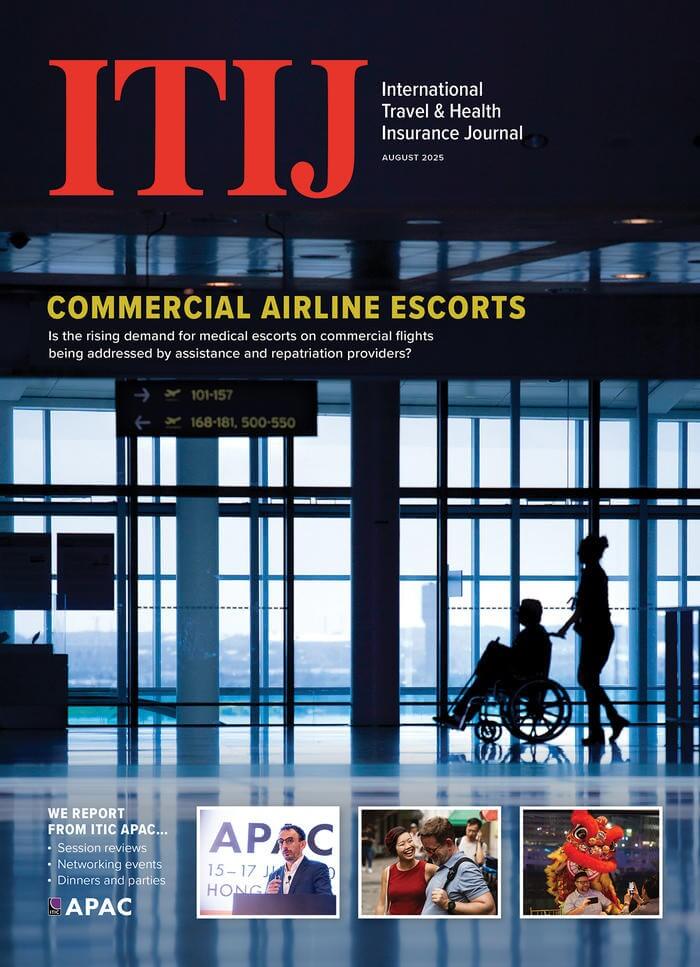
August 2025
Issue
This month we look at the rising demand for medical escorts on commercial airlines, plus ask how the latest technology can help insurance companies. In our International Hospitals and Healthcare Review we examine humanising IPMI in the digital age, and ask what makes a destination desirable for medical tourism.
Editorial Team
The Editorial Team updates the ITIJ website daily, and works on features for the print edition. With expert industry knowledge and years of experience in writing about complex travel insurance issues, the Editorial Team is ready to investigate and report on the topics that matter most to ITIJ's readers.