
Insuring international students

Alysia Cameron-Davies examines shifting student mobility amid geopolitical and economic pressures, and how insurers are responding
International student mobility has always been sensitive to global events. Today, factors such as stricter visa policies, rising costs, and geopolitical tensions are influencing where students are choosing to study.
Rebecca Trawick, Director of Academic Division at Trawick International, said: “The landscape of higher education is undergoing significant transformation, driven by geopolitical changes, immigration policies, and evolving student preferences. These shifts are impacting not only universities but also the industries that support international education, such as insurance providers, recruiting agencies, and student services.”
Navigating visa hurdles
The US, Canada, the UK, and Australia remain the top study destinations for those heading overseas. However, tougher entry rules and stricter visa requirements are increasingly pushing students to look beyond the so-called ‘big four’.
Data shared by Cara Skikne, Head of Communication and Thought Leadership at Studyportals (a leading online platform that helps students search, compare, and apply to international higher education programmes), shows a clear downward trend in international enrolments across North America for the August–October 2025 intake. She attributed the drop in numbers in both Canada and the US to “restrictive government policies and visa uncertainty”.
“According to our Global Enrolment Benchmark Survey, Canada lost about 36% of undergraduate international students and 35% of postgraduate students,” she said. “The US dropped 6% for undergraduates and 19% for postgraduates.” The US Institute of International Education confirmed a 17% fall in new international student enrolments in October 2025.
Skikne stressed that 85% of US schools and 90% of Canadian institutions now view visa policies as a major issue. “When negative news about visa policies hits, we see search interest for programmes in affected countries drop and interest in European and Asian alternatives spike,” she added.

Rising costs shape study choices
Alongside visa challenges, many students are now facing financial barriers when deciding where to study. Speaking from a Canadian perspective, Brad Dance, Chief Customer Officer at TuGo, said the country’s rising financial thresholds – the amount of money international students must show proof of in order to be eligible for a study permit – are increasingly deterring students from less affluent regions.
He noted sharp declines in enrolments from countries such as India and those in North Africa in recent months. “A lot of that has to do with the federal government’s new financial requirements, namely CA$22,895 required per year for a single applicant, in addition to tuition and travel costs,” he explained.
Eighty-five per cent of US schools and 90% of Canadian institutions now view visa policies as a major issue
Reflecting on the knock-on effect for insurers, he said: “Given the decline in international students arriving in Canada, the demand for student insurance is much less.”
Similar pressures are emerging in the UK. Skikne described UK masters’ programmes as among the most expensive in the world and noted that 72% of British institutions now cited affordability as a major barrier for prospective students.
The Chinese student market
Chinese students continue to represent a major segment of the international student market, with over one million studying abroad in 2023 (UNESCO). The US has long been their preferred destination, with Chinese students accounting for nearly a quarter of all international enrolments in 2023–24 (Statista).
However, numbers have fallen in recent years due to the pandemic, escalating US-China tensions, and more complex visa requirements.
The political climate is also influencing students’ personal experiences in the US. A 2024 Multicultural Insights survey found that 68% of Chinese students experienced racial discrimination off campus and 60% on campus.
Despite the challenges, Justin Poehler, International Medical Group (IMG) Chief Commercial Officer, noted that Chinese students remained a “sizeable market” for the US. For those choosing alternative destinations, many still want to study in English-speaking countries. “As a result, countries such as Canada, the UK, Ireland, Australia, and New Zealand have seen an increase in Chinese student enrolment,” he said.
Studyportals reported reduced search interest in US programmes online, and growing interest in the UK, Europe, and Asia. Skikne pointed out: “It’s not that Chinese students don’t want to study abroad any more, but they seem to be choosing different destinations, often those closer to home.”
Destinations gaining traction
“For US outbound students, Europe and the UK continue to see strong demand, particularly in Spain, France, and Ireland, alongside notable growth in Japan and Australia,” Dave Turner, Head of Account Management at AXA Partners US, said. “These shifts are being driven less by geopolitics and more by programme availability, affordability, and the internationalisation of degree offerings. By contrast, inbound student numbers to the US and parts of South America have softened due to visa policy constraints and political instability, which in turn requires institutions and assistance providers to adapt how they support students across a more diversified set of destinations.”
“Recent years have seen a sharp decline in international students coming to the US, with a notable drop in students from India,” Trawick added. “This trend is largely attributed to the removal of visa application options last year, increased tariffs, and changes in immigration policies. As a result, international students are increasingly choosing alternative destinations for their studies, including Germany, Australia, New Zealand, and Canada.
“Germany has become particularly attractive due to its strong employment opportunities with large companies after graduation. Language remains a critical factor influencing student decisions, while Canada’s policy of allowing spousal reunification for international students has further strengthened its appeal.”
Skikne highlighted Asia as the region that saw the strongest growth in 2025. “Asia is consolidating as a destination region with over 20,000 English-taught programmes, and the Middle East North Africa (MENA) region is positioning itself as a serious competitor with major investments in scholarships and branch campuses,” she said. Within MENA, Turkey, the United Arab Emirates, and Saudi Arabia are emerging as increasingly popular choices.
In Asia, Skikne pointed to China’s rise as a host country, particularly for students from within the region, including from Vietnam, Indonesia, and the Philippines. “Interest in studying in China is up 61%, with New Zealand, Ireland, and Malaysia also seeing strong growth.”
Poehler agreed, noting that reliable visa processes and post-graduation work opportunities were now top priorities for students. “As both factors become increasingly restrictive and unclear in certain countries, other countries that do offer transparent visa policies and strong work options are becoming more attractive.”
Skikne highlighted the implications for insurers, explaining that “the speed and scale of these shifts really matter”, as students can switch to entirely different destinations within months when policy uncertainty strikes. “If you’re an insurance provider, these emerging destination markets are where the growth is happening.”

Implications for insurers
As students explore diverse destinations, insurers are facing a more complex landscape.
“The reduction in international student enrolment has a direct effect on insurance demand and risk management for carriers and brokers,” Trawick said. “Insurance rates are calculated based on the cost of claims (medical expenses) and an assumed number of participants purchasing coverage each year. When enrolment numbers drop significantly, the risk pool shrinks, leaving insufficient funds to cover losses. This imbalance often results in higher premiums for schools and students, creating additional financial pressure.”
Asia is consolidating as a destination region with over 20,000 English-taught programmes
Student risk profiles are also evolving amid unstable global conditions. Political unrest, regional conflicts, sudden policy changes, and fluctuating travel restrictions all affect the exposure international students face abroad. Chrissy Valdez, Senior Director of Operations at Squaremouth, noted: “When it comes to the length of trips for international students, they tend to be longer than normal travellers, putting them in a higher-risk category and requiring more long-term medical coverage.”
Expanding on this, Valdez added: “While we can’t say for certain that insurers are placing students in different risk profiles, we have seen a notable shift in coverage options over the last year to include coverage for longer trip durations and coverage for $0 trip costs (or medical-only policies), which typically are required for academic travel requirements or Schengen visas.”
“While students still gravitate toward established destinations in Europe and Asia, we are seeing continued interest in more complex regions for specialised fields of study,” Turner said. “Regional conflicts, political instability, and changing travel restrictions mean that planned destinations can shift quickly, increasing both uncertainty and operational risk. This places greater importance on real-time monitoring, flexible support structures, and clear communication with students as conditions evolve.”
Evacuation policies add another layer of complexity. Unlike short-term travellers, international students live abroad for extended periods, often with overlapping study and visa obligations that make rapid evacuation challenging. Insurers must manage multiple risks – including political unrest, natural disasters, and health emergencies – while coordinating with universities, local authorities, and consulates. Prepaid tuition, housing, and travel costs heighten financial exposure, and the psychological impact of evacuations on students far from their support networks requires careful consideration.
“Evacuation support has become a non-negotiable component of international student programmes, reflecting the realities of today’s risk environment,” Turner said. “At the same time, mental health support is seeing sustained growth in utilisation, driven by the challenges of adapting to life abroad, social isolation, and continuity of care across borders. Programmes that integrate mental health as a core service, rather than a secondary feature, are proving far more effective in supporting student wellbeing.”
Trawick added: “Institutions and insurance providers must remain vigilant about security and compliance. This includes blocking purchases from sanctioned countries, conducting security checks for members from high-risk regions, and monitoring travel advisories. These measures are essential to mitigate risk and ensure regulatory adherence.”
Enhanced mental health support is paramount
Beyond practical and logistical challenges, being far from home amid global pressures can take a serious toll on students’ mental wellbeing. “Regional conflicts, deportation threats, freedom of speech restrictions, travel bans, and tighter visa processes have all added new obstacles to the international student experience and have also placed additional strain on mental health,” Poehler explained.
Dance concurred, saying stress and mental health are common reasons for student claims. Insurers are responding, Poehler noted, by enhancing mental health coverage and integrating telehealth counselling into plans, making support more accessible for students navigating these pressures abroad.
Lynn Pina, Chief Marketing Officer at Blue Cross Blue Shield Global Solutions, agreed that mental health support was “one of the fastest-growing expectations in global health cover.
“For mobile individuals, students, and assignees, the psychological load of moving countries, adapting cultures, living away from support networks, and handling work or study stress is significant,” she said. There has always been a need for mental health support, “but even more so given the current political climate, which could exacerbate existing mental health conditions or trigger new ones,” she added.
Trawick added: “Recognising the importance of mental health, many policies now include telehealth services and virtual counselling options. These counselling services are unlimited, offered at no additional cost, and allow members to maintain continuity by seeing the same counsellor. Mental health support can be a decisive factor in whether a student completes their programme or returns home early due to homesickness. By providing accessible care, institutions and insurers aim to foster positive outcomes for students and schools alike.”
Pina outlined several initiatives at Blue Cross Blue Shield Global Solutions, including remote counselling, multilingual and culturally sensitive support, and partnerships with schools and student health centres to deliver orientation programmes featuring wellbeing modules and peer support groups. Raising awareness and reducing the stigma around mental health are also key priorities. Technology plays a central role in making support easily accessible, with wellbeing portals integrated into mobile apps and digital platforms for self check-ins.
Spotlighting collaboration with universities, Pina explained: “We also offer a support service for school advisers, to help them identify a student in need and train them on how to advise students to leverage the support available to them. It’s even more critical to have student advisers identifying and advocating for international students, given that many may also be managing stigma and cultural norms that introduce additional barriers to seeking mental health care and support.”
Pina concluded that there was still more work to be done: “The political climate could create an environment that makes these students feel lonely and unwelcome. Changing mobility patterns means students who once could count on a robust community of other students from their home country studying at their institution could find themselves among a smaller or dwindling community – further isolating them from their peers. These two trends call for even greater focus on pre-departure support and mental health briefings, along with relocation-stress navigation.”
Addressing the evolving needs of the student market
Alongside expanding mental health benefits, Poehler highlighted the importance of broadening coverage to include protection against visa cancellation or revocation, forced relocation, tuition loss, and school closures. He noted that many policy cancellation requirements had already been eased to account for unforeseen disruptions. “This reflects insurers’ efforts to provide international students with the coverage they need as they navigate growing uncertainties in today’s world.”
He also emphasised the role of technology in delivering risk intelligence and real-time alerts to students about political unrest and travel restrictions.
While technology offers endless possibilities to enhance support and streamline services, it also introduces new risks. Growing reliance on digital learning platforms exposes students to cyber threats, including data breaches and fraud, making robust cyber protections a crucial consideration for insurers designing future-focused student policies.
“As student mobility becomes more complex, travel assistance providers play an increasingly important role through their global situational awareness, local networks, and operational experience across regions. By working closely with institutions and programme sponsors, assistance companies can help anticipate emerging
risks, adapt support models in real time, and ensure students have access to coordinated care wherever they are. Ultimately, proactive support models, rather than reactive ones, will define how effectively students are protected in an increasingly volatile global environment,” Turner said.
Skikne stressed that international students cared about “transparency and flexibility”.
“Students really want clear support structures and plain-language policies,” she said. “Insurance providers who can demonstrate clear, accessible support, especially for students navigating complicated cross-border situations, probably have a real advantage.”
She emphasised the importance of context-specific solutions, noting that each region presented its own challenges. “If insurance feels like another barrier (confusing, inflexible, not designed for their specific regional situation), that could influence which programmes students ultimately choose.”
Skikne concluded: “You need to be fast and agile. Insurance providers that can adapt quickly to new markets and shifting destinations are going to be better positioned.”
February 2026
Issue
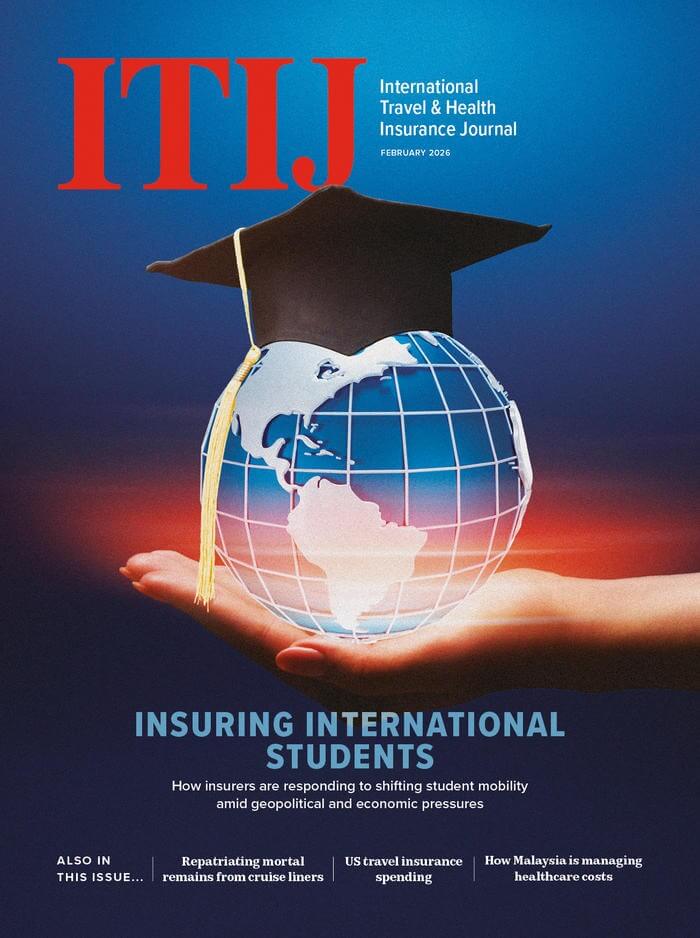
In this issue of ITIJ we look at international student insurance, and consider the impact of geopolitical decisions on market demand; we examine what ensues when a fatality happens on board a cruise ship, and what the protocols are for management of the remains; and we look at younger groups eschewing travel insurance.
Alysia Cameron-Davies
Alysia is a copy writer for Voyageur Publishing.