
An insider’s guide to Venice

ITIC Global 2025 takes place in Italy’s beautiful floating city. Alysia Cameron-Davies explores the best things to see and do there
ITIC Global 2025 will take place in the beautiful Italian city of Venice, at the Hilton Molino Stucky hotel. The hotel is located on Giudecca Island, just south of Venice’s central districts. Giudecca is known for being a tranquil local area offering authentic Venetian beauty and panoramic views of the city across the canal.
Sightseeing and cultural highlights
Giudecca
Giudecca’s main landmark is Il Redentore, a Renaissance church designed by Andrea Palladio in the 16th century. Stroll along the Giudecca Canal for great views of the city, wander the quieter side streets, and stop by the Giudecca Art District to explore its galleries.
Central Venice
Venice’s main districts are easily accessible via the hotel’s shuttle service, which runs regularly to St Mark’s Square (Piazza San Marco) and Zattere. Public water bus (vaporetto) services are also available; the closest stop, Palanca, is a five-minute walk from the hotel.
Giudecca is known for being a tranquil local district offering authentic Venetian beauty and panoramic views of the city across the canal
St Mark’s Square is Venice’s social, religious, and political heart, home to some of the city’s most iconic landmarks, including St Mark’s Basilica and Campanile, the Doge’s Palace (Palazzo Ducale), the Clock Tower (Torre dell’Orologio), the Correr Museum (Museo Correr), and the Procuratie Vecchie. As one of the city’s most visited areas, it can be busy at peak times, though crowds are usually smaller in November.
St Mark’s Basilica, the city’s principal church, draws thousands of visitors each year with its ornate facade, domes, golden mosaics, and marble floors. The terrace provides stunning views over the square.
For panoramic city views, head to the top of St Mark’s Campanile, the tallest structure in Venice at nearly 100m. Nearby, the striking Clock Tower will catch your eye with its Renaissance design and large blue-and-gold astronomical clock, which shows the time, moon phases, and zodiac signs.

No trip to Venice is complete without exploring the city via its canals; hop on a vaporetto or gondola and admire the palaces, bridges, and everyday life along the water
The Doge’s Palace, a Gothic masterpiece, was once the residence of the Doge and the city’s government. Today it’s a museum with grand chambers, notable artworks, and the Bridge of Sighs, named for the convicts who sighed as they caught their final glimpse of Venice before entering prison.
Across the square, the Museo Correr explores Venice’s art and history with paintings, sculptures, maps, and displays of daily life. The Procuratie Vecchie, one of the oldest buildings on the square, once housed the Procurators of Venice. Its long arcades now host shops, cafés, and offices.
Connecting the districts of San Marco and San Polo across the Grand Canal is the Rialto Bridge. Famous for its elegant design, row of shops, and picture-perfect views, it’s one of Venice’s most photographed landmarks. The Accademia Bridge (Ponte dell’Accademia) also offers beautiful views.
For something quirkier, visit Libreria Acqua Alta in the Castello district, a bookshop where novels are stacked in bathtubs and gondolas; there’s even a staircase made of books that leads to a view of the canal.
No trip to Venice is complete without exploring the city via its canals; hop on a vaporetto or gondola and admire the palaces, bridges, and everyday life along the water. Nearby islands such as Murano and Burano are also easily reached by vaporetto. Murano is famous for glassblowing, and Burano for its needle lacemaking industry and rainbow-coloured houses.
Culinary highlights
Italy is renowned for being a foodie’s paradise, and Venice is no exception. The city is particularly known for fresh seafood, risotto, and pasta. Must-try dishes include sarde in saor – sweet-and-sour sardines with onions, raisins, and pine nuts; baccalà mantecato – creamy whipped salt cod, often served on toasted bread; risotto al nero di seppia – risotto made with cuttlefish and its ink, giving it a rich, dark colour and flavour; bigoli in salsa – thick Venetian pasta with anchovy and onion sauce; and fegato alla Veneziana – liver cooked with onions and served with polenta. A seasonal speciality, typically available in spring and autumn, is moeche – lightly fried soft-shell crabs – which can be enjoyed at restaurants or sampled at traditional markets such as the Rialto Market. For a true taste of local life, try cicchetti, small Venetian tapas best enjoyed with a glass of wine or spritz.
There are plenty of excellent dining options on Giudecca, many along the canal, where you can enjoy dinner with a view. Standout choices include Trattoria ai Cacciatori, La Palanca, Cip’s Club, and Majer.
For a true taste of local life, try cicchetti, small Venetian tapas best enjoyed with a glass of wine or spritz
In central Venice, start your day at Fluffy Brunch for a hearty breakfast or visit a patisserie for something sweet – Tre Mercanti is famous for its tiramisu. Caffè Florian on St Mark’s Square, Italy’s oldest café, is a must for many visitors, thanks to its stunning décor, coffee, and pastries. It can be busy and more pricey than other local alternatives, but the atmosphere and occasional live music make it memorable.
For dinner, Osteria Fanal Del Codega offers exceptional food and a peaceful waterfront setting, while Birraria La Corte in San Polo is popular for wood-fired pizza. Arcicchetti Bakaro is a cosy spot for wine and cicchetti, and Impronta serves creative Venetian and Mediterranean dishes made with fresh, seasonal ingredients in a relaxed, modern setting.
Finally, there’s the iconic Harry’s Bar, birthplace of the Bellini cocktail and beef carpaccio. Open since 1931, it’s long been known as a favourite of famous figures including Ernest Hemingway. Like Caffè Florian, it’s world renowned, so expect crowds and prices to match.
Weather
In November, Venice is cool, with daytime highs of 9–14°C (48–57°F) and occasional rain.
November 2025
Issue
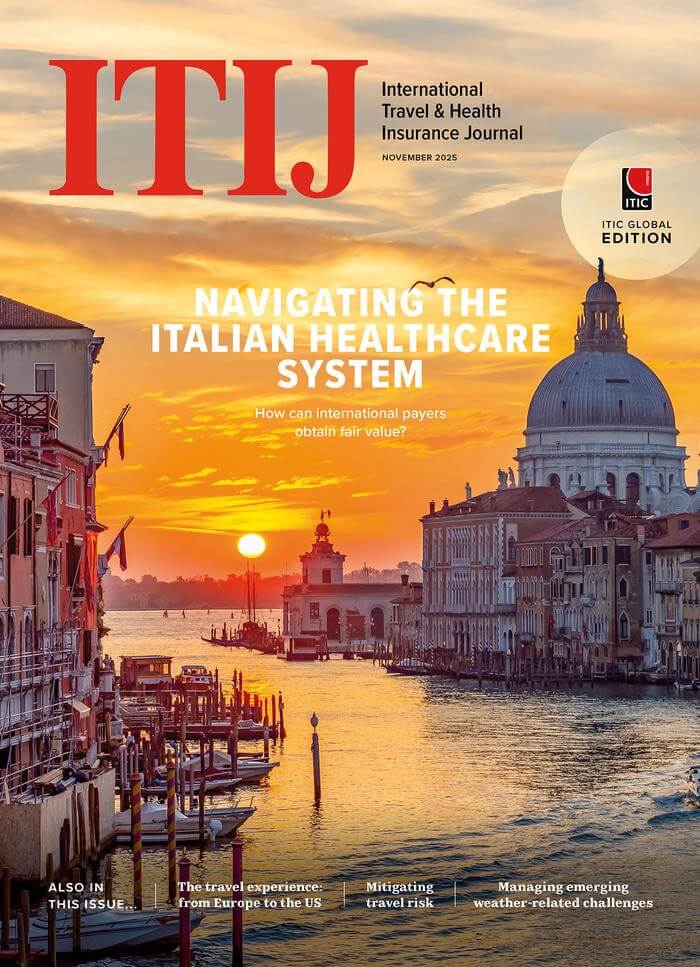
In this issue of ITIJ we look at current travel patterns to and from the US and Europe, take a close look at the Italian healthcare system, and examine how insurers are adapting policies and coverage to manage weather-related challenges.
Alysia Cameron-Davies
Alysia is a copy writer for Voyageur Publishing.