
Innovative insurance

Mark Brunger, Director at Go Walkabout Travel Insurance, talks to ITIJ about policies, older travellers, and embracing new technology
When did you start working in the travel insurance industry, and how has your career progressed to your current role as Director of Go Walkabout?
I joined Go Walkabout in September 2011. The Founding Director and leadership team invited me to join as a sales consultant, to move into business development – a transition I achieved within three years. I was drawn to Go Walkabout because it aligned with my career goal of helping others. Previously I worked in logistical support for Sussex Police and managed an international recruitment team for UK social workers.
In 2019, fellow Director Andrew Ferguson and I were presented with the exciting opportunity to take on the leadership and future development of Go Walkabout. It was a significant learning curve for us. Foremost was the need to adopt a survival strategy when confronted with the unforeseen challenges presented to the travel insurance industry by the Covid-19 pandemic.
What makes the company’s travel insurance policies different from others in the market?
Although we faced challenges, our commitment to customer service and policyholder care has strengthened our brand and product awareness.
Go Walkabout has a reputation for innovation and seeking out the travelling public’s evolving insurance needs, and focusing on matching consumers with the right cover.
Go Walkabout specialises in long-term and niche travel insurance, such as gap year, long-stay, and one-way emigration policies. Twenty-two years ago, our Founding Director, in response to public demand at a TNT Travel Show, devised a product that provided emigration cover for individuals and families. With visa options expanding in destinations like Australia, New Zealand, and Canada, Go Walkabout has adapted its policies accordingly. Long-term travel insurance is now popular among older travellers, who use it for extended family visits, career breaks, or retirement adventures.

With an upper age limit of 99, you are going to see a lot of senior travellers who might struggle to find insurance from other providers. How challenging is it to underwrite the products aimed at the senior market, and ensure they are declaring any/all of their medical conditions properly?
For customers over 80, policies are generally capped at 45 days, depending on travel region and age. We stress the importance of declaring all medical conditions to every client, whatever their age, and explain the consequences of failing to do so.
Partnering with Millstream Underwriting allows us to cover many medical conditions, but not all. Managing our portfolio and claims requires full disclosure, especially as seniors make more claims statistically. Complete transparency helps us address this challenge across the industry.
Go Walkabout specialises in long-term and niche travel insurance, such as gap year, long-stay, and one-way emigration policies
If we cannot underwrite a particular risk, we recommend alternative providers who may offer coverage for excluded medical conditions.
Do efforts like the British Insurance Brokers’ Association’s (BIBA) signposting initiative improve access to insurance for those who might find it challenging to find the right insurance from mainstream providers?
I tell consumers that policies exist for most risks – the challenge is finding an insurer at an acceptable cost, especially for unlikely claims.
While industry professionals know the BIBA signposting initiative, more public awareness is needed. With advances in the internet and artificial intelligence (AI), I hope consumers will more easily find accurate information on insurers who provide higher medical risk coverage.
The UK’s travel insurance sector can be a difficult one to navigate, with close regulatory scrutiny, low pricing and high levels of competition. What makes companies successful in this environment do you think?
There are three main factors typically considered when evaluating insurance:
- Availability – the necessary coverage can be obtained
- Affordability – the premium is manageable
- Reassurance – the provider is reliable, and claims processing is expected to be efficient.
The reputation of an insurance brand depends significantly on the management of policyholder claims throughout the process, which serves as an essential measure for evaluating insurers.
While automation and online claim handling continue to advance, these improvements do not eliminate the possibility of policy voidance due to non-disclosure or incorrect information from the policyholder. When a claim is denied because the policy was void from the start, it can lead to dissatisfaction among stakeholders. Checks should be in place during policy purchase to help ensure accurate information is provided. In the travel insurance industry, repudiation of a claim due to policy voidance is generally undesirable, especially when premiums have been paid.
Distribution channels in the UK are dominated by price comparison websites (PCWs); what role do you think that direct insurers, PCWs, brokers and intermediaries play in the distribution of insurance?
Travel insurance distribution is changing, and comparison sites may have reached their peak. While these platforms will remain for quick quotes and cost insights, new methods are emerging.
However, with the evolution of AI and search engines increasingly directing browsers to the most appropriate solutions, could this lead to a decline in the dominance of comparison sites as the primary choice for consumers?
With stricter regulations and a greater emphasis on fair treatment and pricing, it’s questionable whether insurers can sustainably remain on price comparison sites. We left comparison sites in 2021, unsure how it might impact brand awareness or exposure. Confident in our products and brand, we found that our direct business – supported by innovative offerings and clear client communication – more than replaced the volume previously gained through price comparison websites.

Customer awareness of travel insurance, and understanding of the benefits, remains sorely lacking. What can companies do to better engage with their potential and existing customers?
We aim to deliver personalised customer service by clearly outlining policy benefits and exclusions. We proactively contact customers if their coverage seems unsuitable and send a follow-up email after purchase that reminds them of residency rules, the need to declare medical conditions, and available add-ons like sports, adventure activities, or tech cover. Our website is designed to keep information clear for all customers.
The impact of AI and emerging technologies on risk assessment and the handling of straightforward travel insurance claims is frequently discussed. How is your organisation leveraging these advancements to enhance operational efficiency?
We are undertaking a significant initiative to incorporate AI into the Go Walkabout travel insurance purchasing process, with the target of launching this integration before the end of 2025.
Although AI presents significant opportunities, its success relies heavily on the quality and accuracy of its underlying data. I am confident that AI will substantially shape consumer choices regarding insurance products and providers. Furthermore, I foresee a shift in some customer service functions, particularly in sales and claims management, driven by increasing expectations for rapid communication.
Despite these technological advancements, it remains essential for insurers to retain a human element. Not all customers will opt for a fully online experience, and access to knowledgeable insurance consultants continues to foster trust and provide reassurance, ensuring that individuals can seek personal assistance whenever necessary.
If you could change one thing about the UK’s travel insurance industry, what would it be?
Promote more examples that demonstrate the importance of insurance coverage to the general public, emphasising the provision of financial protection, particularly in situations involving high-cost claims.
Although media outlets report cases where insurers and policyholders are in dispute, there are rarely ‘headline’ accounts about grateful travellers who, having suffered injury, illness and loss, would have, but for the care and organisation of their insurers, also have incurred significant financial loss. Such instances illustrate the positive relationships that exist between policyholders and insurance providers – an aspect that is sometimes less widely reported.
Finally, educate consumers to read the full terms and conditions!
Mark Brunger, Director, Go Walkabout Travel Insurance
Mark initially joined Go Walkabout as a Sales Advisor 2009 and was promoted to Director in 2020 after progressing through various roles. His experience includes leading the company through the trial of international travel with Covid-19. Before joining Go Walkabout, he worked in international recruitment, specialising in financial services and healthcare.
December 2025
Issue
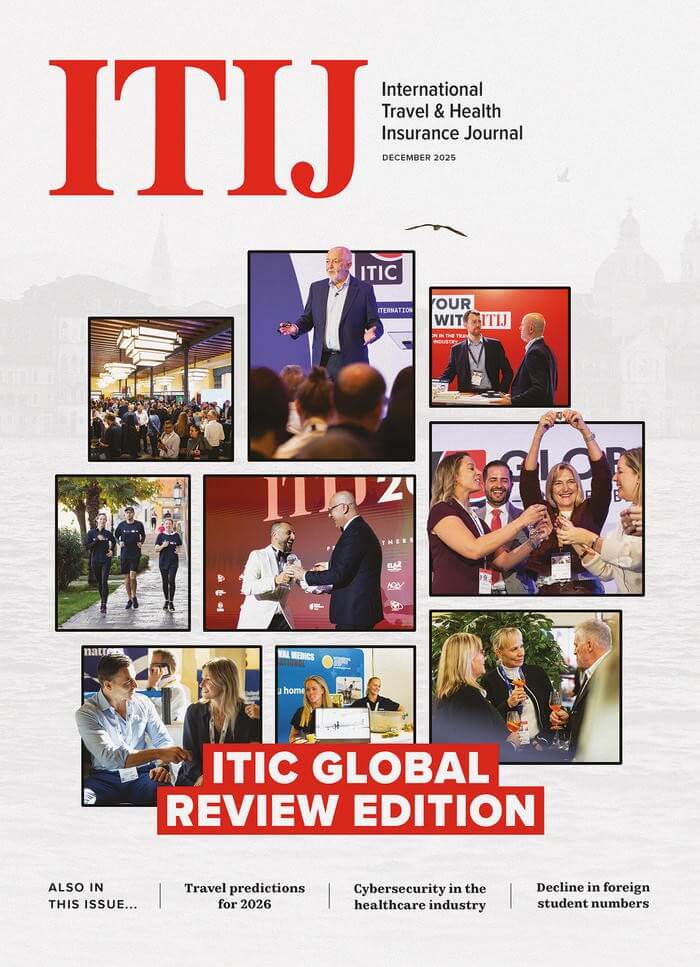
In this issue of ITIJ we examine breaches of cyber security in the healthcare sector and ask what can be done to prevent them, share travel predictions, including risks and hotspots, for 2026, and look at the global implications of changes in international student travel.
Editorial Team
The Editorial Team updates the ITIJ website daily, and works on features for the print edition. With expert industry knowledge and years of experience in writing about complex travel insurance issues, the Editorial Team is ready to investigate and report on the topics that matter most to ITIJ's readers.